Xi'an / China Food and drink
Where should I eat in Xi'an, and which local food or drink is worth trying?
The short answer
Yangrou paomo — bread you crumble yourself into lamb broth — at a century-old house, roujiamo (China's oldest hamburger, by local claim) from a Muslim Quarter grill, biangbiang noodles under a splutter of chili oil, cold liangpi, and a bottle of Bingfeng orange soda: Xi'an eats like a Silk Road terminus because it was one.
The answer, with local context
Start with the ritual dish. Paomo is a meal you help manufacture: the server brings a dense, unleavened flatbread (tuotuo mo) and a bowl; you crumble the bread into ever-finer pieces — the size of soybeans, the regulars insist — and hand the bowl back; the kitchen returns it flooded with rich lamb (yangrou paomo) or beef broth, glass noodles, wood-ear mushrooms and coriander, with pickled garlic and chili sauce alongside. The old houses guard the broth: Lao Sun Jia (trading since 1898) and Tong Sheng Xiang (1920) are the names to seek, and the crumble is not a gimmick for tourists — the texture of the finished bowl is genuinely set at your table, so crumble fine and take your time. It is breakfast or lunch food, filling in the manner of a full day's labor, and it is the first thing Xi'an asks of a visitor.
The second monument fits in one hand. Roujiamo — spiced, slow-braised pork (or beef, in the Muslim Quarter) chopped with green pepper and stuffed into a crisp, griddled baiji bun — is the city's portable masterpiece; the Muslim Quarter's beef versions and the old Han-Chinese pork houses divide opinion, and both are right. Order it with its canonical partners: liangpi, the cold, slippery wheat (or rice) skin noodles dressed with chili oil, black vinegar, sesame and bean sprouts — Qinzhen, a town southwest of the city, claims the original rice version — and a bottle of Bingfeng, the orange soda made in Xi'an since 1984, whose pairing with roujiamo and liangpi is so fixed it has its own local name: the "Sanqin set meal," the city's answer to a burger, fries and Coke.
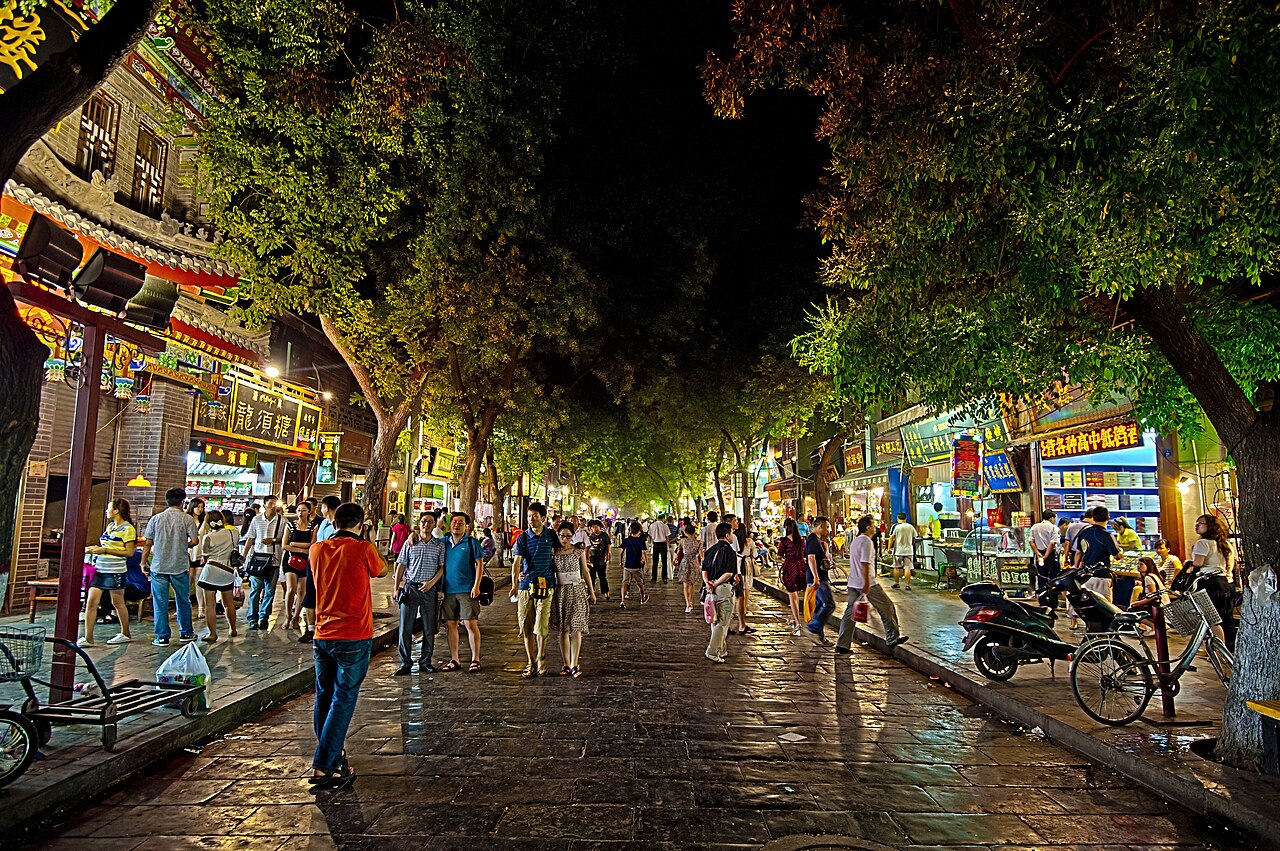
Then the noodles, which in Shaanxi are a architecture of width. Biangbiang mian — hand-pulled ribbons as wide as a belt, slapped against the counter (the "biang" is the slap), dressed with hot oil poured over chili, garlic and greens — takes its name from a character so elaborate (over 50 strokes in its common telling) that it exists almost as a folk stunt; the dish itself is dead serious, chewy, fiery and huge. The Muslim Quarter is where evenings belong: Beiyuanmen's snack street for skewers of cumin lamb, persimmon doughnuts (shizi bing) fried to order, zenggao — sticky rice and dates steamed in great earthenware stacks — mirror cakes (jinggao) of glutinous rice in rose sauce, sour-plum juice, and pomegranate juice pressed as you watch in autumn. For the formal splurge, De Fa Chang (by the Bell Tower, since 1936) serves the jiaozi banquet: course after course of dumplings in a dozen shapes and fillings, the city's banquet tradition. Breakfast's other star is hulatang, the peppery beef-and-vegetable stew eaten with bread for dipping, at its fiercest in the Quarter's early stalls.
Picture the place
In a Beiyuanmen lane at dusk the skewer smoke hangs at head height, a cook fans his coals with one hand and counts change with the other, persimmon cakes blister in a shallow pan of oil, and every third passerby carries the same orange bottle like a badge of citizenship.
The easily missed detail
The paomo crumble has a social function: it makes the meal unhurried by design — twenty minutes of handwork at the table before the kitchen's part begins — and locals judge newcomers kindly by their crumb size. Ask for the bread pre-crumbled by machine (ji jiao) only if time presses; the hand-crumbled bowl (shou nie) is the dish as intended, and the pickled garlic is not a garnish, it is the antidote to the broth's richness, eaten between bites.
A practical rhythm
- Breakfast — Paomo at an old house, crumbled by hand, with hulatang as the alternate day's start.
- Lunch — The Sanqin set: roujiamo, liangpi and Bingfeng from a small counter near the Bell Tower or in the Quarter.
- Evening — A graze through Beiyuanmen (skewers, zenggao, mirror cake, juice), and De Fa Chang's dumpling banquet for the one formal night.
What could complicate the plan
The Muslim Quarter is halal territory: no pork and no alcohol at its tables, and its busiest street is a tourist market whose prices rise with the neon — the better eating is a lane or two deep, on Xiyang and the side streets where the queues are local. Paomo's richness defeats late dinners; take it before noon. Portions of noodles are routinely enormous, and ordering one bowl per person plus sides is the classic first-timer error. And the famous old houses close early by design — Lao Sun Jia's day is a daytime day.
What to do next
Stay inside the wall, eat breakfast like a laborer and dinner like a stroller, and let one meal be the full dumpling banquet — Xi'an's food needs no other city on the trip.
Sources
- Xi'an's historic food houses — Lao Sun Jia (since 1898) and Tong Sheng Xiang (1920) for yangrou paomo; De Fa Chang (since 1936) and the jiaozi dumpling banquet
- Shaanxi food traditions — the hand-crumbled tuotuo mo of paomo; roujiamo in a baiji bun; liangpi (Qinzhen rice liangpi); biangbiang noodles with splashed chili oil; Bingfeng orange soda, made in Xi'an since 1984, and the "Sanqin set meal" of roujiamo, liangpi and Bingfeng
- The Muslim Quarter (Huimin Jie) — Beiyuanmen snack street, the Hui quarter's halal kitchens: beef roujiamo, cumin lamb skewers, shizi bing persimmon cakes, zenggao and jinggao mirror cakes