Yogyakarta / Indonesia Things to do
What are the most worthwhile things to do in Yogyakarta on a first visit?
The short answer
Sunrise on Borobudur's terraces, Prambanan's Shiva towers at dusk, the Sultan's living Kraton and Taman Sari water castle, the Merapi lava fields by jeep, and a night of Malioboro and Ramayana ballet — the deepest cultural itinerary in Indonesia, inside a city you can cross in twenty minutes.
The answer, with local context
Borobudur is the reason the world comes, and it deserves its precedence. Built under the Sailendra dynasty around 780–825 CE, it is the largest Buddhist monument on earth: nine stacked platforms — six square, three circular — climbed as a mandala, carrying 2,672 relief panels (some 4 miles, 6 km, of narrative carving: the Buddha's life, his past lives, the pilgrim's manual in stone) and 504 Buddha statues, 72 of them seated inside the perforated bell-stupas of the upper terraces. Abandoned to jungle and Merapi's ash, it was cleared from 1814 and restored under UNESCO between 1973 and 1983; UNESCO inscribed it in 1991. The modern visit is regulated — climbing the structure is by timed entry with mandatory upanat sandals and a guide, capped at about 1,200 climbers a day — and the classic hour is dawn, entering through the Manohara gate as the mist lifts off the Menoreh hills. Give it half a day, walk the reliefs clockwise (pradaksina, as the pilgrims did), and do not skip the museum and the Karmawibhangga's hidden foot.
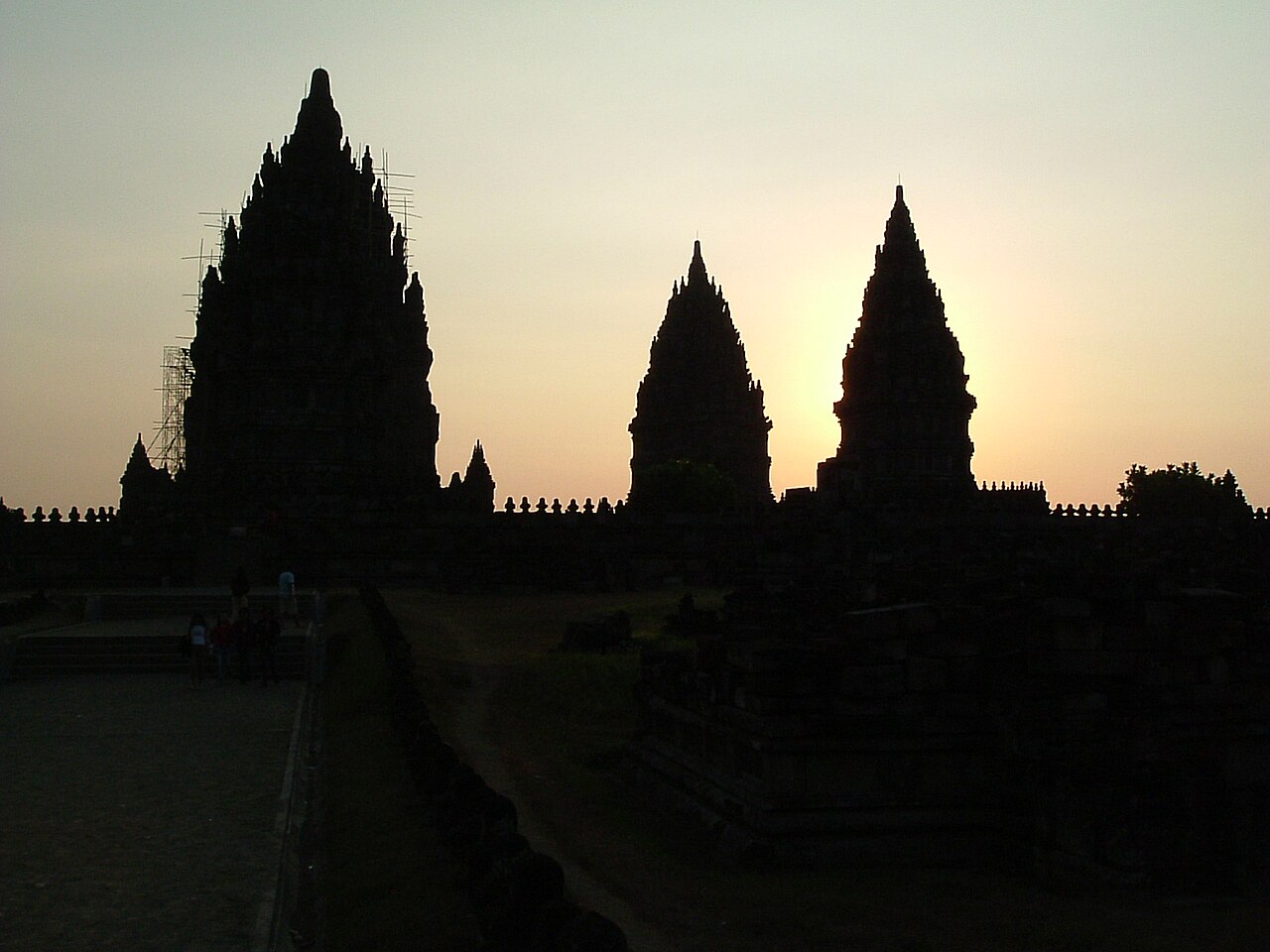
Prambanan, 11 miles (17 km) east, is the Hindu answer — built around 850 CE, Indonesia's largest Hindu temple complex, also UNESCO-listed in 1991: originally some 240 temples, its inner court ruled by the Trimurti — Shiva's tower rising 154 feet (47 m), flanked by Vishnu and Brahma, each with its vahana temple opposite — its walls carved with the Ramayana that the open-air ballet performs on the grounds on dry-season nights (since 1961, the full company running to about 200 performers). The 2006 earthquake (magnitude 6.4, which killed some 5,700 people across the region) damaged the complex, and restoration continues stone by stone — scaffolding on a spire is part of the honest view. Neighboring Plaosan and the exquisite Sewu (Buddhist, a generation older) complete the plain's archaeology; skip neither if temples are the trip's purpose.
Back in the city, the Kraton is not a museum of a monarchy but a monarchy still in session. Yogyakarta is Indonesia's only Special Region ruled by its sultan as hereditary governor — Hamengkubuwono X, whose palace (founded 1755–56 after the Treaty of Giyanti split the Mataram Sultanate) employs abdi dalem courtiers, performs gamelan and classical dance in its pavilions on weekday mornings, and keeps the royal carriages in their museum. Adjacent, the Taman Sari water castle (built 1758–1765) is the sultan's ruined pleasure garden — bathing pools, an underwater mosque chamber reached by tunnels, and a village of batik workshops grown through its walls. Round out the city with Kotagede, the 16th-century first capital of Mataram, now the silver-work quarter; a batik workshop (Indonesian batik is UNESCO-listed Intangible Heritage, 2009) in the Prawirotaman lanes; the Affandi Museum, the expressionist master's house and gallery; and the evening city itself — Malioboro's arcades, the Beringharjo market, the two alun-alun squares where the blindfolded walk between the banyan trees is the local rite. For the volcano: Merapi's 2010 eruption fields at Kaliadem — jeep tours among the ash-buried villages, the bunker, the Sisa Hartaku "museum" of a melted household — grave, strange and essential, run only within the geological agency's alert rules.
Picture the place
At Prambanan at closing time the stone goes apricot, then gray, the swallows pour into the carved niches of Shiva's tower, and from the ballet stage beyond the river comes the first bronze breath of the gamelan warming up for the night.
The easily missed detail
Kota Gede's royal cemetery and Imogiri — the hilltop necropolis of Mataram's kings, climbed by hundreds of steps in prescribed dress (sarong provided; open limited days) — are where Yogyakarta's court culture is most alive and least visited, while Ullen Sentalu, the private museum on Merapi's slope at Kaliurang run by the royal families, is widely called the best museum in Indonesia and is on no standard tour. Put one of the three on the list and the city's sultanate stops being a photo stop.
A practical rhythm
- Day one — Borobudur at sunrise, the Mendut and Pawon temples on the sacred axis home, and the Kraton quarter after lunch.
- Day two — Prambanan from mid-afternoon into the ballet at night; the morning for Kotagede's silver and a batik class.
- Day three — Merapi's lava fields by jeep at dawn (if the alert level allows), Ullen Sentalu on the way down, and Malioboro after dark.
What could complicate the plan
Borobudur's climbing cap is real: the 1,200 daily slots with sandals and guide are booked out on weekends and holidays, and the temple-grounds ticket (without the climb) is a different, lesser experience — book the climb days ahead online. The Kraton keeps morning hours and closes for royal ceremonies without much notice; its dance and gamelan program rotates by day of the week. Taman Sari's tunnels and the Sumur Gumuling mosque are reached through a living village — hire the local guide at the gate rather than wandering the lanes with a map. And distances deceive: the airport (YIA, in Kulon Progo) is an hour-plus from the city, so arrival days are not temple days.
What to do next
Base near Malioboro or Prawirotaman, book the Borobudur sunrise climb before anything else, and give the city three days beyond the temples — Yogyakarta, not its monuments, is the destination.
Sources
- UNESCO World Heritage List (1991) — Borobudur Temple Compounds: built c. 780–825 under the Sailendra dynasty; nine platforms, 2,672 relief panels, 504 Buddha statues with 72 in perforated stupas; restored 1973–1983
- UNESCO / Prambanan Temple Compounds (1991) — built c. 850 CE; about 240 temples; the Shiva temple at 47 m (154 ft); damaged in the 2006 Yogyakarta earthquake (magnitude 6.4)
- Injourney / Borobudur park management — structure climbing by timed entry with mandatory upanat sandals and guide, capped at about 1,200 visitors a day
- The Kraton Ngayogyakarta — the palace founded 1755–56 after the Treaty of Giyanti; Yogyakarta's sultan serving as hereditary governor of the Special Region; Taman Sari built 1758–1765; Indonesian batik on UNESCO's Intangible Cultural Heritage list (2009)