Yogyakarta / Indonesia When to visit
When should I visit Yogyakarta, Indonesia, for the best experience?
The short answer
June — the heart of the dry season, when BMKG's pattern for the region gives the year's clearest mornings for Borobudur's sunrise and Merapi's silhouette, before Indonesia's July–August school-holiday peak fills the temples.
The answer, with local context
Yogyakarta lives 8 degrees south of the equator, and its year is written in water rather than temperature: the thermometer barely moves (highs of 88–90°F, 31–32°C, lows near 73°F, 23°C, all year), but the rain swings violently. The west monsoon drenches the region from November to March — January and February each deliver around 12 inches (300 mm) or more, much of it in afternoon walls of water — while the east monsoon's dry season runs April to October and tightens through the middle months: August is the driest month of the year at roughly 1 inch (25 mm), and June and July sit close behind with mornings rinsed clean and cloud rare before noon. For a city whose two essential sights are a sunrise over a valley of volcanoes (Borobudur) and an unobscured sacred mountain (Merapi, 9,610 feet, 2,930 m — visible from half the city on clear dry-season mornings), the middle of the dry season is not a preference; it is the whole game.
Within the dry season, June is the arbitrage. July and August are Indonesia's own peak — school holidays, the country's domestic-tourism surge, and the full price-and-queue regime at Borobudur's gates — while June offers the same sky with the crowds a month behind. The Ramayana Ballet's open-air season at Prambanan (outdoor performances run through the dry months, roughly May to October) is in full stride; the rivers are at their clearest for the Gunung Kidul cave and beach country to the southeast; and the volcano behaves as it behaves — Merapi is perpetually restless, and dry-season clarity at least lets you see the mountain you are respecting. Vesak, Buddhism's holiest day, draws thousands to Borobudur for the lantern-lit procession (it falls in May, sometimes early June by the lunar calendar — in 2026 on May 31), and a trip timed to the festival's edge gets both the ceremony and the dry sky.
Picture the place
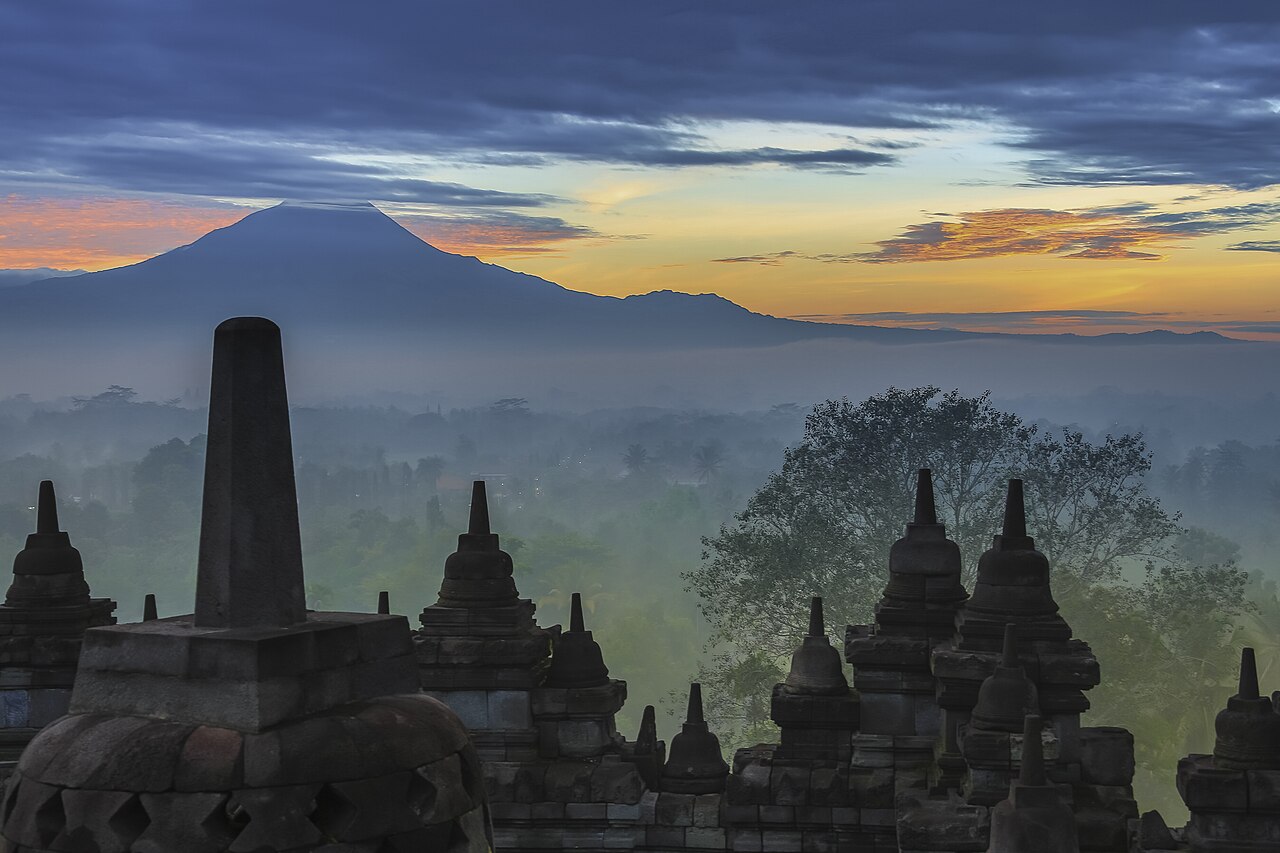
A June dawn on Borobudur's eastern terrace: the mist sits in the Menoreh valley below like a held breath, the perforated stupas stand in silhouette rows, and Merapi — impossibly sharp, a perfect cone smoking faintly — hangs in the pink air exactly where the temple's architects pointed the pilgrim's climb.
The easily missed detail
The dry season has a morning economy: everything important in Yogyakarta happens before ten. Borobudur's gates, Merapi's visibility, the Kraton's gamelan rehearsals, the markets' best hour — all are morning events, because the tropical afternoon, even rainless, belongs to heat. June rewards early risers almost vindictively, and punishes the lie-in with haze.
A practical rhythm
- Morning — The temples at opening: Borobudur one day at sunrise, Prambanan another, the Kraton on a gamelan morning.
- Afternoon — Museums, batik workshops and the shaded lanes of Kotagede; the volcano country only if the sky holds.
- Evening — Malioboro and the angkringan stalls, then the Ramayana Ballet under dry-season stars.
What could complicate the plan
Merapi is an active volcano with a modern death toll — its 2010 eruption killed 353 people — and its alert level, set by the geological agency BPPTKG, can close slopes, jeep routes and viewpoints on any date in any season; June optimizes weather, not geology. The dry season's end is feathered: an early October rain or a stubborn wet May happens in some years. And Vesak week, if the trip overlaps it, brings Borobudur's biggest crowds of the year — magnificent, but a queue regime of its own.
What to do next
Book mid-June weekdays, stay within walking distance of Malioboro or in Prawirotaman, and schedule Borobudur for the clearest forecast morning of the stay rather than a fixed day.
Sources
- BMKG (Indonesian meteorological agency) patterns for the Yogyakarta region — a dry season from April to October peaking around August (about 25 mm), a wet season November–March with January–February around 300 mm a month; temperatures near 31–32°C (88–90°F) highs year-round
- BPPTKG / Indonesian geological agency — Mount Merapi (2,930 m) continuously monitored, its alert level governing access; the October–November 2010 eruptions killed 353 people
- Borobudur–Prambanan visitor practice — the Ramayana Ballet's open-air season at Prambanan through the dry months (about May–October); the Vesak (Waisak) celebrations at Borobudur on the full moon of May (May 31 in 2026)