Yucatan Peninsula / Mexico Things to do
What are the most worthwhile things to do in Yucatan Peninsula on a first visit?
The short answer
Chichén Itzá at opening time, Uxmal for the deeper archaeology, a swim in a cenote, and Mérida's colonial center — the four stops that explain the peninsula: Maya stone, Maya water, and the city built from both.
The answer, with local context
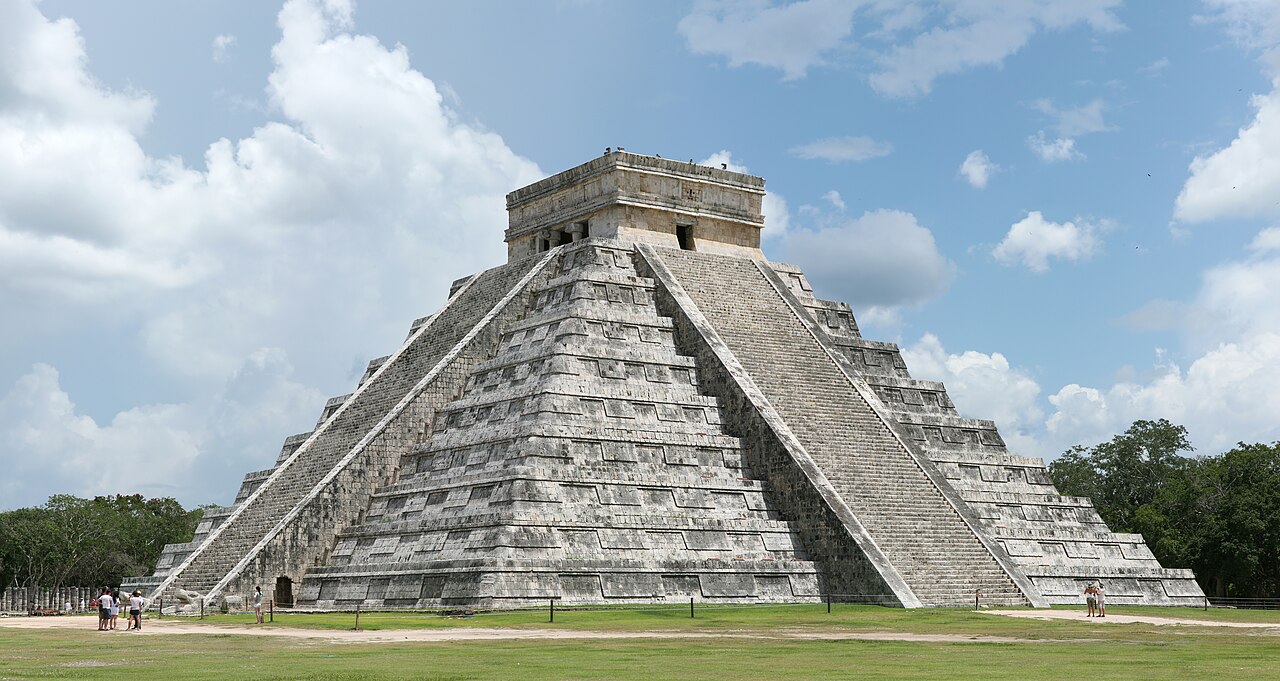
Chichén Itzá, managed by Mexico's INAH and a UNESCO World Heritage Site since 1988, was a Maya city of up to 50,000 people at its height, by INAH's estimate, and its pyramid is a calendar you can read. El Castillo stands 98 feet (30 m) to the top of its temple on a base 182 feet (55.5 m) square; each of its four stairways climbs 91 steps, and with the top platform the count is 365 — the days of the solar year. Around the March and September equinoxes, the late-afternoon sun throws seven triangles of light and shadow down the north stairway to the serpent head at its base, an effect visible for roughly five days either side of the equinox; the spring equinox of 2025 drew 32,872 visitors in a single day. The site also holds the largest ball court in Mesoamerica, 551 feet (168 m) long. It opens daily at 8 a.m., last entry at 4 p.m., and climbing El Castillo has been prohibited since 2006. In 2007 the site was voted one of the New7Wonders of the World.
Uxmal, 50 miles (80 km) south of Mérida and a World Heritage Site since 1996, is the connoisseur's counterweight: a Puuc-style city of carved limestone façades in the peninsula's only hills, its Pyramid of the Magician rising 115 feet (35 m) on an elliptical base found nowhere else in Maya architecture, and a fraction of Chichén's crowds. Between the two, swim. The peninsula's limestone is riddled with cenotes — natural wells into the underground rivers — with estimates of 6,000 to 10,000 across the peninsula, of which only about 2,000 have been explored. Their arc around the northwest traces the buried rim of the Chicxulub crater, left by the asteroid that ended the dinosaurs 66 million years ago; the Maya treated the cenotes as portals to Xibalbá, the underworld, and threw offerings into them. Ik Kil, near Chichén Itzá, drops some 130 feet (40 m) of vine-hung wall to its pool.
Mérida closes the argument. Founded on January 6, 1542, on the Maya city of T'Hó — the "City of Five Hills" — it is among the oldest continuously inhabited cities in the Americas, and its cathedral of San Ildefonso, built between 1561 and 1598, is the oldest cathedral on the American mainland, raised partly from the carved stones of T'Hó's temples, which are still visible in its walls. Beyond the city, the peninsula holds five UNESCO sites in all — Sian Ka'an's wetlands (1987), Campeche's walled city (1999) and Calakmul's jungle ruins (2014) join the two great Maya cities — and the Tren Maya railway, 1,554 kilometers (966 miles) of track, now links them into a single circuit.
Picture the place
At eight in the morning El Castillo stands in an empty green plaza, its four stairways sharp in the low sun, the Great Ball Court's walls beyond it and nothing moving but the iguanas coming out onto the warm stone.
The easily missed detail
Admission to Chichén Itzá is two tickets, not one, sold at two windows: a federal INAH fee and a much larger Yucatán state (CULTUR) fee — 697 pesos in total for a foreign visitor in 2026, of which the state takes 592. Travelers surprised by the second window are a daily sight at the gate; Mexican nationals, by INAH's standing rule, enter Mexico's archaeological sites free on Sundays.
A practical rhythm
- Morning — Through Chichén Itzá's gate at 8 a.m. and straight to El Castillo and the Ball Court before the Cancún buses arrive around eleven.
- Midday — Cenote Ik Kil or one of the Homún ring cenotes in the heat of the day, then lunch in Valladolid or Piste.
- Evening — Mérida's Plaza Grande and cathedral at dusk, with the second ruin day — Uxmal and the Puuc route — saved for its own morning.
What could complicate the plan
The equinox is the one day to avoid unless the serpent is the whole point: 32,872 people entered on the spring equinox of 2025. Heat is the standing complication — neither great site has meaningful shade, both close by 5 p.m., and a May visit turns the plazas into a endurance test by noon, which is why the opening hour matters more here than anywhere else in Mexico.
What to do next
Base in Mérida or Valladolid rather than day-tripping everything from the coast; the distances shrink and the food question in this group becomes part of the trip instead of a footnote.
Sources
- UNESCO — World Heritage List: Chichén Itzá (1988), Uxmal (1996), Sian Ka'an (1987), Campeche (1999) and Calakmul (2014)
- INAH — Chichén Itzá: El Castillo's dimensions and 365-step calendar, the equinox effect, opening hours, the climbing prohibition since 2006 and the dual INAH–CULTUR admission fees
- INAH / Yucatán state (CULTUR) — 2026 admission totals for foreign visitors at Chichén Itzá and Uxmal
- Government of Yucatán — Mérida's founding in 1542 on T'Hó and the cathedral of San Ildefonso, 1561–1598