Afghanistan country guide Trip planning
How can I plan a memorable first trip to Afghanistan without rushing?
The short answer
The honest planning answer is that there is no trip to plan: the State Department advisory reissued on 20 February 2026 carries Level 4, Do Not Travel, with the instruction not to travel to Afghanistan for any reason — and it tells US citizens already there to leave immediately.
The answer, with local context
The grounds the advisory sets out are not generic. It lists civil unrest and crime; terrorism, including active militant groups that target Americans for kidnapping and violence; a high risk of wrongful or arbitrary detention reaching tourists and dual nationals; Taliban surveillance of travelers; earthquakes, naming a September 2025 event that killed more than 1,100 people; limited medical care; and aviation safety concerns, because the Federal Aviation Administration has not assessed Afghanistan's civil aviation authority. The advisory was reissued with no change from the prior version.
The consular position compounds it. The US Embassy in Kabul suspended operations on 31 August 2021, so the US government cannot provide routine or emergency consular services, and the advisory directs citizens seeking help to depart to an email address rather than a mission.
If the cultural pull is what brought you to this question, it is worth knowing how the heritage itself is faring. Both Afghan World Heritage properties are on the List of World Heritage in Danger — Bamiyan since its 2003 inscription, retained in 2019 under decision 43 COM 7A.41, and Jam since its 2002 inscription, retained in 2019 under decision 43 COM 7A.42. At Jam, UNESCO records that actual conservation work had not been carried out for lack of funds and access, that monitoring equipment to track the minaret's lean was never installed because of unreliable electricity and insecurity, and that the September 2017 survey data risked going obsolete.
Picture the place
What a traveler would be going to see is partly absent. The Bamiyan cliffs once held standing Buddhas of 55 meters and 38 meters; both were deliberately destroyed in March 2001, and the valley's inscription in 2003 under criteria (i), (ii), (iii), (iv) and (vi) covers 8 component sites of which the empty niches are only one. Preliminary consolidation of parts of the Western Buddha niche was carried out in 2018, with work on 8 further sites postponed.
The easily missed detail
Conservation at both properties has run on foreign money and borrowed security. Bamiyan had drawn roughly 22.7 million US dollars in extra-budgetary funds, with Italian funding paying for guards at Shahr-i Ghulghulah and the interior ministry appointing 20 police officers across the component sites; Jam had 20 police officers deployed and funding including 844,901 dollars from Italy and 124,300 from Switzerland between 2003 and 2012. The Committee has repeatedly urged permanent national funding for site security rather than internationally financed guards, which is a fair measure of how fragile on-site protection is.
A practical rhythm
- Read the advisory — Level 4, reissued 20 February 2026, with no change from the previous version.
- Note the absence of a fallback — No routine or emergency consular services since 31 August 2021.
- Follow the heritage instead — Both properties' status and condition are published and updated by the World Heritage Committee.
What could complicate the plan
Beyond the advisory itself, the humanitarian picture is severe: FAO's brief of 15 September 2026 projected about 13.8 million people, roughly 28% of the population analyzed, in IPC Phase 3 or worse, including about 2.9 million in Phase 4, with cereal imports for 2026/27 forecast at 4.6 million tonnes and retail food prices about 10% to 20% higher year on year in several markets. On the heritage side, the Committee has asked for a boundary modification and new legislation at Bamiyan because the cultural landscape sits outside protected zones, and has flagged impact assessments for a proposed bypass road; at Jam the property and buffer-zone boundaries remain imprecisely defined, with looting and illicit excavation among the listed threats.
What to do next
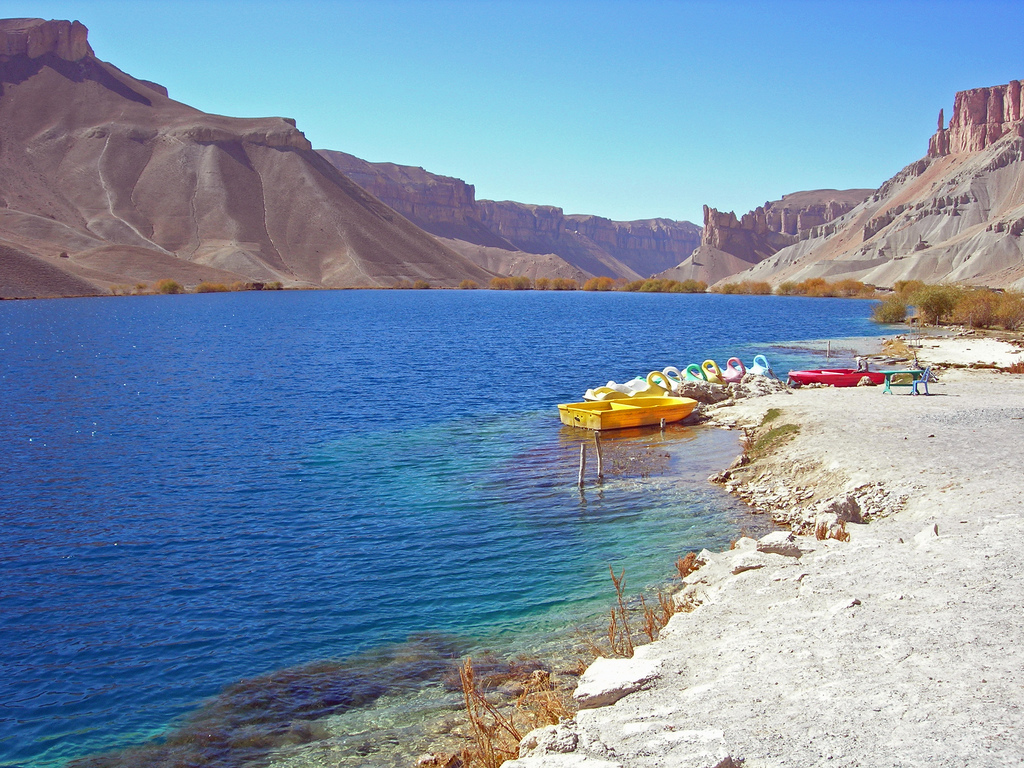
The Afghanistan when-to-visit answer covers Bamiyan's designation and condition in detail, and the places-and-experiences answer sets out Jam and Band-i-Amir.
Sources
- US Department of State, Afghanistan travel advisory — Level 4 designation, exact wording and 20 February 2026 date, the listed risks, earthquake toll, FAA assessment status, embassy suspension date and loss of consular services
- UNESCO World Heritage Centre, Bamiyan Valley and Minaret of Jam state-of-conservation records — inscription years and criteria, Danger List retention decisions, Buddha heights and destruction, 2018 niche work, donor funding and police deployments, monitoring equipment failure, boundary and legislation requests, listed threats
- FAO GIEWS, Afghanistan country brief — reference date, IPC food-insecurity figures, cereal import forecast, retail price movement