Afghanistan country guide When to visit
When is the best time to visit Afghanistan for Bamiyan Valley?
The short answer
There is no recommended time: the State Department's advisory, reissued on 20 February 2026 at Level 4, says "Do not travel to Afghanistan for any reason" — and the Bamiyan Valley has itself been on the List of World Heritage in Danger since the year it was inscribed.
The answer, with local context
The advisory is unambiguous and it was reissued without change. It names civil unrest and crime, terrorism including militant groups that target Americans for kidnapping, a high risk of wrongful or arbitrary detention extending to tourists and dual nationals, Taliban surveillance of travelers, earthquakes — citing a September 2025 quake that killed more than 1,100 people — limited medical care, and aviation safety concerns arising because the Federal Aviation Administration has not assessed Afghanistan's civil aviation authority. The US Embassy in Kabul suspended operations on 31 August 2021, so there are no routine or emergency consular services, and the advisory urges US citizens in the country to leave immediately.
Against that, the heritage case for Bamiyan is extraordinary. UNESCO inscribed the Cultural Landscape and Archaeological Remains of the Bamiyan Valley in 2003 under 5 criteria — (i), (ii), (iii), (iv) and (vi) — and placed it on the List of World Heritage in Danger the same year, where the Committee retained it in 2019 under decision 43 COM 7A.41. It is a serial property of 8 sites: the Bamiyan Cliffs, the Kakrak Valley Caves, Qoul-i Akram, Lalai Ghami, Shahr-i Ghulghulah, Qallai Kaphari A and B, and Shahr-i Zuhak.
Seasonality, where it is documented, is agricultural. FAO's country brief with a reference date of 15 September 2026 records winter wheat, about 80% of Afghan output and mostly irrigated, harvested by June 2026, with spring wheat accounting for about 20% and its harvest completing in September.
Picture the place
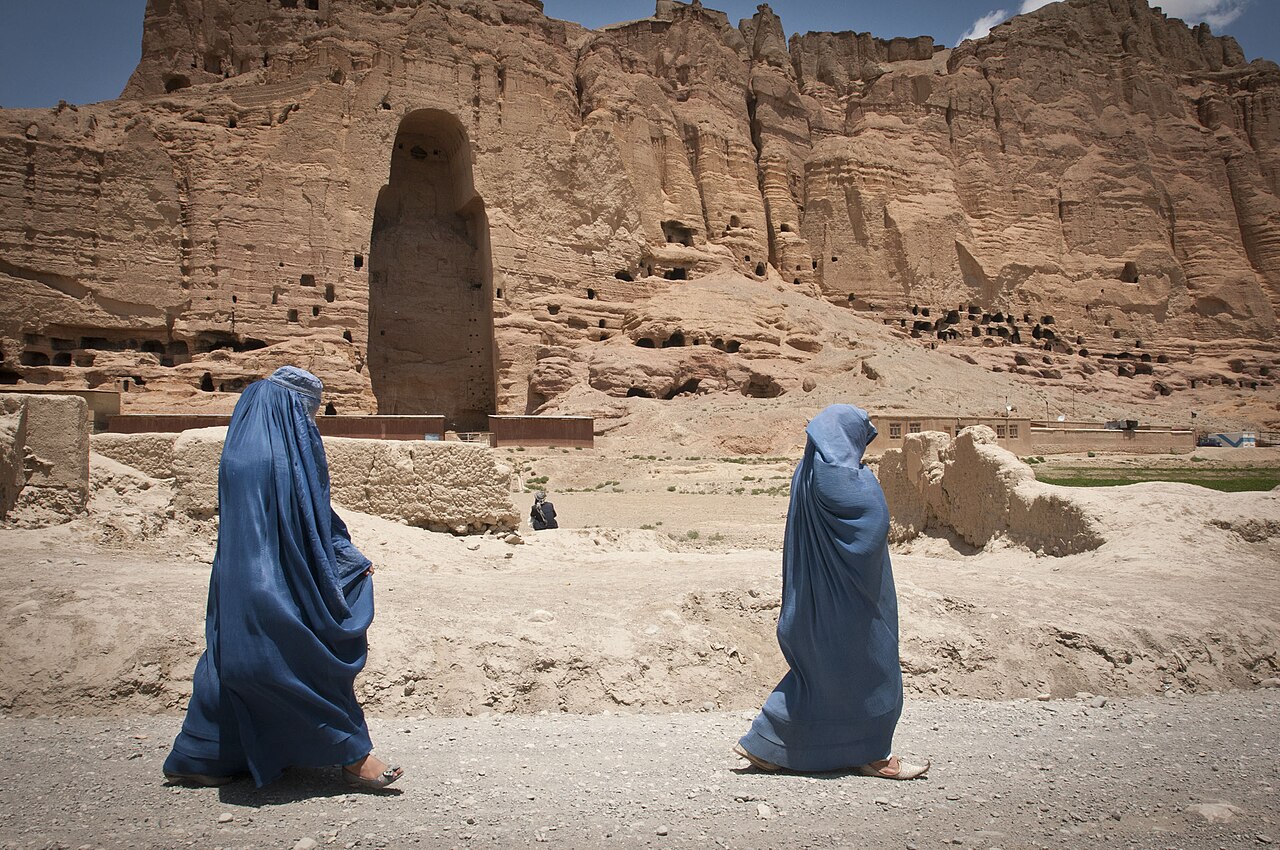
Bamiyan lies in the central highlands at around 2,800 meters, enclosed by the high mountains of the Hindu Kush, opening into a broad basin walled to the north by rock cliffs. The two standing Buddhas carved into those cliffs were 55 meters and 38 meters tall; the Taliban destroyed them deliberately in March 2001. The Kakrak Valley still holds a 10-meter standing Buddha fragment and a Sasanian-period sanctuary, and the valley system carries Buddhist monasteries, painted caves and Islamic-period fortifications including those at Shahr-i Zuhak.
The easily missed detail
The empty niches are not stable ground. UNESCO's state-of-conservation record shows preliminary consolidation work carried out in 2018 on parts of the Western Buddha niche, with work on 8 other sites, including the Foladi Valley, postponed; the Committee noted a shortage of funds for stabilizing that niche and for other sites at risk of collapse. Roughly 22.7 million US dollars in extra-budgetary funds had been granted by then, including 7.34 million from the Republic of Korea between 2013 and 2019, 7.32 million from Japan between 2003 and 2018, 6.85 million from Italy between 2013 and 2021, 1.5 million committed by the Afghan government for 2017 to 2026, and 159,000 from Switzerland in 2011 and 2012. Italian funding paid for guards at Shahr-i Ghulghulah, and the interior ministry appointed 20 police officers to monitor the component sites.
A practical rhythm
- The advisory first — Level 4, reissued 20 February 2026, with the instruction not to travel for any reason.
- No consular fallback — Embassy operations in Kabul have been suspended since 31 August 2021.
- Aviation — The FAA has not assessed Afghanistan's civil aviation authority, which the advisory lists among its reasons.
What could complicate the plan
Everything, and the complications are of a different order from a difficult destination. Wrongful or arbitrary detention is listed as a high risk for tourists as well as dual nationals. There is no US mission to call. The September 2025 earthquake that killed over 1,100 people illustrates both the seismic exposure and the thinness of medical capacity. Food security remains severe: FAO projected about 13.8 million people, roughly 28% of the population analyzed, in IPC Phase 3 or worse, including about 2.9 million in Phase 4, improved from 17.4 million in the preceding assessment period. Cereal imports for the 2026/27 marketing year were forecast at 4.6 million tonnes, about 7% above average, driven partly by returnees from Pakistan and Iran. Within the heritage property itself, the Committee has asked for a boundary modification and new legislation because the cultural landscape lies outside protected zones, and has flagged impact assessments for a proposed bypass road.
What to do next
The Afghanistan places-and-experiences answer covers the Minaret of Jam and Band-e-Amir, and the trip-planning answer sets out why the advisory governs every other decision.
Sources
- US Department of State, Afghanistan travel advisory — Level 4 designation, exact wording, 20 February 2026 date, listed risks, September 2025 earthquake toll, FAA assessment status, embassy suspension date
- UNESCO World Heritage Centre, Cultural Landscape and Archaeological Remains of the Bamiyan Valley — inscription year and criteria, Danger List status and retention decision, the 8 component sites, Buddha heights and destruction date, Kakrak fragment, altitude and Hindu Kush setting, 2018 niche work, donor funding figures, police deployment, boundary and legislation requests
- FAO GIEWS, Afghanistan country brief — reference date, winter and spring wheat shares and harvest timing, cereal import forecast, IPC food-insecurity figures