Argentina country guide Trip planning
How can I plan a memorable first trip to Argentina without rushing?
The short answer
Fly the long legs, chain no more than three regions to Buenos Aires, and give the whole thing at least two weeks — Argentina's distances are continental, and the unhurried version is built from its flight map, not its road map.
The answer, with local context
The map is the argument. Buenos Aires to Iguazú is some 800 miles (1,300 km): just under two hours by air, or eighteen hours on a bus. Buenos Aires to Mendoza is about two hours by air against thirteen or more by overnight coach. Nearly every route in the country funnels through the capital's two airports — Aeroparque, downtown, for domestic flights, and Ezeiza for international arrivals — and all routings to Patagonia connect through Buenos Aires. The structure that respects this is a hub and a chain: Buenos Aires for four nights, then two regions, then back. Two weeks fits the capital, Iguazú for two nights, and one deep region — Mendoza with the Uco Valley, or El Calafate and El Chaltén. Three weeks buys the second region or the northwest.
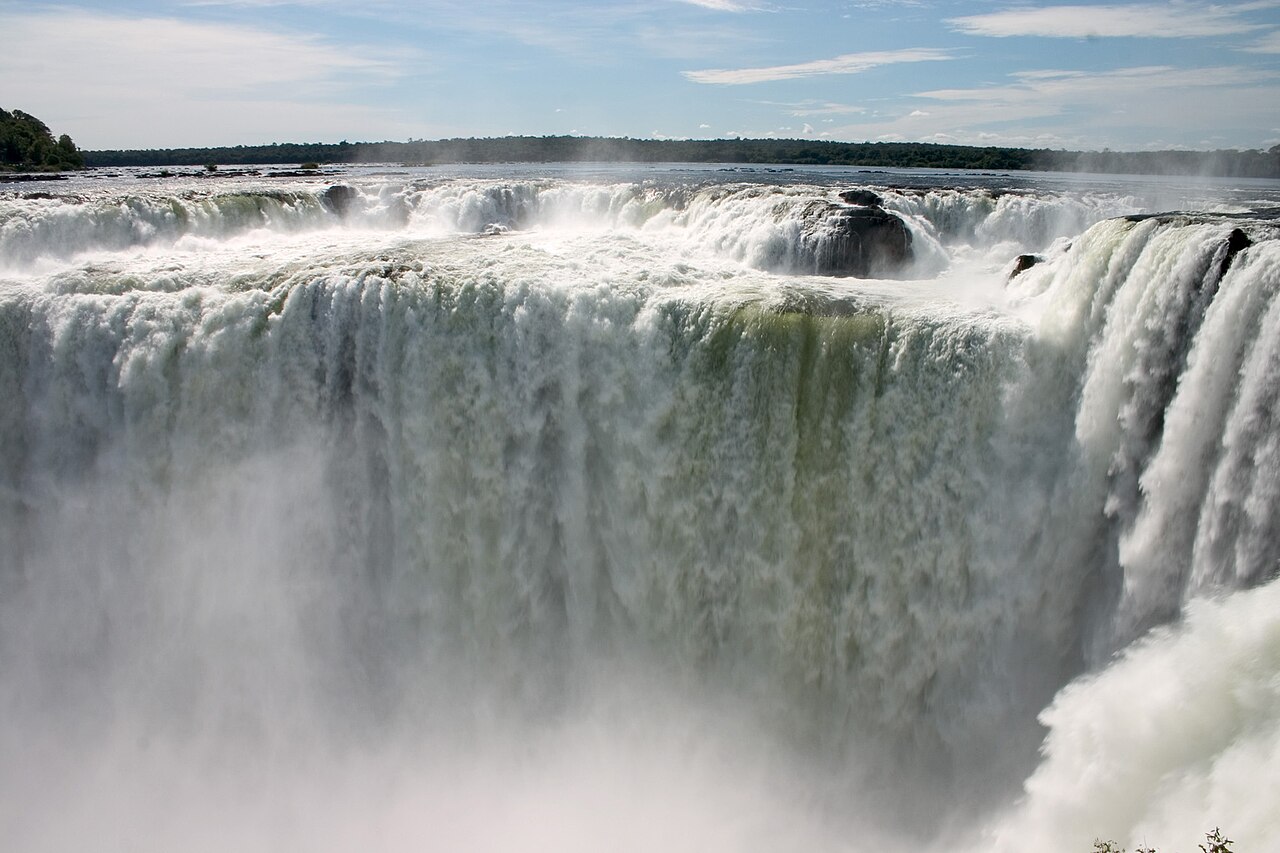
Iguazú deserves its own arithmetic, because it is the trip's most underestimated asset. The falls are a system of some 275 cascades spread 1.7 miles (2.7 km) along the river, the tallest dropping 269 feet (82 m), with over 80 percent of them on the Argentine side — which is the side with the walkways, the Upper and Lower Circuits, and the rainforest train that runs to the Devil's Throat station and its catwalk. Give the Argentine park a full day and the Brazilian park a morning for the panorama. One border detail with teeth: since 2025, Brazil has required visas of United States, Canadian and Australian visitors, so the morning across the river may need paperwork the Argentine side does not.
On the ground, the unhurried principle is to let each region's geometry set its nights. Patagonia's distances are the country's largest per sight: El Calafate is a flight, El Chaltén a three-hour transfer, and the town — founded only in 1985 — is a trailhead with beds, where the Fitz Roy and Cerro Torre walks begin at the street's end, so three nights there is a minimum, not a luxury. The northwest runs on altitude instead: you land at Salta, at about 3,800 feet (1,150 m), and sleep in the Quebrada at over 8,000 feet (2,450 m), so the first two days should climb gently. The legendary alternative to flying — Ruta 40, some 3,230 miles (5,194 km) along the Andes from the Bolivian border to the Strait of Magellan — is a trip in itself, to be driven in sections and seasons, not a transfer between sights.
Picture the place
On the Devil's Throat catwalk the river arrives from three sides at once — a U-shaped chasm half a mile around, the water folding over the edge in absolute silence at the lip and detonating into mist and noise below, rainbows standing in the spray where the walkway ends.
The easily missed detail
The long-distance bus is not the punishment visitors assume. Argentina's intercity coaches run in cama and suite classes with seats that recline nearly flat, meals served at your seat, and overnight departures timed to deliver you at breakfast — on the Buenos Aires to Mendoza run, the bus converts a dead transfer day into a night's sleep, and locals with the money to fly still choose it for exactly that reason.
A practical rhythm
- Morning — Fly in the mornings, when Patagonia's and the northwest's airports are at their calmest, and give every flight day a soft landing: no tour booked before mid-afternoon.
- Midday — The siesta is infrastructure in the north and in Mendoza: shops close, towns sleep, and the traveler who schedules lunch and rest at two is living the local day instead of fighting it.
- Evening — Argentina's day ends after midnight: dinner at ten, the parrilla's courses past midnight, and the next morning protected by a late start — plan the itinerary's mornings accordingly and nothing feels rushed.
What could complicate the plan
The seasons refuse to align: Patagonia peaks in the southern summer while the northwest is best in the dry winter, so a single trip maximises one and accepts the other's shoulder — the timing answer in this group makes the trade explicitly. Domestic flight schedules in Patagonia thin drastically outside summer, and some routes vanish entirely in winter. And Buenos Aires' two airports are an hour or more apart in traffic: a same-day connection that arrives at Ezeiza and departs Aeroparque needs a generous margin, every time.
What to do next
Draft the route as Buenos Aires plus two regions, book the internal flights as one chain, and hold the third week — if you have it — for the northwest. The places answer in this group tells you which second tier to spend it on.
Sources
- Administración de Parques Nacionales — Iguazú National Park's circuits, the rainforest train to the Devil's Throat station, and the park's share of the falls system
- Argentina Ministry of Tourism — Ruta 40's 5,194 km along the Andes, and the national route network of domestic flights through Buenos Aires
- Swoop Patagonia / Iguazú park guides checked against park data — the falls' roughly 275 cascades over 2.7 km with over 80 percent on the Argentine side, and Brazil's 2025 visa requirement for US, Canadian and Australian visitors