Argentina country guide When to visit
When is the best time to visit Argentina for Buenos Aires?
The short answer
November — the single month when Buenos Aires is in jacaranda bloom, Patagonia's trekking season has opened, the southern right whales are still on the Valdés coast, and summer's heat has not yet arrived anywhere.
The answer, with local context
Argentina has to be timed as a continent, not a country. It runs some 2,300 miles (3,700 km) from the Bolivian border to Tierra del Fuego — at about 1.07 million square miles (2.78 million km²) it is the eighth-largest country on earth — and its seasons are the Northern Hemisphere's reversed: summer December to February, winter June to August. The south keeps the opposite calendar from the north: Patagonia's trekking and glacier country is a November-to-March proposition, closed down by winter storms that can cut off southern towns until spring, while the subtropical northeast and Iguazú Falls work all year, and the northwest — Salta and the Quebrada de Humahuaca — is at its best in the dry months from April to October, when summer rains no longer wash out the puna roads.
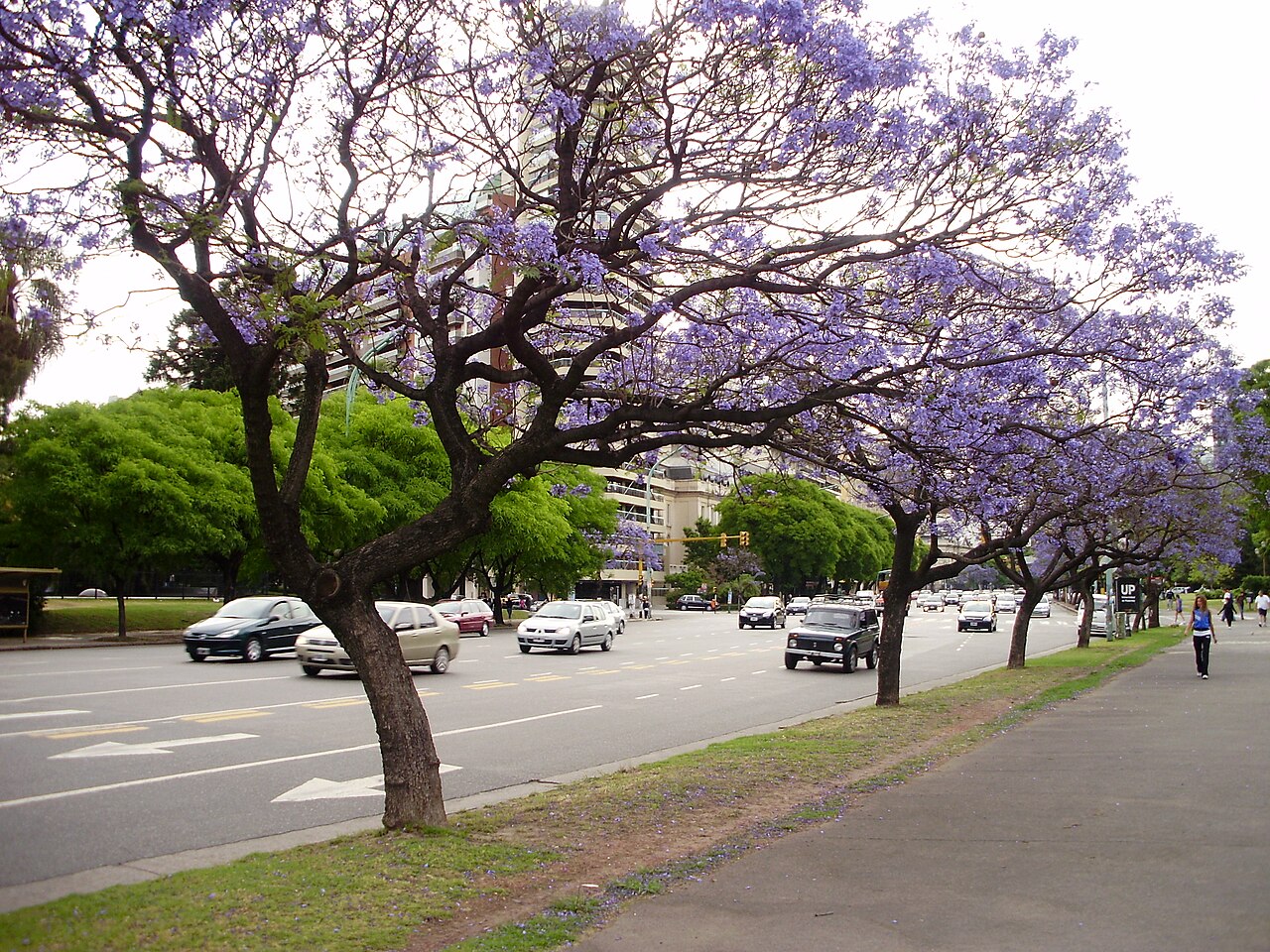
Buenos Aires, the anchor, is a city of two shoulder seasons. The Servicio Meteorológico Nacional's 1991–2020 normals give January average highs of 86°F (30.1°C) with humid nights at 68°F (20.2°C), and July — the coldest month — highs of 60°F (15.5°C) and lows of 46°F (7.5°C). Rain falls all year, about 49 inches (1,250 mm) of it, with no dry season to plan around. November sits in the capital's sweet spot: average highs of 79°F (26°C), the December heat still a month away, and the city under its famous bloom — thousands of jacaranda trees planted along the avenues flower purple in November, dropping their petals across the pavements of Palermo and Recoleta.
November also assembles the country's widest hand. Southern right whales gather off Península Valdés from June to December and peak from September to November, overlapping in those months with the Magellanic penguins that come ashore at Punta Tombo from September — the only weeks of the year when both are present. Iguazú, whose falls UNESCO measures at some 262 feet (80 m) high and 8,860 feet (2,700 m) across, runs full but not yet at the swollen, humid peak it reaches after the summer rains. The one region November underserves is Mendoza, whose Vendimia harvest festival belongs to early March — which is why March stands as the autumn alternative, trading the jacarandas for harvest, golden vineyards and the last warm weeks in Patagonia.
Picture the place
On Avenida del Libertador in mid-November the jacarandas are in full flower — a violet canopy over six lanes of traffic, petals drifting onto café tables and bus windscreens, and the whole city briefly color-coordinated in a shade no planner would have dared.
The easily missed detail
It has snowed on Buenos Aires once in living memory: on July 9, 2007, the first snowfall since 1918 — an 89-year gap — dusted the capital for a few hours. The city's winter is mild enough that a single morning of snow became a national holiday of the imagination; porteños still date photographs by it.
A practical rhythm
- Morning — November mornings in Buenos Aires are the walking hours: Recoleta and Palermo before the day warms, when the jacaranda petals are fresh on the ground.
- Midday — The capital eats late and rests in the heat of the day even in spring; use the middays for the museums and the long café hour, and save the Costanera and the river light for later.
- Evening — Dinner in Buenos Aires rarely starts before 9 p.m., and in November the terraces are open — build the day backwards from a 10 p.m. table, not forwards from a 7 a.m. start.
What could complicate the plan
December through February concentrates every pressure: Patagonia at its fullest and most expensive, Buenos Aires hot, humid and half-emptied of its own residents in January, and Iguazú at its most swollen and its most mosquito-rich. Winter inverts the problem — the northwest and the capital are lovely in July, ski season runs in Bariloche and Las Leñas, but El Calafate and El Chaltén effectively close, and the Valdés whales are the south's only summer-scale attraction. Any single trip is therefore a choice about which Argentina to peak; November is simply the choice that peaks the most of them at once.
What to do next
Fix November (or March for the harvest), book Patagonia and Iguazú flights early — they route through the capital — and let the planning answer in this group set the route's order.
Sources
- Servicio Meteorológico Nacional — Buenos Aires climate normals, 1991–2020: January highs of 30.1°C, July highs of 15.5°C, November highs of 26°C, and annual rainfall of about 1,250 mm
- UNESCO World Heritage Centre — Iguazú National Park: the falls at some 80 m high and 2,700 m across, and Península Valdés as the whales' protected habitat
- Administración de Parques Nacionales — the seasonal operation of the Patagonian parks, and the Valdés whale season from June to December, peaking September to November