Brazil country guide Places and experiences
What should a first-time traveler see in Brazil beyond the obvious highlights?
The short answer
Brazil's twenty-six UNESCO sites point past the postcards: go to the dune lagoons of Lençóis Maranhenses, the rock galleries of Serra da Capivara with paintings over 25,000 years old, the French-founded, tile-faced streets of São Luís, and the rubber-boom opera houses that became the newest inscription of all in 2026.
The answer, with local context
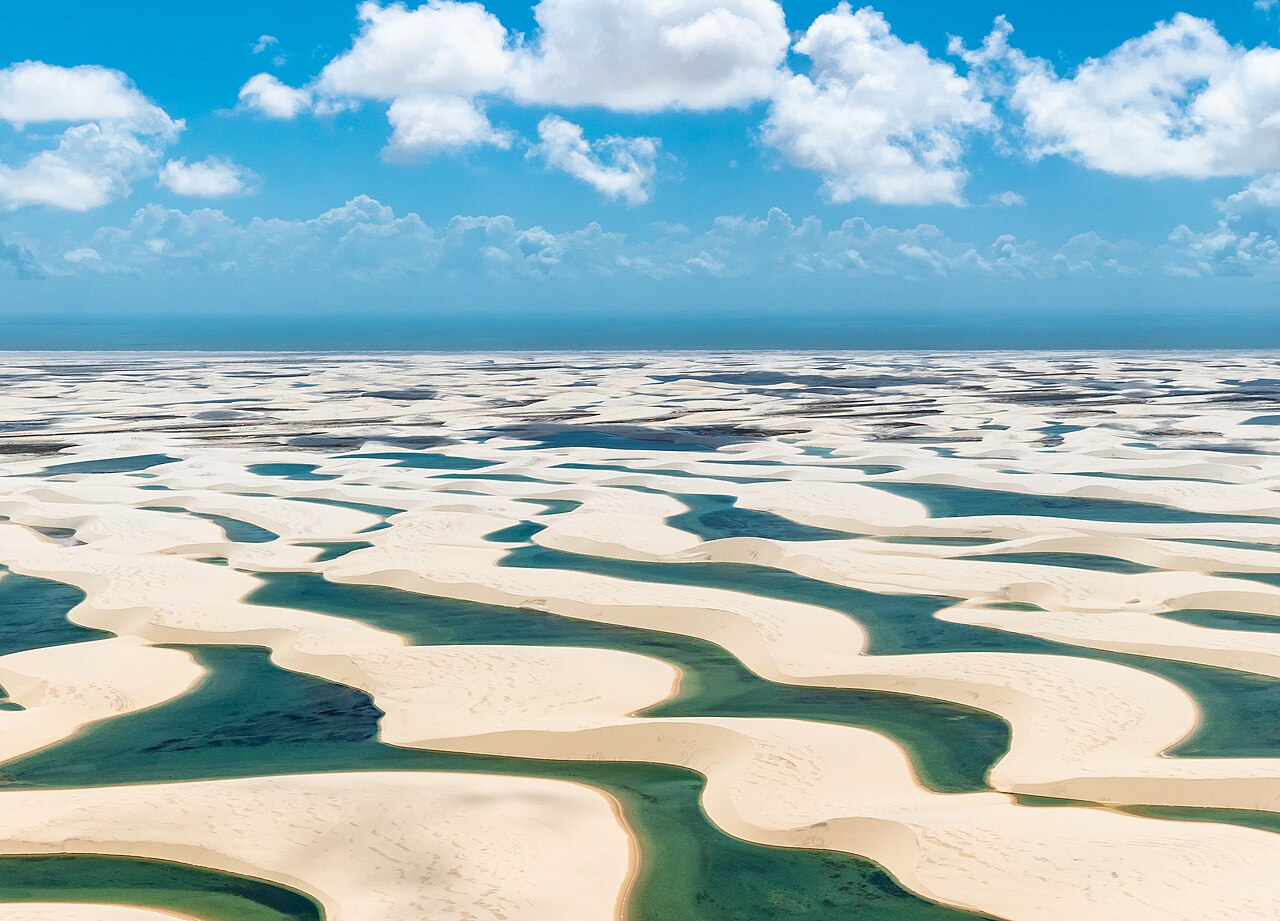
The northeast holds the two extremes. In Maranhão, Lençóis Maranhenses — inscribed on July 26, 2024, at 386,000 acres (156,562 ha) — is South America's largest dune field, a white desert at the meeting point of three biomes, Cerrado, Caatinga and Amazon, where the rain itself becomes the attraction: caught in the hollows between dunes, it forms thousands of clear lagoons that exist for a few months each year. In Piauí, Serra da Capivara — inscribed in 1991 across 322,700 acres (130,600 ha) — guards more than 300 sites of rock paintings, some dated to more than 25,000 years ago, a body of evidence so old it forced a rewrite of the theories of how the Americas were first peopled.
The coast keeps the history. São Luís, inscribed in 1997, is the only Brazilian capital founded by the French — in 1612 — and its preserved grid of Portuguese colonial streets is faced in azulejo tiles imported to beat the equatorial rain. Further out to sea, Fernando de Noronha lies some 217 miles (350 km) off the northeast coast: 21 islands inscribed in 2001 with the Atol das Rocas reserve, where the state of Pernambuco runs a daily environmental preservation tax and caps visitor numbers, and where its partner reserve, the Rocas Atoll, is closed to tourism altogether — a World Heritage site you are meant never to see.
The interior holds the rest of the argument. Ouro Preto, Brazil's first inscription in 1980, is the gold-rush baroque capital of Minas Gerais, and 40 miles away at Congonhas stand Aleijadinho's Twelve Prophets, carved in soapstone by a sculptor who worked, legend and parish records agree, with his tools strapped to stumps of arms. The cerrado — Brazil's savanna — is protected at Chapada dos Veadeiros and Emas across 942,000 acres (381,430 ha), and the Peruaçu River Canyon, inscribed in 2025, added 93,900 acres (38,003 ha) of caves and dry canyon in northern Minas. The newest name on the list, from 2026, may be the most poignant: the Amazonia Theaters, the opera houses of Manaus and Belém, built on rubber money at the edge of the forest — including the Teatro Amazonas, inaugurated in 1896 when its city was one of the richest on earth.
Picture the place
In the Lençóis at the end of the day the dunes go apricot and the lagoons hold the sky — sheet after sheet of still blue water laid between white sand ridges, with a few bathers standing waist-deep in rain that fell months ago and has nowhere to go.
The easily missed detail
Paraty and Ilha Grande, on the Costa Verde between Rio and São Paulo, is the country's only mixed site — inscribed in 2019 for culture and biodiversity at once: a colonial port where the gold trail came down from Minas Gerais, wrapped in Atlantic Forest that survived precisely because the town was bypassed and poor for two centuries. Obscurity as a conservation strategy: it is the Brazilian pattern, and half this list is evidence of it.
A practical rhythm
- Morning — The dune fields and the rock-art sites are both morning countries: Lençóis before the wind and heat rise, Serra da Capivara's painted shelters in the low light that makes the ochre figures read.
- Midday — Colonial Brazil is a midday refuge — São Luís' tiled streets lead from museum to museum, and Ouro Preto's churches keep the gold of the cycle in cool, dark interiors.
- Evening — In Manaus, the opera house at dusk: the Teatro Amazonas lit against the equatorial dark, a building that makes its whole strange argument — marble, chandeliers, the Amazon — in one façade.
What could complicate the plan
Season locks the flagship: outside roughly June to September the Lençóis lagoons shrink or vanish, and the park becomes a beautiful but emptier desert. Serra da Capivara is one of the most remote inscriptions in the Americas — hours by road from the nearest airport at Teresina or Petrolina, in some of Brazil's hottest country. Fernando de Noronha's tax, its capped flights and its booked-out pousadas make it the one Brazilian destination that cannot be improvised. And the sites are spread across a continent: this list is a second trip's itinerary as much as a first trip's detours.
What to do next
Choose one name per region — Lençóis for the northeast, Capivara for the deep interior, São Luís on the way — and check the planning answer in this group for how to chain them without a lost week.
Sources
- UNESCO World Heritage Centre — Brazil's 26 inscriptions, including Lençóis Maranhenses (2024; 156,562 ha), Serra da Capivara (1991; 130,600 ha), São Luís (1997), the Brazilian Atlantic Islands (2001), Peruaçu River Canyon (2025) and the Amazonia Theaters (2026)
- ICMBio — the federal park system covering Lençóis Maranhenses, Serra da Capivara and the Cerrado parks
- IPHAN — the national heritage records for Ouro Preto, Congonhas and the Aleijadinho sculptures