Brazil country guide When to visit
When is the best time to visit Brazil for Rio de Janeiro?
The short answer
September — Rio is deep in its dry season and warming into spring, the Pantanal is at peak jaguar season, the Amazon's rivers are low enough for forest trails, and the Lençóis lagoons are still holding their blue.
The answer, with local context
Brazil defeats any single-season answer by size alone: at about 3.29 million square miles (8.5 million km²) it is the fifth-largest country in the world, running from the equator to the temperate south, so the calendar has to be read by region. The Amazon around Manaus keeps a dry season from June to November and a wet one from December to May, when the rivers rise into the forest. The Pantanal's dry season starts in May, concentrates its wildlife from June to November, and peaks for jaguar sightings on the riverbanks from July to October. The northeast coast takes its heaviest rain between April and July. Iguaçu Falls runs fullest in the wet summer, December to March. September is where those calendars overlap most generously.
Rio de Janeiro, the anchor, explains why. The national weather service INMET's 1991–2020 normals give the city January highs of 88°F (30.6°C) with steamy lows of 76°F (24.3°C), and July — the coolest month — highs of 78°F (25.4°C) and lows of 66°F (19.2°C). The rain is the real divider: December to March brings 5.1 to 5.3 inches (130–135 mm) a month in afternoon downpours, while July delivers about 1.6 inches (40 mm) across just four rainy days. September sits at the dry season's warm end, with the sea climbing back toward the 75°F (24°C) it holds from November to May — after dipping to about 72°F (22°C) in the winter months — and before the December machine of Réveillon and Carnival doubles the crowds and the prices.
The month also catches two short-lived spectacles at once. The Lençóis Maranhenses lagoons fill with the early-year rains and hold their impossible blue through about September before draining away. And in Rio itself, the dry months open the full height of the city — the trails of Tijuca National Park, 9,800 acres (3,953 ha) of forest inside the city limits that ICMBio manages and that was replanted by hand beginning in 1861, after coffee farms had stripped the hillsides bare. May is September's mirror image and the alternative: the Pantanal's season opening, Rio at a fresh 77°F (25°C), and the rains newly ended — but the Lençóis not yet full and the jaguars not yet concentrated.
Picture the place
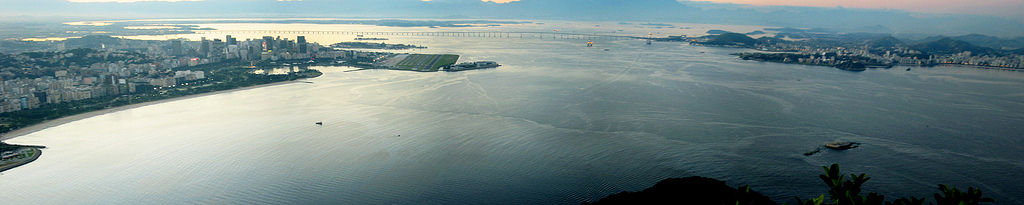
From Sugarloaf in September the harbor lies out in hard, dry-season light — Guanabara Bay's blue unsoftened by summer haze, Niterói across the water, the bridge running to it, and the city's beaches curving away south in a city finally out from under its own weather.
The easily missed detail
Rio's winter can turn genuinely cold for a night or two: Antarctic air masses push up the coast between May and October and can drag night temperatures down to 50–54°F (10–12°C), with the locals in scarves and the beach deserted at temperatures a Northern visitor would call mild. Pack the layer; the cariocas' reaction will tell you how rare it is.
A practical rhythm
- Morning — September light is the city's best: be on Sugarloaf or the Corcovado train early, before the spring haze builds, and take the Tijuca forest trails in the cool of the day.
- Midday — Lunch is Brazil's main meal and Rio takes it seriously; the prato feito at a neighborhood restaurant is the city's real cuisine, and the beach belongs to the afternoon.
- Evening — The boteco hour: cold beer, small plates and samba in Lapa as the temperature drops to its evening sweetness — September nights ask for nothing heavier.
What could complicate the plan
December to March trades every advantage away: Rio at its hottest and wettest, Carnival and New Year at peak prices, the Pantanal flooded and its wildlife dispersed, and the Amazon at high water — magnificent for canoeing the flooded forest, useless for trails. Winter inverts the south: June to August can bring real cold fronts to São Paulo and the southern states while the northeast is in its rains. September's own risk is small but real — it is the hinge month, and an early spring rain system can still park over Rio for two days.
What to do next
Fix September, sequence the trip Rio first and the Pantanal after, and let the planning answer in this group set the order of the regions around it.
Sources
- Instituto Nacional de Meteorologia (INMET) — Rio de Janeiro climate normals, 1991–2020: January highs of 30.6°C, July highs of 25.4°C, summer rainfall of 130–135 mm a month against July's 40 mm
- ICMBio — Tijuca National Park's 3,953 ha within Rio de Janeiro and its management of Brazil's federal conservation areas, including the Pantanal and Lençóis seasons
- Riotur — the scale and timing of Rio's Réveillon and Carnival peak season