Chile country guide Trip planning
How can I plan a memorable first trip to Chile without rushing?
The short answer
Plan it as flights, not miles: everything routes through Santiago, so give a fortnight to three regions — the Atacama and Patagonia are each the better part of a week once the road legs are counted — and treat Rapa Nui as its own expedition.
The answer, with local context
The geometry decides everything. Chile is 2,670 miles (4,300 km) long and averages 110 miles (177 km) wide, and its domestic network — LATAM, Sky and JetSmart — radiates from Santiago's Arturo Merino Benítez airport, so nearly every regional move costs a flight back through the capital plus a road leg at the far end. The Atacama leg runs 2 hours 10 minutes to Calama, then 60 miles (95 km) and about an hour and a half by road to San Pedro. The Patagonia leg runs 3 hours 25 minutes to Punta Arenas, then 155 miles (250 km) and three to four hours by road to Puerto Natales outside Torres del Paine; a seasonal nonstop to Puerto Natales itself, about 3 hours 15 minutes, flies mostly in summer. The honest fortnight is therefore Santiago and Valparaíso for three nights, San Pedro for four, the Paine for five, and the flight days absorbed between them.
Two destinations carry their own rulebooks, and both reward reading them first. Torres del Paine runs on CONAF's seasons: the O Circuit closes for winter until the end of October, winter walkers on the W Trek must hire a licensed guide, and the refugios and campsites along both routes are booked through the concessionaires months ahead in high season. Rapa Nui, 2,300 miles (3,700 km) out in the Pacific and reached only by LATAM's flight from Santiago — 5 hours 20 minutes out, 4 hours 35 minutes back — has, since 2018, required a Single Entry Form filed online, a return ticket and a registered booking, caps every visitor's stay at 30 days, and sells a national park pass without which the archaeological sites, including the moai platforms, stay closed to you. Four or five nights there is a trip, not a detour.
The slow alternative exists and is worth one leg of someone's journey. The Carretera Austral runs 770 miles (1,240 km) south from Puerto Montt, gravel beyond Coyhaique, its northern link made by two ferries between Hornopirén and Caleta Gonzalo that are booked months ahead in high season; and the Navimag ferry sails from Puerto Montt to Puerto Natales through the fjords in four days, roughly weekly from October to March — the one move in Chile that turns the transfer itself into the experience. Two clerical details grease everything else: visitors from the United States, the European Union, the United Kingdom, Canada and Australia enter visa-free for 90 days, and Chile's clocks have a quirk — the Magallanes region, Torres del Paine included, stays on UTC−3 all year by the Navy's official time service, while Rapa Nui runs two hours behind the mainland. Finally, the desert rule that outranks all others: San Pedro sleeps at 7,900 feet (2,400 m) and its excursions climb past 14,000 feet (4,300 m) to the Tatio geysers, so the itinerary's first two Atacama days should be its gentlest — and Chile's agricultural inspection at every airport is strict enough that the apple in your bag is a fine, not a snack.
Picture the place
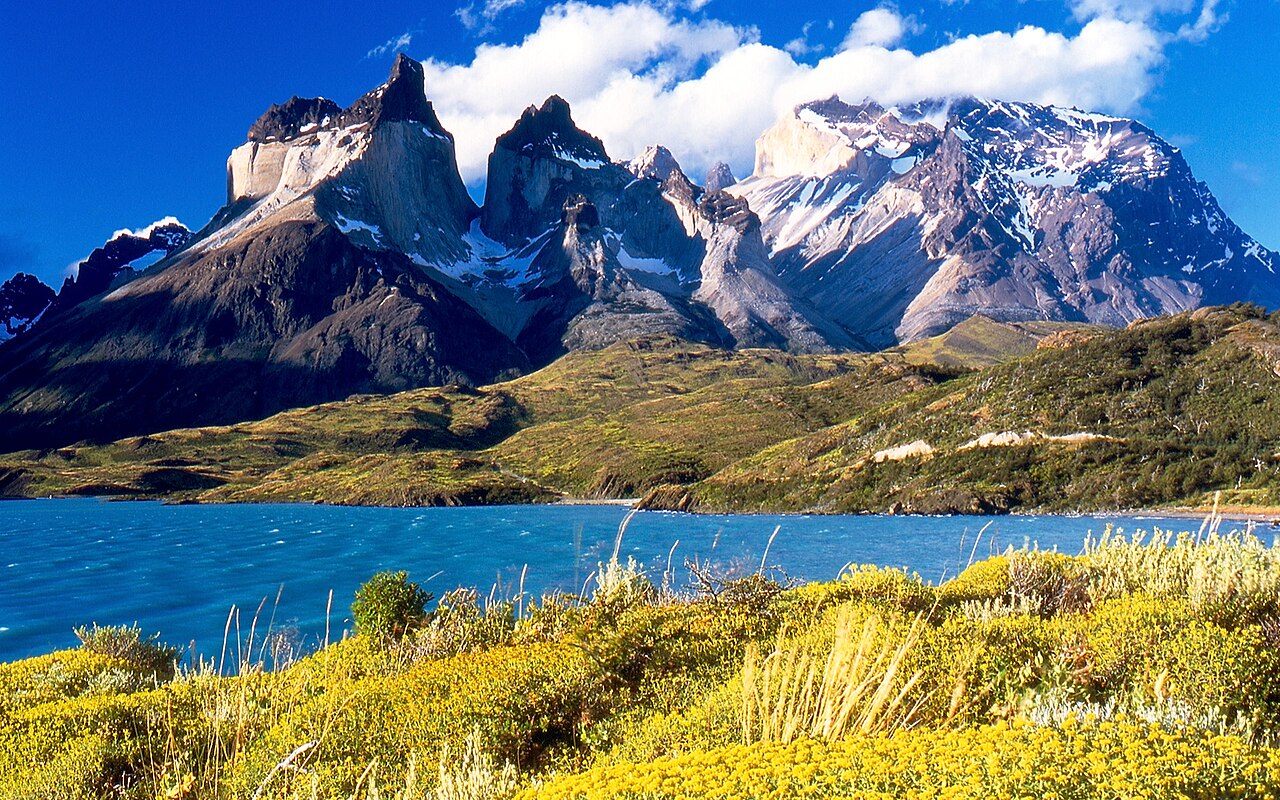
From Lake Pehoé the Cuernos del Paine stand across water the color of glacier milk — black sedimentary caps on golden granite horns, clouds tearing off the summits in the wind — and the road from Puerto Natales, three hours behind you, suddenly feels like the shortest part of the story.
The easily missed detail
Puerto Natales' airport has seasonal runway works and a thin schedule even in good years, and Punta Arenas' dependable flights sit three to four hours away by road — which means Patagonia's real gateway discipline is the buffer day. Travelers who give Puerto Natales a night on arrival, rather than sprinting for the park, lose nothing when the wind delays a flight; travelers who don't, lose the trek.
A practical rhythm
- Morning — Fly in the mornings and spend the transfer days as the locals do: Chile's regional flights are front-loaded, and a noon arrival in Calama or Natales still leaves the afternoon for the town, the museum and an early night.
- Midday — Every region change crosses Santiago at midday whether you plan it or not; build the connection as a feature — a long lunch in the capital between the desert and the fjords resets the trip's clock.
- Evening — Altitude and latitude both argue for early nights at the ends of the country: Tatio's vans leave San Pedro before dawn, and the Paine's weather is read at breakfast — the trip runs on sleep.
What could complicate the plan
The seasons grate against each other: Patagonia opens as the ski season closes, the Atacama's storm risk sits inside Patagonia's best months, and a single trip cannot peak everything — the timing answer in this group makes the October case in full. Domestic flights on thin routes — Puerto Natales, Balmaceda for the Carretera Austral — run a few times a week, not daily, so the itinerary must be built around the flight days, not the reverse. And the Rapa Nui paperwork, the Paine bookings and the Austral ferries all close early: this is a country whose best trips are decided three to six months out.
What to do next
Book in this order: the Paine's refugios, the Rapa Nui flight and form if the island is in, the Austral ferries if the road is — then the domestic chain through Santiago that joins them, and hold one buffer day in Puerto Natales.
Sources
- CONAF — Torres del Paine's seasonal circuit rules and the Rapa Nui National Park pass required for the archaeological sites
- SERNATUR (chile.travel) — visa-free entry for 90 days for US, EU, UK, Canadian and Australian visitors, and the Rapa Nui Single Entry Form with its 30-day maximum stay in force since 2018
- Servicio Hidrográfico y Oceanográfico de la Armada (SHOA) — official time: Magallanes on UTC−3 year-round, Rapa Nui two hours behind the mainland
- LATAM / domestic network schedules — Santiago to Calama in about 2 hours 10 minutes, to Punta Arenas in 3 hours 25 minutes, and to Rapa Nui in 5 hours 20 minutes, LATAM only