Chile country guide Places and experiences
What should a first-time traveler see in Chile beyond the obvious highlights?
The short answer
Chile's seven UNESCO sites are all cultural — not one is natural — and the overlooked ones carry the best stories: Chinchorro mummies two thousand years older than Egypt's, the nitrate ghost towns of Humberstone, a mining city abandoned in the sky at Sewell, and the wooden churches of Chiloé.
The answer, with local context
Start at the very top of the country, at Arica. The Settlement and Artificial Mummification of the Chinchorro Culture, inscribed in 2021 as Chile's seventh site, protects three locations — two cemeteries in Arica itself and a settlement at the mouth of the Camarones River — belonging to marine hunter-gatherers who lived on this desert coast from about 5450 to 890 BCE. Their dead are the oldest artificially mummified bodies known anywhere: of 282 Chinchorro mummies recovered, 149 were deliberately prepared by their makers, some two thousand years before Egyptian embalmers began. The Government of Chile's own citation calls it the world's oldest archaeological evidence of artificial mummification.
The desert keeps the industrial sequel. Humberstone and Santa Laura, inscribed in 2005, are two of more than 200 saltpeter works that once operated in the Atacama, where nitrate fertilizer made Chile rich from the 1870s to the mid-twentieth century and bred a whole pampino working culture of theatres, plazas and unions in the middle of nowhere. The buildings are so fragile that the site spent 2005 to 2019 on the List of World Heritage in Danger. The pattern repeats in the Andes at Sewell, inscribed in 2006: a company town built from 1905 by the Braden Copper Company on slopes at 7,200 feet (2,200 m) for the workers of El Teniente, the world's largest underground copper mine — a city of staircases with no roads, housing 15,000 people at its late-1960s peak and largely abandoned within a decade.
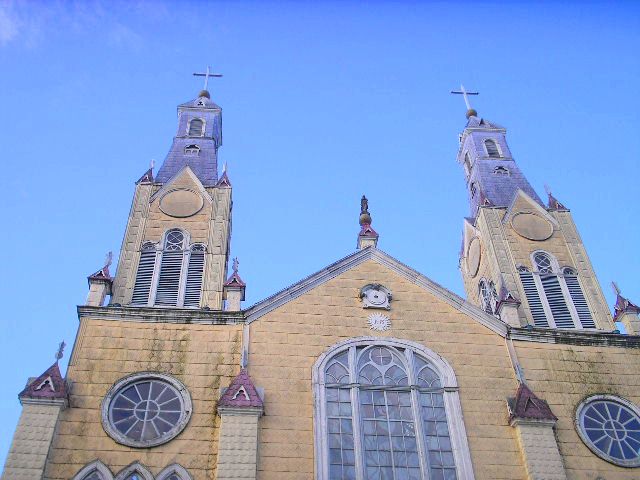
Two of the seven belong to gentler stories. Sixteen of Chiloé's wooden churches were inscribed in 2000 — Jesuit-era temples built by island carpenters with the joinery of boat-builders, in an archipelago that kept its own mythology, food and building craft apart from the mainland for centuries. And inland from La Serena, the Elqui Valley — pisco country, and the birthplace at Vicuña of Gabriela Mistral, who in 1945 became the first Latin American to win the Nobel Prize in Literature — protects its night as carefully as any site on the list: the Gabriela Mistral Dark Sky Sanctuary, designated in 2015, was the world's first International Dark Sky Sanctuary. Below them all runs the road trip: the Carretera Austral, 770 miles (1,240 km) of mostly gravel through Aysén's fjords and rainforest, past the marble caves of Lake General Carrera — the Chile that no inscription has yet caught up with.
Picture the place
At Humberstone in the late afternoon the pampa wind works the whole town — a theater with its seats in rows, a church, a swimming pool of riveted iron, a plaza with bandstand — all standing in a silence so complete that the corrugated roofs ticking in the heat are the loudest sound in Tarapacá.
The easily missed detail
Sewell cannot be visited independently at all: the town sits inside Codelco's working El Teniente mine, and the only way in is an authorised tour from Rancagua, an hour south of Santiago. The most inaccessible UNESCO site in Chile is also one of the closest to its capital — a whole city, painted in greens and reds against the snow line, that you may see only in a group, on a schedule, wearing a visitor's badge.
A practical rhythm
- Morning — The northern sites are morning country: Arica's museums and the Camarones valley before the desert heat, Humberstone in the first cool hours when the pampa wind is down.
- Midday — Chiloé runs on the midday ferry and the long lunch: the churches are strung along the island's east coast, and the curanto lunch is itself the afternoon's occupation.
- Evening — Save the Elqui for the night it was protected for: a pisco distillery in the afternoon at Pisco Elqui, then an observatory session in a valley whose darkness is a designated sanctuary.
What could complicate the plan
Chile's length taxes every addition: Arica is a flight from Santiago, Chiloé a flight and a ferry, the Carretera Austral a week of its own with ferries that book out in summer. Humberstone's fragility is real — parts of the works are fenced and the pampa offers no shade, water or second chances at midday. And the Chinchorro sites are working archaeology, not spectacle: the mummies themselves are met in Arica's museums, Colón 10 among them, which rewards travelers who prefer evidence to theater.
What to do next
Pick one north and one south — Chinchorro with Humberstone on the Arica–Iquique run, Chiloé on the way to Patagonia — and read the planning answer in this group for the flight chain that holds them.
Sources
- UNESCO World Heritage Centre — Chile's seven inscriptions, all cultural: Chinchorro (2021), Humberstone and Santa Laura (2005), Sewell (2006), Churches of Chiloé (2000), Valparaíso (2003), Qhapaq Ñan (2014) and Rapa Nui (1995)
- Government of Chile (gob.cl) — the Chinchorro inscription: the world's oldest evidence of artificial mummification, 149 prepared mummies among 282, at three sites in Arica and Camarones
- International Dark-Sky Association — the Gabriela Mistral Dark Sky Sanctuary in the Elqui Valley, designated in 2015 as the world's first