Chile country guide When to visit
When is the best time to visit Chile for Atacama Desert?
The short answer
October — the Atacama is in its driest, clearest stretch of the year, Torres del Paine reopens for the season at the month's end, and Santiago is in spring sunshine; no other month lines up desert, capital and Patagonia at once.
The answer, with local context
Chile cannot be timed whole, only in layers: it runs some 2,670 miles (4,300 km) across 38 degrees of latitude, averaging just 110 miles (177 km) wide, and the Dirección Meteorológica de Chile's 1991–2020 normals read like four countries. Punta Arenas, in Patagonia, averages January highs of 60°F (15°C) and July highs of 40°F (4°C). Puerto Montt, gateway to the Lake District, takes 61.6 inches (1,566 mm) of rain a year. Santiago keeps a Mediterranean rhythm — January highs of 87°F (30°C), July highs of 60°F (16°C), 11.3 inches (286 mm) of rain of which 76 percent falls from May to August, and less than a quarter-inch across January to March combined. Any national answer is really a decision about which of these to peak, and October peaks the most.
The Atacama, the anchor, is the world's driest desert, and its numbers barely behave like weather. At Calama — 7,630 feet (2,326 m), the airport town for San Pedro de Atacama — the DMC records average highs between 70°F and 77°F (21–25°C) in every month, annual rainfall of 0.3 inches (7 mm), and, for October through December, effectively none. Arica, on the coast, averages under a tenth of an inch (2.2 mm) of rain a year on fewer than one day; the wider Antofagasta region averages about 0.04 inches (1 mm); and some Atacama weather stations have never recorded rain at all. What the desert does vary is temperature by the hour and the sky by the season: the daily swing runs 32°F (18°C) in January and 39°F (22°C) in July, when the average dawn is 31°F (0°C). Its one wet risk is the invierno altiplánico, the high-plateau summer storm season from about December to March, when afternoon storms over the Andes can spill isolated showers into San Pedro and cut the altiplano roads — over by October.
October's other half is Patagonia's gate swinging open. CONAF closes Torres del Paine's long O Circuit for the winter and reopens it at the end of October — in the current season, October 31 — and even the W Trek may be walked in winter only with a licensed guide. An October traveler therefore gets the desert at its driest, the park at its emptiest fortnight of the year, Santiago in spring, and, in years when rare winter rain has fallen on the northern coast, the desierto florido — the Atacama blooming with wildflowers in September and October. March is the respectable alternative: harvest festivals in the wine valleys, autumn light, the Paine still open — but the altiplano's storm season only just behind you in San Pedro.
Picture the place
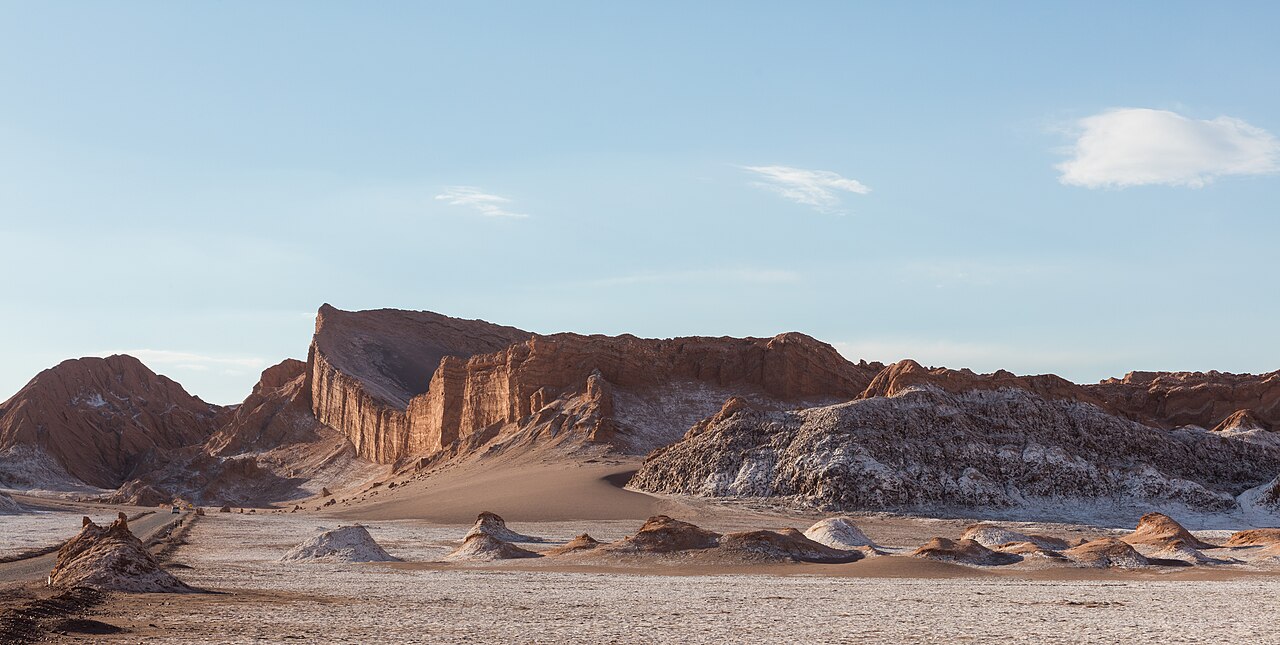
In the Valle de la Luna at golden hour in October the amphitheatre of eroded rock holds the day's last heat while the temperature falls off a cliff around you — salt-crusted ridges turning rose, then violet, under a sky so dry and clear that the first stars arrive before the light has finished leaving.
The easily missed detail
San Pedro de Atacama sleeps at about 7,900 feet (2,400 m), and the excursions climb from there — the El Tatio geysers steam at over 14,000 feet (4,300 m). The desert's seasons matter less than its altitude: whichever month you choose, give the town two easy days before the high lagoons and the geysers, and let October's cold, clear dawns — the year's best for Tatio — come after you have acclimatised.
A practical rhythm
- Morning — Atacama mornings are for altitude: the high lagoons and salt flats in the clear early light, when the flamingos of the Los Flamencos reserve are feeding and the wind has not yet risen.
- Midday — The desert's middle hours belong to San Pedro itself — adobe streets, the church, a long lunch — because the sun at 7,900 feet in October is not a suggestion.
- Evening — The desert's second act is dark: astronomical tours run from San Pedro on moonless nights, and October's dry air makes it the stargazing capital at its best — book around the new moon.
What could complicate the plan
Mid-September is the one spring week to avoid: the Fiestas Patrias of September 18–19 send the whole country traveling, and prices and crowds spike from the Atacama to Patagonia. December to February inverts the desert's calm — altiplano storms, San Pedro at its fullest, Patagonia at peak price — while June to August closes the southern parks to all but guided winter trekking and turns Santiago grey and wet. And October in Patagonia is still early: the famous winds are building, not yet at their January worst, but the park's first fortnight demands layers and a spare day.
What to do next
Fix October, work backwards from the new moon for San Pedro's nights, and let the planning answer in this group sequence the flights — Patagonia's reopening date is the hinge of the whole route.
Sources
- Dirección Meteorológica de Chile — climate normals, 1991–2020: Calama's 7 mm of annual rain and 70–77°F highs, Arica's 2.2 mm, Santiago's 286 mm with 76 percent falling May to August, and the altiplano summer storm pattern
- CONAF — Torres del Paine's seasonal rules: the O Circuit closed through winter until October 31, and winter W Trek access with a licensed guide only
- SERNATUR — the Fiestas Patrias travel peak in mid-September and the desierto florido phenomenon after winter rains