Colombia country guide Trip planning
How can I plan a memorable first trip to Colombia without rushing?
The short answer
Give it a fortnight and four bases — Bogotá, Medellín, the coffee country and Cartagena — joined by flights of about an hour, because the Andes split into three ranges here and turn every cross-country road into a day of its own.
The answer, with local context
The map lies politely and the mountains correct it. Colombia's Andes arrive from Ecuador and divide into three cordilleras — Western, Central and Eastern — separated by the Magdalena and Cauca river valleys, so a journey that looks like a short hop is usually a climb, a descent and a climb again. The practical consequence is a route built on wings: published schedules put Bogotá–Medellín at about one hour, Medellín–Cartagena at about an hour and a quarter, and Bogotá–Cartagena at about an hour and a half, while the roads behind those flights are measured in full days. Bogotá's El Dorado is the hub, with international gateways also at Medellín, Cartagena and Cali, and there is effectively no passenger rail to fall back on — the choice is a one-hour flight or a beautiful, slow bus, and a first trip should spend its slowness inside places, not between them.
Altitude is the second architect. Most travelers land at Bogotá, 8,660 feet (2,640 m), where altitude sickness can develop in anyone who has ascended rapidly past 8,200 feet (2,500 m) — so the capital's first day should be its gentlest, with the museums of La Candelaria rather than Monserrate's summit. From there the country descends in steps: Medellín at 4,900 feet (1,495 m), the coffee towns between 3,900 and 6,200 feet (1,200–1,900 m), and Cartagena at sea level, which is why the comfortable order runs high to low — three nights in Bogotá, three in Medellín, three in the coffee country around Salento and the Cocora Valley, then four on the coast split between Cartagena and Santa Marta — and why reversing it, coast first, wastes the acclimatization you get for free.
The paperwork has one hard deadline, and it is medical. The CDC's current guidance lists yellow fever vaccination as required for travelers aged one and older arriving in Colombia, and since April 28, 2025, Parques Nacionales Naturales has required the vaccination card — dated at least ten days before entry — to enter Tayrona, the Ciudad Perdida route and Los Flamencos, against the background of a yellow fever emergency declared by the Ministry of Health. The certificate, once valid, lasts for life under WHO rules; but a shot taken a week before the trip does not count at the Tayrona gate, which makes vaccination the first booking of all, ahead of every flight. Around it, the formalities are light: US, UK, EU and Canadian visitors are stamped in for up to 90 days. The calendar needs the same respect as the paperwork — Ciudad Perdida closes every September, Caño Cristales opens only from June to November, and the country's own Christmas and Holy Week holidays move millions of Colombians onto the same roads and beaches, which is why the timing answer in this group builds the case for February.
Picture the place
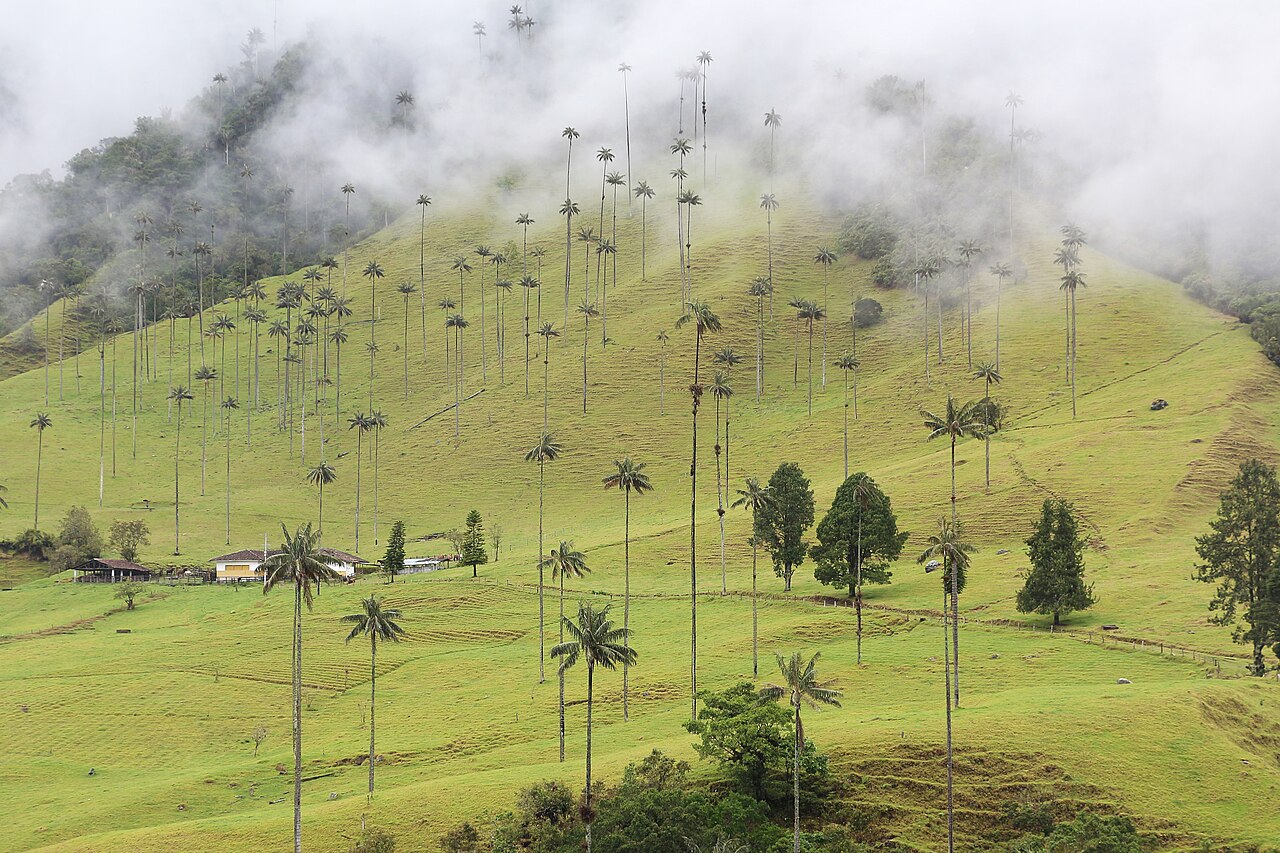
In the Cocora Valley the wax palms stand a hundred feet and more over green pasture, absurdly tall and thin, their crowns in the drifting cloud — and the Willys jeeps from Salento, the coffee country's shared taxis since the 1950s, line up below them in primary colors, loading walkers for the ride back to town.
The easily missed detail
Medellín is the one Colombian city where the public transport is itself a sight: its Metro is the only one in the country, and its Metrocable gondolas — six cable-car lines climbing the valley walls — were built as transport for the hillside neighborhoods, not as a tourist attraction. Riding Line K to Santo Domingo at rush hour shows you the city's real engineering, social and otherwise, for the price of a metro fare.
A practical rhythm
- Morning — Fly in the mornings: Colombia's domestic schedule is front-loaded, an early flight lands you in the next climate by lunch, and the mountain roads you are avoiding are at their most beautiful — and slowest — in the same hours.
- Midday — Give every base a full, uncommitted midday: the bandeja in Medellín, the finca lunch in the coffee country, the shaded old-town pause in Cartagena — the trip's texture lives in these, not in the transfers.
- Evening — Bogotá evenings are for the museums' late hours and an early night at altitude; the coast reverses the deal, and Cartagena's day properly starts when the sun drops and the walls turn gold.
What could complicate the plan
Ambition is the usual failure: the Amazon through Leticia, the Pacific's whales and San Agustín's statues are each expeditions of three to five days once the flights are counted, and bolting any one of them onto the four-base fortnight turns the trip back into a rush — choose one, or extend. Altitude punishes shortcuts at the start, not the end, so resist front-loading Bogotá's sights. And the parks' rules — the vaccination card, the September closure, the river's season — are administered without exceptions at gates a long way from the nearest pharmacy or consulate, which is precisely why they belong at the top of the plan.
What to do next
Vaccinate first, then book the chain — Bogotá in, Cartagena out, the domestic flights between — then the Lost City agency or the Caño Cristales season if either expedition made the cut.
Sources
- Parques Nacionales Naturales de Colombia — the yellow fever vaccination card, dated at least 10 days before entry, required since April 28, 2025 for Tayrona, Ciudad Perdida and Los Flamencos
- US Centers for Disease Control and Prevention — yellow fever vaccination listed as required for travelers aged 1 and older arriving in Colombia (guidance updated July 9, 2025); altitude sickness risk on rapid ascent above 2,500 m, including flights into Bogotá
- Migración Colombia — 90-day visitor stays for US, UK, EU and Canadian passport holders
- Published domestic schedules (Avianca / LATAM Colombia) — Bogotá–Medellín about 1 hour, Medellín–Cartagena about 1 hour 15 minutes, Bogotá–Cartagena about 1 hour 30 minutes