Colombia country guide Food and drink
What local dishes should I try in Colombia, and where should I look for them?
The short answer
Colombia cooks by region, not by nation: Bogotá's three-potato ajiaco, Antioquia's bandeja paisa platter, Tolima's twelve-hour lechona, Santander's pre-Columbian roasted ants — and coffee over all of it, from a landscape UNESCO protects as a culture.
The answer, with local context
Start in the cold capital, where the signature dish is a soup engineered like a sauce. Ajiaco santafereño — named for Santa Fe, Bogotá's colonial name — builds its body from three potatoes with three destinies: the small yellow criolla, which dissolves completely and colors the broth; the pastusa, which holds some shape; and the sabanera, which thickens the whole. Into that go chicken, corn on the cob and a handful of guascas (Galinsoga parviflora), a wild herb of the savanna without which, Bogotanos insist, the soup is merely good. It arrives in a clay bowl with cream and capers to stir in and avocado on the side, and its roots are double — Muisca cooking fused with Spanish ingredients. Bogotá's other emblem is a breakfast that startles visitors: changua, a milk soup with poached egg, scallion and cilantro, eaten with bread for dunking.
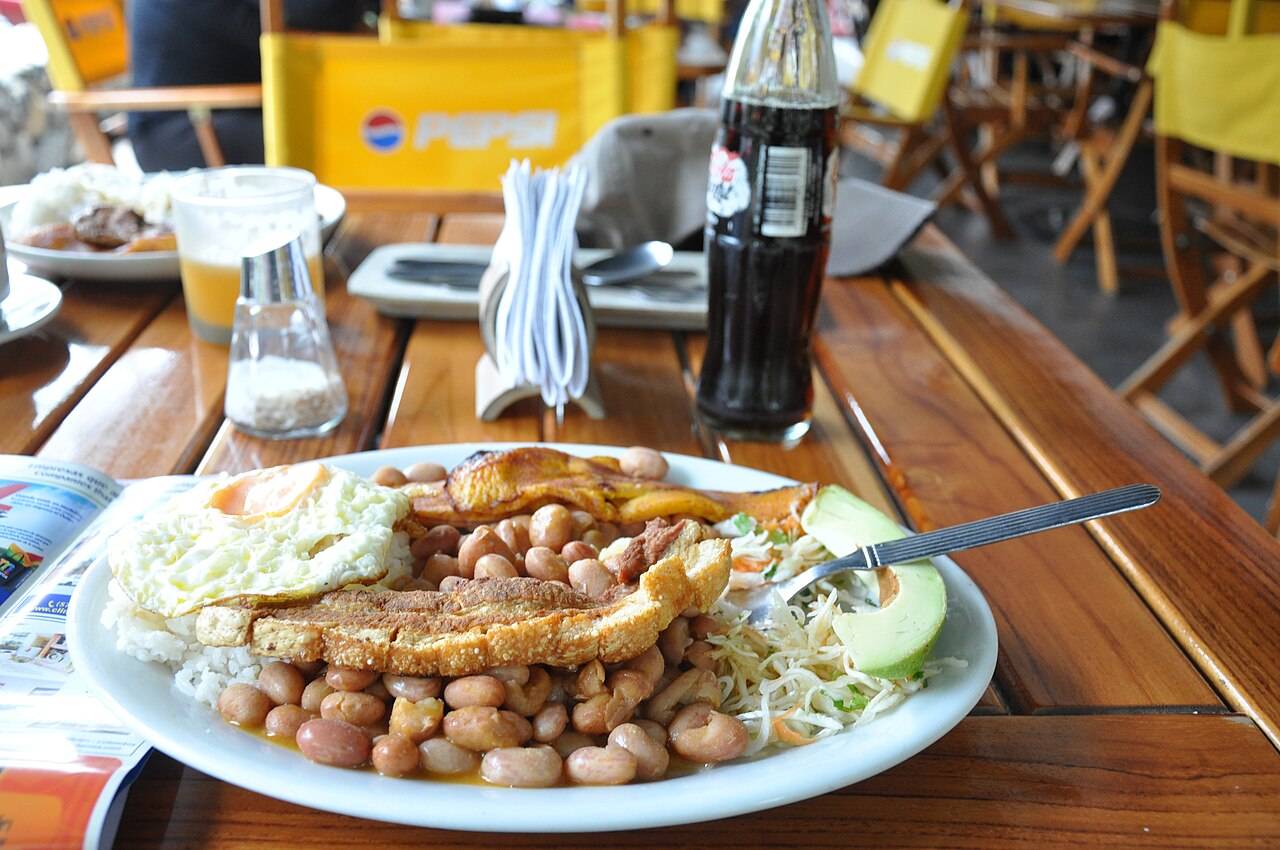
Antioquia, the Paisa country around Medellín, answers soup with a platter. The bandeja paisa needs a tray rather than a plate: red beans, white rice, ground beef, chicharrón, chorizo, morcilla, a fried egg, sweet plantain, an arepa and avocado, a farm-worker's lunch scaled into the dish Colombians abroad ask for first. Tolima, southwest of the capital, keeps the country's great feast dish: lechona, a whole pig stuffed with rice, yellow peas and spices and roasted for ten hours or more in a clay oven, carved to order at festivals and family celebrations. And in Santander, in the northeast, the kitchen keeps a pre-Columbian course alive: hormigas culonas, the big-bottomed queen ants the Guane people ate long before the Spanish came, harvested only in the rainy weeks of March and April when the queens leave the nest to mate, then soaked in salt water and roasted in ceramic pots. Santander backs them with heartier fare — mute, its tripe-and-corn soup, and carne oreada, sun-dried beef — while the far south, in Pasto, roasts cuy, guinea pig, as it has since Inca times on that border.
The thread through all of it is coffee, and Colombia has arranged for its coffee to be heritage. The Coffee Cultural Landscape, inscribed by UNESCO in 2011, covers six farming landscapes and 18 urban settlements across 47 municipalities in Caldas, Quindío, Risaralda and Valle del Cauca — some 24,000 small farms, most under five hectares, planted on slopes steeper than 25 percent where machinery cannot go and every cherry is picked by hand. The drink itself, drunk Colombian-style, is not the tasting flight: it is the tinto, a small, sweet black coffee poured from thermoses on street corners from Bogotá to the coast, and its cold-climate cousin the aguapanela, hot sugar-cane water, with cheese melted into hot chocolate as Bogotá's other standing joke that turns out to be delicious.
Picture the place
At a Tolima festival the lechona comes out of the clay oven whole and gleaming, the skin a sheet of amber crackling, and the carver works down the flank with a machete's confidence — rice and peas spilling from the cavity, a queue already formed with plates and arepas in hand.
The easily missed detail
The hormigas culonas are a season, not a menu item: miss the March–April mating flights in Santander and no restaurant can conjure them, because the harvest is those few rainy weeks when the queens emerge. Of every dish in this answer, the ants are the one that cannot be rescheduled — plan the Santander leg around them, or accept the legend secondhand.
A practical rhythm
- Morning — Breakfast is a meal in Colombia, not a prelude: changua in Bogotá, eggs with arepa and hot chocolate everywhere, and the first tinto of the day before any of it.
- Midday — Lunch is the main event — the corrientazo set lunch in working restaurants, the bandeja paisa at its midday fullest, and lechona at the weekend markets and festivals where the ovens are.
- Evening — Evenings run lighter and later: ajiaco is as much a Sunday-family dish as a restaurant one, and the coffee axis saves its farm dinners for the fincas, where the day's picking ends at the table.
What could complicate the plan
Regional pride is enforced: order a bandeja paisa in Bogotá and an ajiaco in Medellín and both kitchens will comply while quietly judging, because these dishes belong to their altitudes — the ajiaco's potatoes are highland crops, and the bandeja's beans and plantain are the Paisa farm in one tray. Cuy divides tables in the south and the ants divide them everywhere; neither is a test of character, and Santander's mute will feed the sceptics at the same table. Finally, the coffee landscape's harvests pulse through the year, with the main crop gathered in the last quarter — a farm visit then is a working harvest, not a demonstration.
What to do next
Eat the itinerary in order — ajiaco on the Bogotá Sunday, bandeja in Medellín, lechona if a festival crosses the route, the ants if the season allows — and take the coffee country slowly enough to drink tinto where the cherries are picked.
Sources
- Ministerio de Cultura, Biblioteca básica de cocinas tradicionales de Colombia (2013) — the regional framework of Colombian cooking: the ajiaco's three potatoes and guascas on the Altiplano, lechona and the tamal in Gran Tolima, hormigas culonas and mute in the Santanderes, cuy in Pasto
- UNESCO / ICOMOS evaluation of the Coffee Cultural Landscape (2011) — six landscapes and 18 urban settlements across 47 municipalities, some 24,000 coffee farms, cultivation on slopes over 25 percent
- Federación Nacional de Cafeteros — co-manager, with the Ministry of Culture, of the Coffee Cultural Landscape's management committee