Colombia country guide Places and experiences
What should a first-time traveler see in Colombia beyond the obvious highlights?
The short answer
Head south and strange: the stone guardians of San Agustín, the painted underground tombs of Tierradentro, a river that runs in five colors for half the year, and a lost city in the Sierra Nevada built some 650 years before Machu Picchu.
The answer, with local context
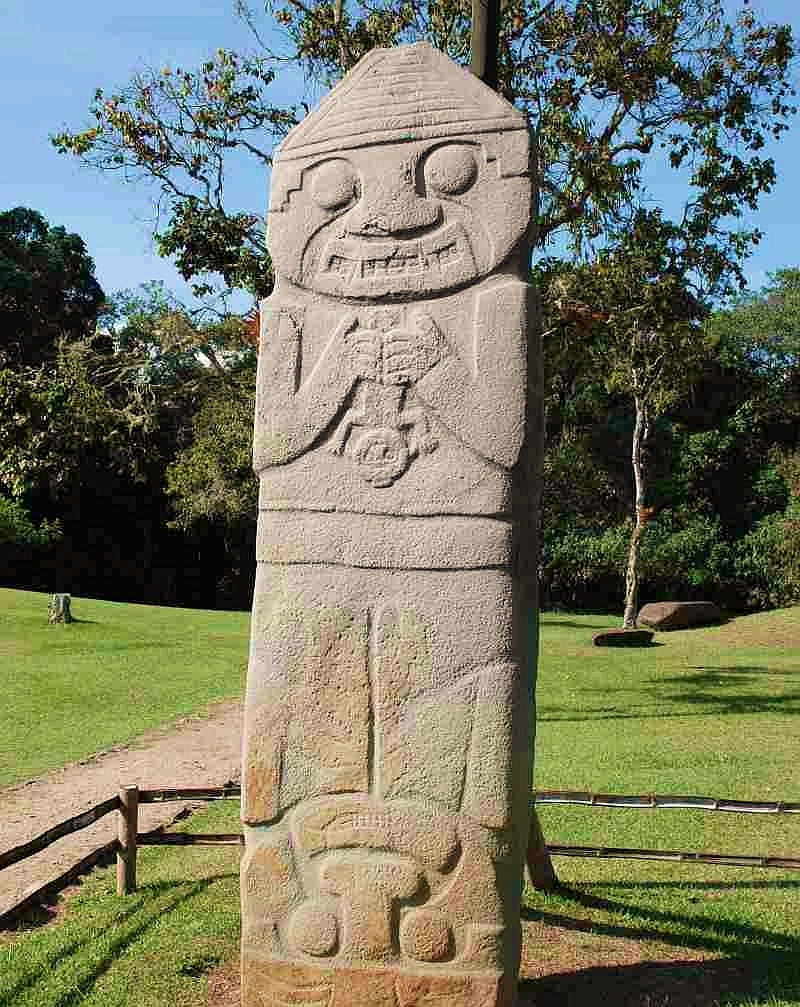
Colombia holds nine UNESCO properties — six cultural, two natural and one mixed — and beyond Cartagena's walls the list turns pre-Columbian. San Agustín Archaeological Park, inscribed in 1995 in the Upper Magdalena valley, protects what UNESCO calls the largest group of religious monuments and megalithic sculptures in South America: more than 500 statues documented across the region, carved between the 1st and 8th centuries AD by a culture whose name we still do not know. The inscribed property spans three separate zones totaling 287 acres (116 ha); its tallest figures, at Alto de los Ídolos, stand about 23 feet (7 m), and its strangest monument, the Fuente de Lavapatas, is a ceremonial channel carved directly into the bed of a stream. A day's travel away in Cauca, Tierradentro — inscribed the same year — goes underground instead: 162 hypogea, shaft tombs cut into the ridges between the 6th and 9th centuries, the largest up to 39 feet (12 m) wide and painted in red, black and white.
The Caribbean hides the country's great trek. Ciudad Perdida — Teyuna — was built by the Tairona around 800 AD, some six and a half centuries before Machu Picchu, a city of 169 terraces and tiled roads rediscovered by treasure hunters only in 1972. There is no road and no independent access: the 27-mile (44 km) round trip takes four to six days on foot, entry runs exclusively through agencies authorized by ICANH, the national anthropology institute, and the site closes for the entire month of September each year at the request of the Sierra's Indigenous peoples, who hold their cleansing rituals there. South of the mountains, in Meta, Caño Cristales runs through the Serranía de la Macarena — a national park of 1.55 million acres (629,280 ha) where the Andes, the Amazon, the Orinoquía and the Guiana Shield meet. Its color is a plant: the endemic Macarenia clavigera, which grips the riverbed rocks and flushes red once the water level and sunlight align. Parques Nacionales opens the river for a season that runs from early June to late November — in 2026 it opened on May 29 — and closes it from December to May while the plant reproduces.
Two of the nine come with asterisks that are themselves the story. Chiribiquete, the mixed site inscribed in 2018, is Colombia's largest national park at 10.6 million acres (4.3 million ha), covered in tepuis and tens of thousands of rock paintings — and it is closed to visitors entirely, a World Heritage site you experience by knowing it exists. Mompox, inscribed in 1995, is the opposite case: a colonial river port founded in 1540 on the Magdalena whose importance drained away in the 19th century when the river's main channel shifted, leaving its churches and balconied streets preserved by neglect. And out in the Pacific, 310 miles (500 km) offshore, the Malpelo sanctuary completes the set — a dive-only island reached by liveaboard, for the travelers who thought the mainland was the whole trip. Nearer the standard route, the Cocora Valley outside Salento holds the emblem of the coffee country: the Quindío wax palm, Colombia's national tree and the tallest palm species on Earth, standing in pasture like a plantation of telegraph poles drawn by a surrealist.
Picture the place
At San Agustín the statues stand in ones and twos across green, groomed hilltops — flat-faced guardians with fanged mouthpieces and hands folded over their bellies, a jaguar or an eagle at a shoulder — watching over burial mounds in a landscape that gives no clue which god they served.
The easily missed detail
San Agustín's carvers left no name, no writing and no certain explanation, and the culture had abandoned the sites by about 1350 — two centuries before the Spanish arrived to ask. Colombia's greatest archaeological park is a masterpiece by anonymous authors, which is exactly why the statues, and not any story attached to them, carry the whole visit.
A practical rhythm
- Morning — Archaeology is morning work in the southern Andes: San Agustín's main park and Tierradentro's Segovia tombs in the cool hours, before the climbs between the hypogea turn strenuous.
- Midday — Mompox runs on the river's clock — a long, shaded midday, then the town as the heat breaks; and in La Macarena the river boats and the walk to Caño Cristales fill the middle of the day by design.
- Evening — On the Lost City trek the evening is the camp: hammocks or bunks, the river for a swim, and an early night, because the terraces are climbed at dawn on the final morning.
What could complicate the plan
The calendar closes doors: Ciudad Perdida shuts every September, Caño Cristales for half the year, and Chiribiquete forever. The southern sites are also a journey inside the journey — San Agustín and Tierradentro sit a full day's travel from each other and further from Bogotá, on Andean roads that reward patience. And the Lost City's authorized-agency rule is absolute: there is no permit to buy at a trailhead and no legal way to walk in alone, which makes booking ahead, in the dry months, the whole game.
What to do next
Choose one expedition — the south for the statues and tombs, the Sierra for the trek, Meta for the river's season — and let the planning answer in this group build the fortnight around it.
Sources
- UNESCO World Heritage Centre — Colombia's nine properties (six cultural, two natural, one mixed), including San Agustín's status as the largest group of religious monuments and megalithic sculptures in South America, Tierradentro's painted hypogea of the 6th to 9th centuries, Mompox (1995), Malpelo (2006) and Chiribiquete (2018) at 4.3 million hectares
- Parques Nacionales Naturales de Colombia — the Caño Cristales visitor season, early June to late November under the park's rules, and the Serranía de la Macarena's 629,280 hectares at the junction of four biogeographic regions
- ICANH (Instituto Colombiano de Antropología e Historia) — access to Teyuna–Ciudad Perdida only through authorized agencies, and the site's annual September closure at the request of the Sierra Nevada's Indigenous communities