Estonia country guide Food and drink
What local dishes should I try in Estonia, and where should I look for them?
The short answer
Black rye bread with everything, a kiluvõileib sprat sandwich at a Tallinn market hall, verivorst and Mulgi puder where the regions make them, and a farm-table dinner in the south — Estonian food is regional first and restaurant food second.
The answer, with local context
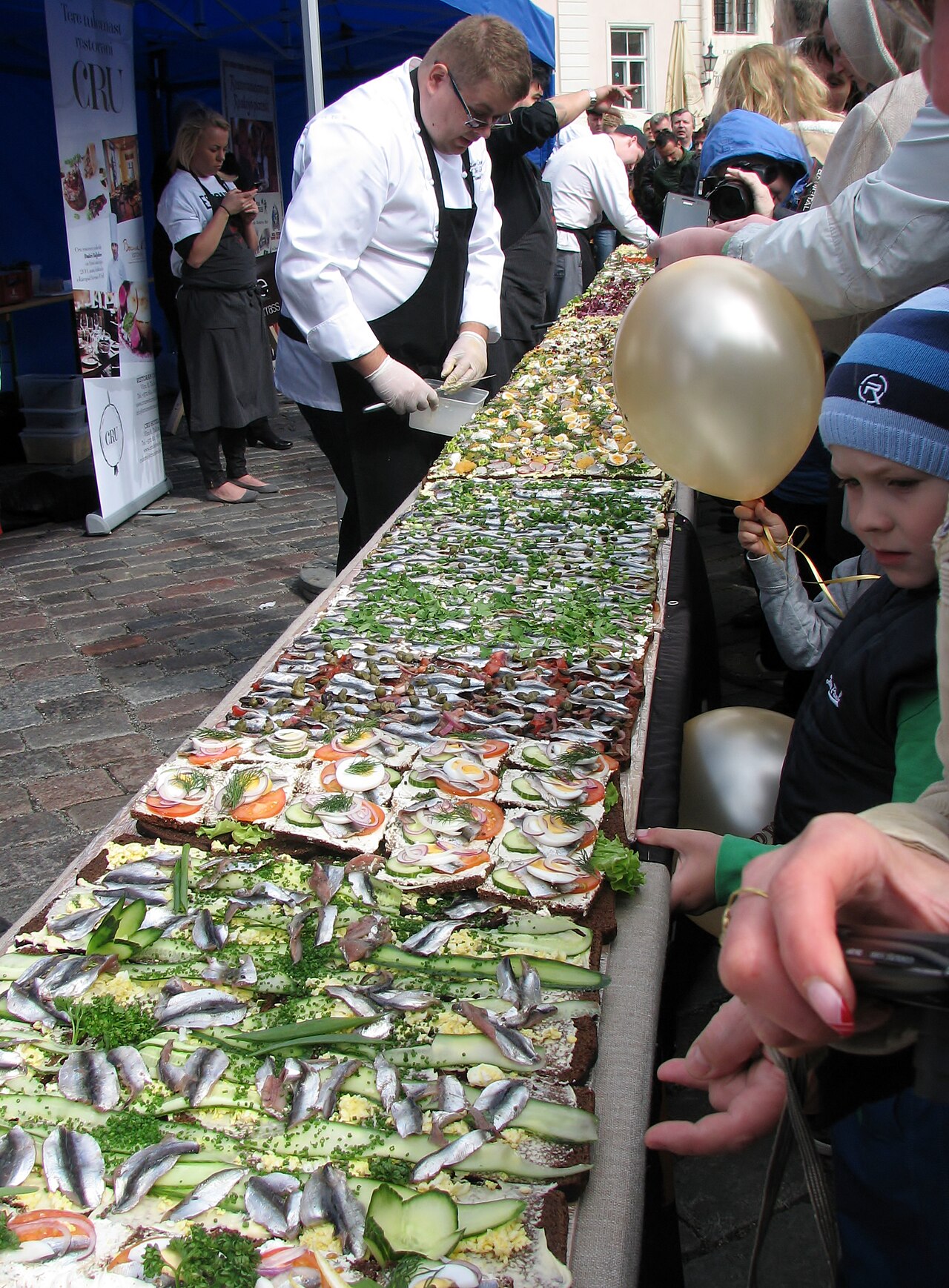
The foundation is leib — dark rye bread, leavened and faintly sweet, so central that the Estonian word for bread doubles as the word for food and livelihood. It carries the national sandwich: kiluvõileib, Baltic sprats (Tallinn's kilu have been canned and celebrated since the 19th century) on buttered black bread with egg and herbs, served in cafés and market halls as the default light lunch. Find it, and the rest of the classic table, at Tallinn's Balti Jaama Turg (the rebuilt station market, the capital's best food hall) and at the cafés of the Old Town; find the ingredients at any market in Tartu or Pärnu. The other bread-sovereign products are kama — a roasted flour of barley, rye, oats and peas, whisked into kefir or yogurt for breakfast, and now reborn in modern desserts — and kohupiim, the fresh curd that fills pastries (kohupiimakook, curd cake) across the country.
Eat by region, because Estonia's map is a menu. In the south, Mulgimaa cooks Mulgi puder — mashed potato beaten with barley, served with fried bacon and sour cream — whose cooking and eating UNESCO inscribed as Intangible Cultural Heritage in 2024; order it in Viljandi and Abja-Paluoja country taverns where it is a daily dish, not a display. The islands smoke and juniper everything: Saaremaa's home-brewed õlu, juniper-smoked fish and dark island bread belong to its farm restaurants (and its October food festival), while Setomaa in the southeast serves sõir, a caraway-flecked fresh cheese made for feasts, alongside mushroom soups from the border forests. Christmas, if you come in winter, is verivorst — blood sausage with barley, roasted and served with lingonberry jam and sauerkraut, the season's non-negotiable plate; summer counters with cold beet soup's local cousins, grilled Baltic herring (the national fish since a 2007 public vote) and new potatoes with dill.
The capital's top tables translate the larder: Michelin's Estonian guide — the first in the Baltic states, launched in 2022 — lists 180°, Matthias Diether's chef's counter holding two stars, and NOA Chef's Hall with one, while the beloved mid-range (Moon, Lee, Rataskaevu 16) cooks Estonian produce through Russian, Asian and Nordic lenses. In Tartu, Joyce and the university quarter's bistros do the same for the south. And drink like the country: Vana Tallinn, the rum-based herbal liqueur made since the 1960s, in coffee or neat; the craft beer of Põhjala (founded 2011, its cellar door in Tallinn's Noblessner district) and a dozen small breweries; and in farm country, kali — the lightly fermented bread drink — sold by the liter at markets.
Picture the place
Balti Jaama market at noon: a sprat sandwich on black bread, a glass of kali beading with cold, pickled cucumbers and smoked fish in paper — Tallinn's lunch, eaten standing at a counter under the old station's market roof.
The easily missed detail
Estonia's sweetest heritage is a spice: the country's gingerbread (piparkoogid) and its glögi arrive with the Christmas markets, but the year-round secret is the Tallinn marzipan tradition — the Raeapteek and Maiasmokk (the city's oldest café, in business since 1864) both claim the confection's medieval roots, and Maiasmokk's marzipan room still hand-paints the little figures. A painted marzipan pig from Pikk street is the souvenir Estonian grandmothers actually approve of.
A practical rhythm
- Markets in the morning — Balti Jaama (Tallinn) or Tartu's market hall for sprats, kama, curd and bread to build the day's picnic
- Regions for the dishes — Mulgi puder in Mulgimaa, sõir in Setomaa, juniper fish on Saaremaa: the dish tastes of its parish
- Book the starred counters — 180° and NOA Chef's Hall take small seatings; reserve weeks ahead for weekends
What could complicate the plan
Drink here runs on a clock written into law: Estonia's Alcohol Act suspends the retail sale of alcoholic beverages between 22:00 and 10:00, so the bottle of island õlu or the Vana Tallinn for the hotel room has to be bought before the cut-off, and a late evening arrival is a dry one. The border is the other new variable. Short stays in Estonia run on Schengen's allowance of 90 days in any 180-day period, and the EU's Entry/Exit System — live from 12 October 2025 and fully operational at every external crossing point since 10 April 2026 — registers a facial image and fingerprints at a first entry, lengthening the queue between the plane and that first sprat sandwich. The dishes themselves are parish-bound: Mulgi puder, sõir and juniper-smoked island fish are cooked where they come from, so a trip confined to Tallinn tastes the national menu at second hand.
What to do next
Start with a market breakfast in Tallinn, put one regional dish per region on the route south and east, and end one evening at a Michelin-listed table that cooks the same larder.
Sources
- UNESCO Intangible Cultural Heritage — "Cooking and eating Mulgi puder, traditional mashed potato with barley in the Mulgimaa region," inscribed 2024
- Michelin Guide Estonia — the Baltic states' first Michelin guide (2022): 180° (two stars) and NOA Chef's Hall (one star), Tallinn
- Visit Estonia — the kiluvõileib and Tallinn sprats; Baltic herring as the national fish (chosen 2007)
- Estonian Ministry of Rural Affairs — kama and the regional food networks (Mulgimaa, Setomaa, the islands)
- Riigi Teataja (Estonia's official legal gazette), Alcohol Act, consolidated English text — suspension of the right of retail sale of alcoholic beverages from 22:00 to 10:00
- European Commission, Migration and Home Affairs — the Entry/Exit System live on 12 October 2025 and fully operational from 10 April 2026, biometric registration, and the 90-days-in-180 short-stay rule