Estonia country guide Places and experiences
What should a first-time traveler see in Estonia beyond the obvious highlights?
The short answer
Walk a bog boardwalk in Lahemaa, cross to Saaremaa for its meteorite crater and castle, take a smoke sauna in Võromaa, and end in the university city of Tartu — Estonia's depths lie east, south and offshore.
The answer, with local context
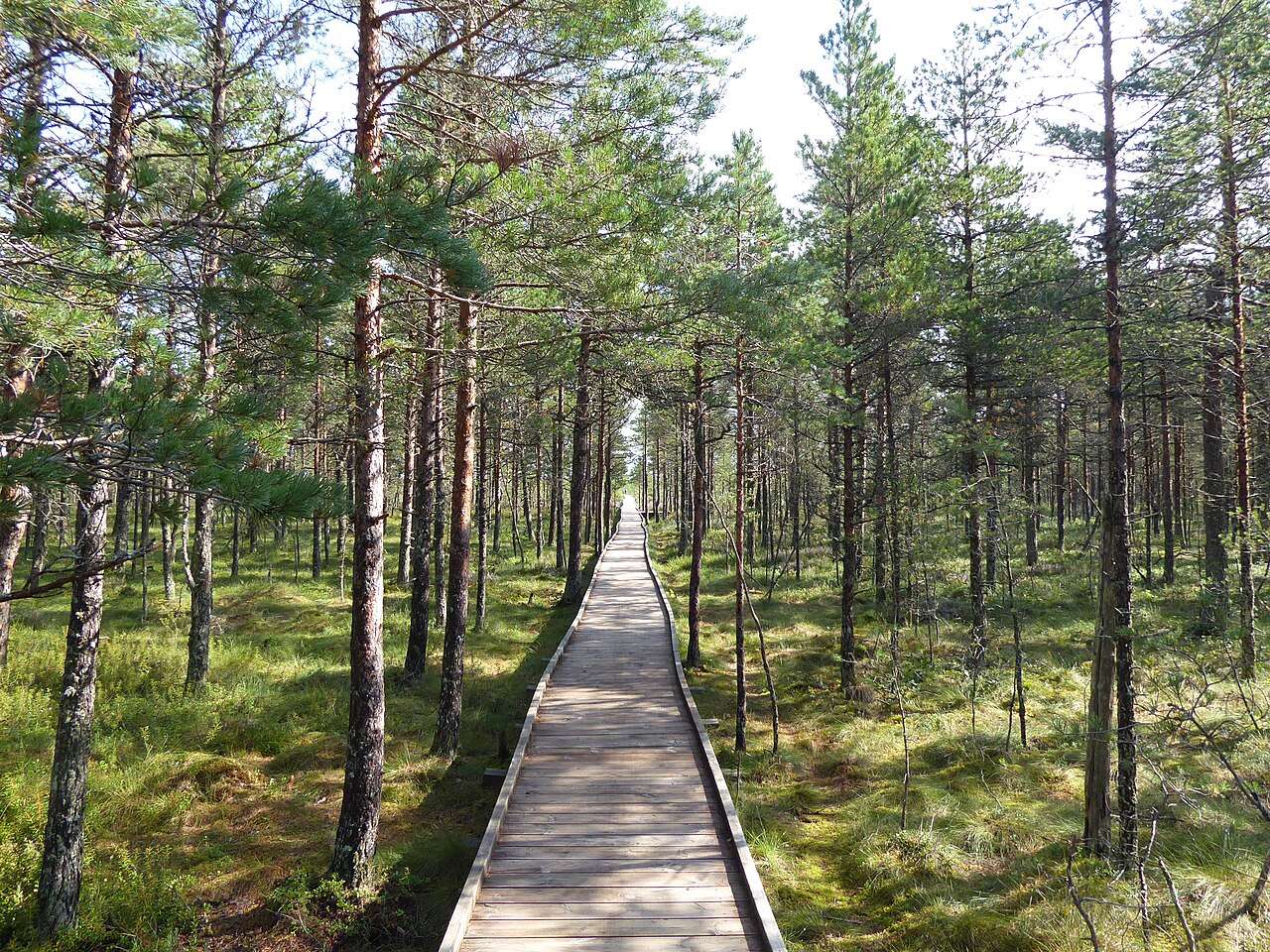
Start an hour from Tallinn in Lahemaa National Park — at 290 square miles (725 km²) the country's largest, established in 1971 as the first national park in the entire Soviet Union — where Estonia's signature landscape pairing appears: Baltic manor houses (the restored Palmse, Sagadi and Vihula estates of the German landowning class) set in forest that runs to a boulder-strewn shore. Walk the Viru bog boardwalk, a 2.2-mile (3.5 km) plank path over rust-red pools to a lookout tower: the raised bog, built of sphagnum over millennia, is Estonia's true interior wilderness, repeated across the country (a quarter of Estonia is wetland and forest covers about half the land), and Soomaa National Park in the southwest floods so completely each spring that locals name it the "fifth season" and travel by canoe — including in the haabjas, the expanded dugout boat whose making UNESCO put on its urgent-safeguarding list in 2021.
Go offshore, because a quarter of Estonia's identity is insular: the country counts some 2,300 islands. Saaremaa, the largest, holds the Kaali crater field — a meteorite impact roughly 3,500 or more years ago that left a 360-foot (110 m) main crater holding a sacred lake, sung about in Baltic-Finnic epic — plus Kuressaare's 14th-century episcopal castle, among the best-preserved medieval fortresses in the Baltic states, and the Angla windmill hill. Hiiumaa answers with Kõpu lighthouse, a massive 16th-century tower that ranks among the world's oldest continuously operating lighthouses. Small Kihnu, in the Gulf of Riga, is run in practice by its women — its traditional dress, weddings and motorcycle-sidecar culture form a UNESCO-listed "cultural space" (2008) — and in the southeast, Setomaa keeps the Orthodox Seto people's polyphonic leelo singing (UNESCO-listed, 2009) and a borderland culture distinct from Lutheran Estonia.
Then take the south's two institutions. In Võromaa, the smoke sauna — a windowless log sauna heated for hours, meat smoked in the same room, the bather whisked with birch and plunged into a pond — is UNESCO-listed (2014) not as folklore but as weekly practice; farm stays around Haanja and the Rõuge lakes will host you through the full five-hour rite under Suur Munamägi, at 1,043 feet (318 m) the highest point in the Baltic states. And Tartu, the country's intellectual capital, anchors the east: a university founded in 1632 by Sweden's Gustavus Adolphus, the old observatory that anchored the Struve Geodetic Arc (Estonia holds three points of that UNESCO-listed survey chain), and a youthful café culture that made it European Capital of Culture in 2024. Finish, if season allows, with the east's edge: Narva, where the great Hermann Castle faces Russia's Ivangorod fortress across the Narva river — Europe's border drawn in one view.
Picture the place
On the Viru bog at dawn, mist sits in the hollows between bog pines no taller than a person, the boardwalk runs straight as a ruler to the tower, and the only sound is a crane somewhere in the white.
The easily missed detail
Estonia's most original overnight is a bear hide: in the Alutaguse forests of the northeast — some of Europe's densest brown-bear country, with a national population estimated by the Environment Agency in the high hundreds — operators run wooden watching hides where, on May and June nights, you sit silent from dusk while bears, raccoon dogs and elk work the clearing. It is the country's wilderness made intimate, and it books out weeks ahead precisely because almost nobody outside Estonia knows it exists.
A practical rhythm
- One park, one island, one city — Lahemaa (day trip or overnight), Saaremaa (two nights), Tartu (a night): the triangle that teaches Estonia
- Sauna as an appointment — Book the smoke-sauna farm experience days ahead; it takes an afternoon to heat and cannot be improvised
- Drive the gaps — Estonia's pleasures are spaced 30–60 miles apart on empty roads; a rental car converts the country from day trips into a journey
What could complicate the plan
The islands run on ferry time: Saaremaa's causeway-linked route via Muhu is easy, but Hiiumaa and Kihnu ferries book out on summer weekends and shrink in winter. Soomaa's fifth season is a spring flood event whose timing is weather's decision, and the bog boardwalks ice over in the dark months. Distances are small but roads are rural two-laners — the Tallinn–Tartu highway aside, pace plans at 40 mph and daylight in winter is a ration (about six hours in December).
What to do next
Build the loop: Tallinn → Lahemaa → Tartu → Võromaa sauna → Pärnu → the islands → back to Tallinn, and give it nine days minimum.
Sources
- State Forest Management Centre (RMK) / Environmental Board — Lahemaa (est. 1971, 725 km²) and Soomaa national parks; the Viru bog trail
- UNESCO Intangible Cultural Heritage — the smoke sauna tradition in Võromaa (2014), Seto leelo (2009), the Kihnu cultural space (2008), and the Soomaa haabjas dugout boat (2021, urgent safeguarding)
- UNESCO World Heritage Centre — the Struve Geodetic Arc (2005), with three Estonian points including Tartu Observatory
- Visit Estonia / Statistics Estonia — some 2,300 islands and islets; Suur Munamägi (318 m) as the Baltic states' highest point