Great Barrier Reef / Australia Things to do
What are the most worthwhile things to do in Great Barrier Reef on a first visit?
The short answer
A day on the outer reef from Port Douglas or Cairns, a sail-and-sand day at Whitehaven Beach in the Whitsundays, and one specialist act of devotion — the Yongala wreck for divers, the southern islands for turtle people — because the reef's greatest hits are a day apart from each other, not an hour.
The answer, with local context
The standard first day, done properly, is the outer reef. From Port Douglas the big catamarans run to the Agincourt Ribbon Reefs at the continental shelf's edge; from Cairns they run to pontoons on reefs such as Moore Reef, with snorkeling, semi-submersibles and introductory dives in water that can hold 100 feet (30 m) of visibility in the dry season. Every boat works under a Reef Authority permit, and the permit system caps sites and numbers — which is why the pontoons feel organized rather than crowded. The near-shore alternative is a coral cay: Green Island, 17 miles (27 km) off Cairns and about 45 minutes by catamaran, is unusual among the reef's cays for carrying mature rainforest on its coral sand, and Low Isles off Port Douglas pairs its shallow lagoon with a lighthouse operating since 1878.
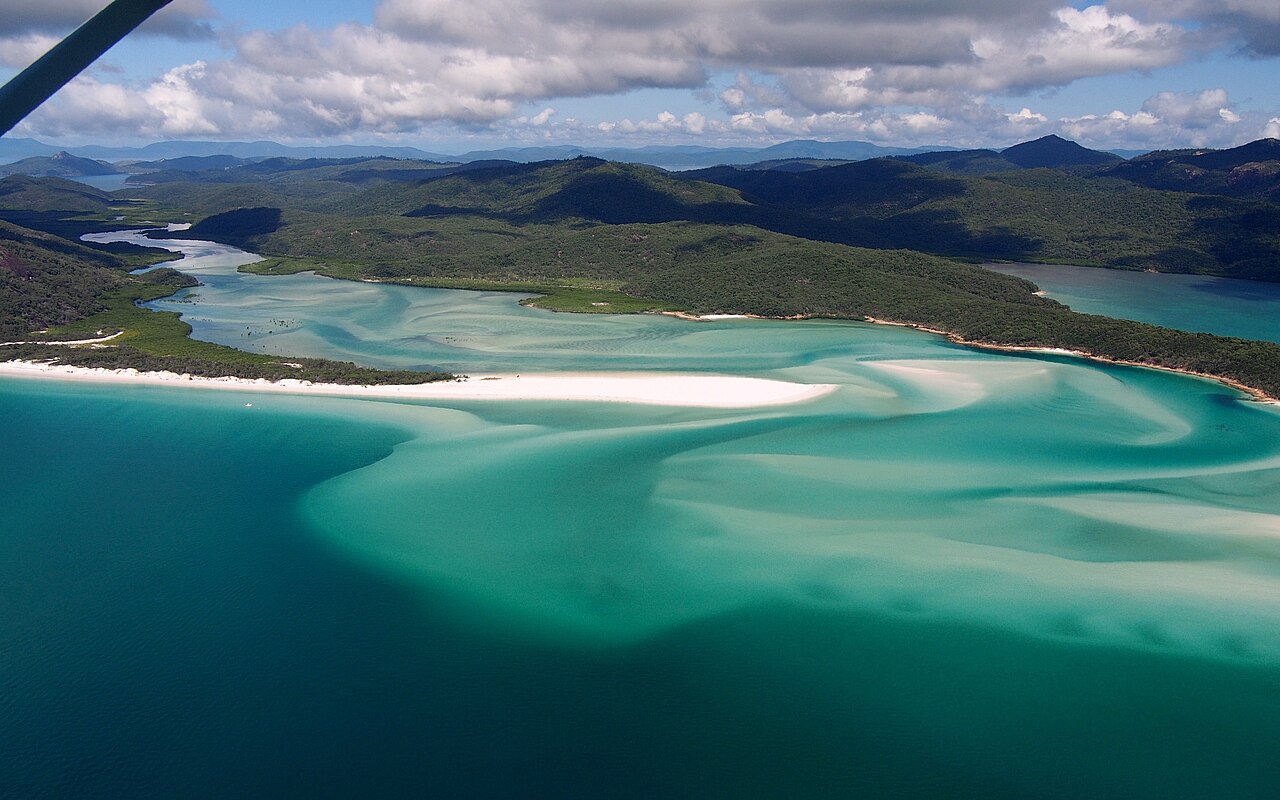
The Whitsundays, 74 islands around Airlie Beach, contribute the reef's most famous above-water day. Whitehaven Beach runs 4.3 miles (7 km) along Whitsunday Island, and its sand is 98 percent pure silica — a composition that arrived by sea current over millions of years and has two party tricks: it squeaks underfoot, and it does not hold the sun's heat, so it stays cool to walk on at noon in January. At its northern end, Hill Inlet pours the same white sand through turquoise water in swirls that move with every tide; the lookout walk above it is the reef's most reproduced photograph. Sailing trips work the islands for two or three days, snorkeling the fringing reefs of Hook and Hayman between anchorages.
Then the specialists' shortlist. Divers rate the wreck of the SS Yongala, off Cape Bowling Green south of Townsville, among the finest wreck dives in the world: a 361-foot (110 m) passenger steamer that vanished in a cyclone on March 23, 1911, with all 122 people aboard, lay undiscovered until 1958, and now rests 46 to 92 feet (14–28 m) down in open water, so encrusted and so crowded with gropers, rays, sea snakes and turtles that it functions as an artificial reef. It is protected under Australia's underwater cultural heritage law — divers may look but never enter or touch — and Townsville also holds the Museum of Underwater Art, sculptor Jason deCaires Taylor's Coral Greenhouse installed on John Brewer Reef. Snorkelers get their equivalent at the reef's ends: the Cod Hole off Lizard Island, where potato cod the size of divers allow themselves to be admired, and Lady Elliot Island in the far south, where the snorkeling starts off the beach on both sides of a 100-acre (42 ha) coral cay.
Picture the place
At Hill Inlet the tide is turning and the sandbars are rewriting themselves in real time — ribbons of white silica unwinding through water that grades from milk to glass-green to deep blue, while forty feet below the lookout a stingray draws its own brief pattern across the flat.
The easily missed detail
Whitehaven's sand was not made here. Silica that pure is not produced by the reef's coral and shell machinery; geologists believe it drifted to Whitsunday Island in ancient sea currents from far away, which is why the beach squeaks like fresh snow, never burns a bare foot, and was once mined — the story goes — for the optical glass of the space age.
A practical rhythm
- Morning — Outer reef on the first sailing, when the crossings are calmest and the pontoons' first snorkel session is the day's clearest.
- Midday — The cay hours: Green Island's rainforest boardwalk and glass-bottom boat while the day boats' crowds are at lunch.
- Evening — A Whitsundays sunset sail out of Airlie Beach, or the Reef Authority's own Eye on the Reef talks and reef-teaching nights that Cairns' aquarium and operators run through the season.
What could complicate the plan
The reef's distances tax the greedy: Cairns to Airlie Beach is a 90-minute flight or a full day's drive, Townsville sits between them, and the Yongala — a minimum two-dive day for certified divers, with a depth that excludes beginners — cannot be bolted onto a Cairns stay. Liveaboard trips to the Ribbon Reefs and the Coral Sea run three to seven nights and sell their minke-whale June–July departures far in advance; the first visit that tries to do every gateway usually ends up doing one of them badly.
What to do next
Pick one gateway as the base and one as the excursion. The responsible-travel question in this group is the briefing to read before the first snorkel, whichever boat you board.
Sources
- Great Barrier Reef Marine Park Authority (Reef Authority) — the permit system governing reef tourism and site use across the Marine Park
- Queensland Government (underwater cultural heritage) — the SS Yongala: lost March 23, 1911, with 122 people, rediscovered in 1958, protected against entry and interference
- Queensland Parks and Wildlife Service — Whitehaven Beach's 98 percent silica sand and the Hill Inlet lookout, Whitsunday Islands National Park
- Museum of Underwater Art (Townsville) — the Coral Greenhouse installation by Jason deCaires Taylor on John Brewer Reef