Great Barrier Reef / Australia Responsible travel
What should first-time visitors know before snorkeling the Great Barrier Reef?
The short answer
That you are a guest inside a working marine park with rules that have legal force — look at everything, touch nothing, take nothing, and let your fins, your sunscreen and your distance from turtles do the conservation work the Reef Authority asks of every snorkeler.
The answer, with local context
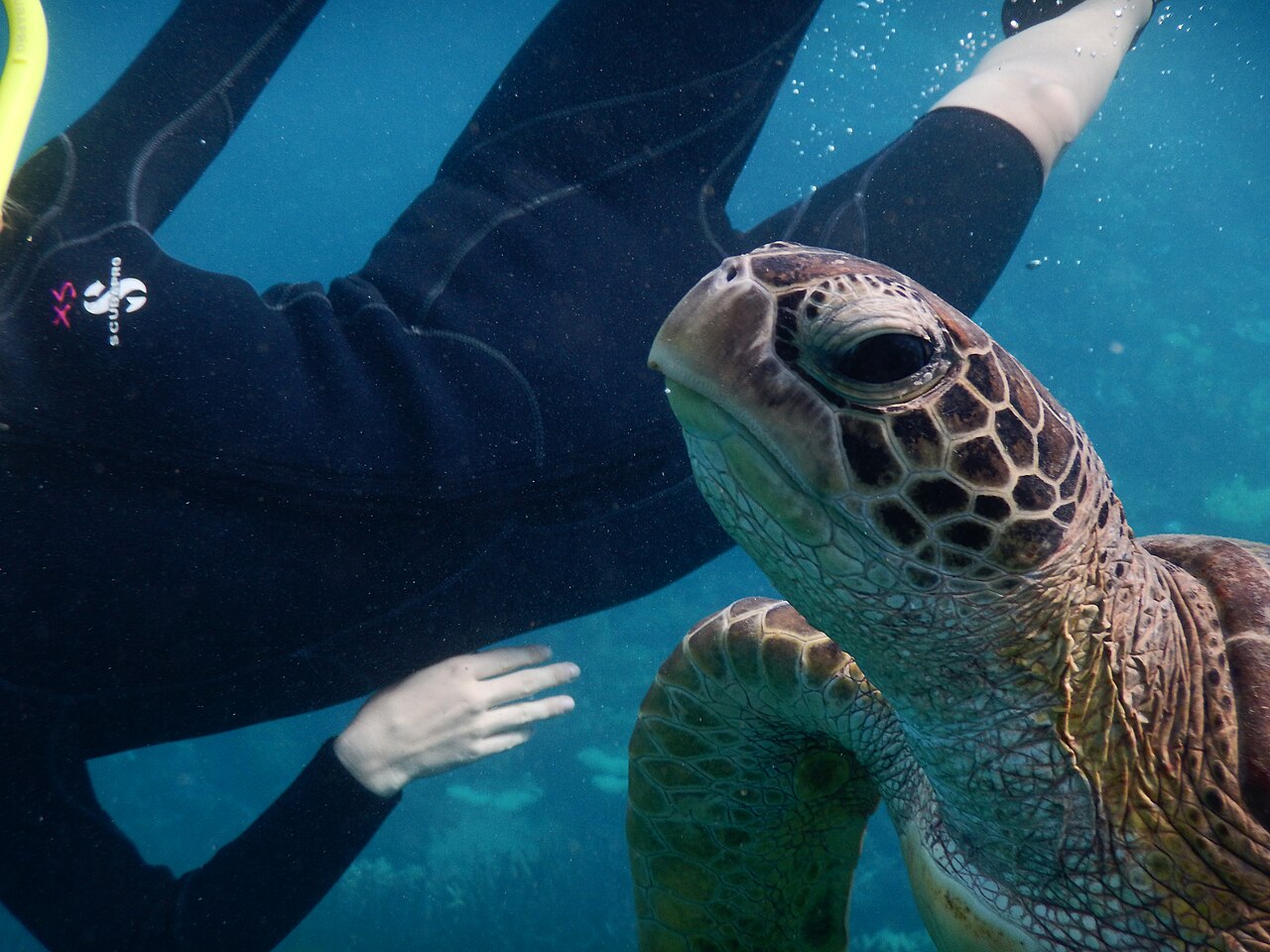
Begin with the single physical fact that organizes all the others: coral is alive and slow. The great boulder corals of the reef grow about a centimetre — under half an inch — a year, so the head you are hovering over may be older than the boat you arrived on, and a single careless fin kick can shear off a decade of growth. The Reef Authority's responsible reef practices are built on it: never stand on coral — if you tire, float, use the rest stations the pontoons provide, or stand only on sand — never touch, lean on or collect anything, and keep fins up and horizontal when the water shallows over a bommie. Six of the world's seven species of sea turtle live in the park; the rule with turtles is theirs, not yours — let them choose the distance, never chase, block or ride one, and give a resting turtle the whole frame of your patience.
The map you are swimming in is a legal document. Since July 1, 2004, the park's zoning plan has made 33 percent of the Marine Park — up from less than five percent — into Marine National Park "Green Zones," no-take areas where fishing and collecting are prohibited and where, to protect all 70 of the park's bioregions, at least 20 percent of every habitat type is represented. Most of the famous snorkel sites sit in or beside these zones, which is precisely why the fish are large and unafraid. The zoning runs finer than green and blue, too: Habitat Protection (Dark Blue) Zones cover about 28 per cent of the park and shut out trawling, Buffer (Olive Green) Zones take roughly three per cent and allow trolling for pelagic fish and nothing else, and the Preservation (Pink) Zones — less than one per cent of the Marine Park — are flatly no-go, enterable only with the Reef Authority's written permission. The same law explains the smaller prohibitions a first-timer meets: feeding fish is allowed only to permit-holding operators at set sites, so your sandwich crust stays on the boat; and taking shells, coral or "just a dead piece" home is collecting, and it is an offence in the park — empty shells are hermit crabs' housing stock.
Your own protection is part of the reef's. The stinger suit your operator hands you from November to May is not theater: it covers you against box jellyfish and Irukandji and, all year, against the sun — and it is also the Reef Authority's preferred answer to sunscreen, since a suit needs no chemicals at all. Where you do use sunscreen, apply it well before entering the water so it binds to skin rather than washing into the lagoon. Finally, a snorkeler can be useful: the Authority's Eye on the Reef programme is its rapid monitoring system, and visitors who photograph something unusual — a crown-of-thorns starfish outbreak, a bleaching patch, an injured turtle — can report it through the Eye on the Reef app, putting a pair of tourist eyes into the park's own surveillance network.
Picture the place
On the pontoon's snorkel platform the guide is doing the morning liturgy — mask, fins, suit zipped to the chin — and below the platform the water is so clear that the reef's shadow lies printed on the sand thirty feet down, with a green turtle already in slow orbit around the coral head the group has been told, twice, not to touch.
The easily missed detail
The most useful thing a first-time snorkeler owns is a photograph they did not plan to take. Eye on the Reef turns visitor sightings into management data — the crown-of-thorns control programme dispatches its divers partly on reports like yours — so the bleaching patch or starfish you noticed at the second snorkel site is worth the two minutes it takes to log it before lunch.
A practical rhythm
- Morning — Listen to the briefing like it matters — zones, rest stations, the no-touch rule and the day's stinger advice are all delivered before the first swim, and they are specific to that site.
- Midday — Float, don't stand: take the rest floats, keep a body-length from the coral in the shallows, and let turtles set every distance.
- Evening — Log the day's sighting — starfish, bleaching, anything injured — in the Eye on the Reef app while the site names are still fresh.
What could complicate the plan
Confidence is the commonest hazard: the outer reef pontoons sit in deep water over a shelving wall, the current along a reef edge can carry a daydreaming snorkeler a long way from the platform, and the operators' lookout system works because swimmers stay inside the marked area and the buddy habit. The seasons add their own entries — summer's stingers and glare, winter's trade-wind chop on the surface — and none of them are reasons to skip the reef; all of them are reasons to take the briefing, the suit and the boundaries seriously.
What to do next
Download the Eye on the Reef app before you sail, choose a Green Zone snorkel site when the operator offers one, and read the timing question in this group for the months when the water makes all of this easiest.
Sources
- Great Barrier Reef Marine Park Authority (Reef Authority) — Responsible Reef Practices for snorkellers, the Zoning Plan 2003 (33 percent Green Zones since July 1, 2004, across 70 bioregions) and the Eye on the Reef monitoring programme
- Great Barrier Reef Marine Park Authority — zone-by-zone rules: Habitat Protection (Dark Blue) Zones at about 28 per cent with trawling prohibited, Buffer (Olive Green) Zones at about three per cent permitting only trolling for pelagic species, and Preservation (Pink) Zones at less than one per cent, which cannot be entered without written permission
- Australian Institute of Marine Science (AIMS) — coral growth rates and the park's six species of sea turtle within its marine life inventories
- Queensland Government — stinger suit use in northern waters from November to May