Guyana country guide Places and experiences
What should a first-time traveler see in Guyana beyond the obvious highlights?
The short answer
Iwokrama's canopy walkway and community lodges, the Rupununi savannah's giant-anteater country, Shell Beach's nesting turtles in season, and Georgetown's wooden city: beyond Kaieteur, Guyana is South America's last great wilderness with a Caribbean capital attached.
The answer, with local context
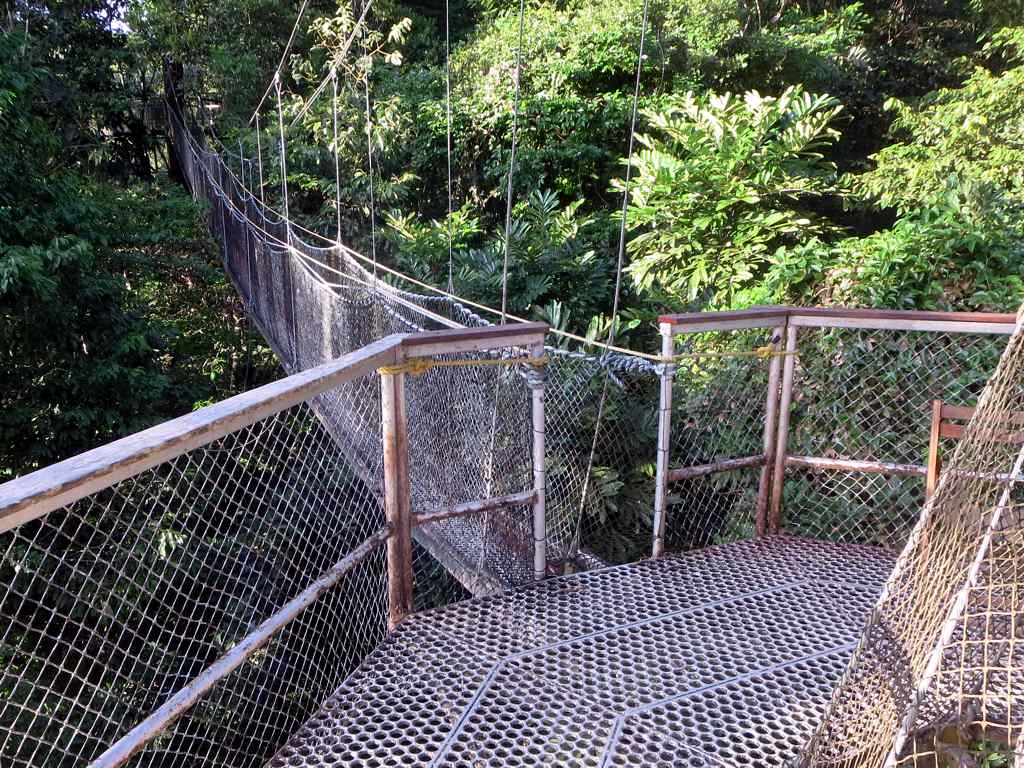
The proportions first: 83,000 sq mi (215,000 km²) of country, about 800,000 people, roughly 87% of it forested (among the highest forest-cover percentages on Earth), and a population pressed to the coast — the interior is Indigenous country (9 peoples, about 10% of the population, holding titled lands across the south and west). The interior's organized heart is Iwokrama: 371,000 hectares of rainforest protected under its own 1996 Act as an international center for conservation and sustainable use, straddling the Georgetown–Lethem road at the Essequibo River. Its visitor circuit is the model: the Iwokrama River Lodge at Kurupukari, and at Atta Rainforest Lodge the Canopy Walkway — 154 m of suspension bridge strung between platforms 30 m up in the greenheart canopy (opened 2003), where dawn delivers toucans, macaws and howler monkeys at eye level. Around it, the community-tourism lattice that is Guyana's real innovation: Surama Village (Makushi-run lodge and village tours, the model since the 1970s), Rewa at the Rupununi–Rewa river junction (arapaimas, river otters, harpy eagle nests), Yupukari's Caiman House (black caiman research you join at night), and Karanambu Ranch in the northern Rupununi (the late Diane McTurk's giant otter rehabilitation country, running since 1927 as a ranch and since the 1980s as an ecolodge — otters, giant anteaters on the savannah at dawn, Victoria amazonica lilies in the ponds).
The north coast keeps the wild register too: Shell Beach Protected Area (declared 2011) runs along some 90 miles (145 km) of Atlantic shore in the northwest, where 4 turtle species nest (leatherback, green, hawksbill, olive ridley — nesting roughly March–August, peak April–June) under a community-conservation programme (the GMTCS's decades of beach patrols) — reached by boat from Charity or overland expedition-style, and emphatically not a resort beach (the Atlantic here is brown, the sand shelly, the magic zoological). And Georgetown earns its 2 days outright: St George's Cathedral (1892, an 143-ft wooden Gothic giant, among the tallest wooden churches in the world), the Stabroek Market's 1880s iron clock tower (visited in daylight, in company, per this guide's safety notes), the Walter Roth Museum of Anthropology's Indigenous collections, the National Museum, the Promenade Gardens, the seawall promenade at dusk, and the new Demerara Harbour Bridge (opened October 2025, replacing the 1978 floating bridge) — the oil-boom capital rebuilding itself in real time, moderated by wooden gingerbread houses on every shaded avenue.
Picture the place
Dawn on the Iwokrama walkway: mist below the platform, a channel-billed toucan planing across the gap at eye level, and the forest — unbroken to every horizon — making its morning noise.
The easily missed detail
Guyana's community lodges are not a marketing style; they are the land system. Villages like Surama and Rewa hold title to their lands, set their visitor terms, staff the lodges with their own people and rotate the work — your fees are village revenue, your guide is a shareholder, and the jaguar on the road is a neighbour whose cattle-conflict politics your visit helps pay to solve. The second detail is scale discipline: Guyana's sights are separated by expedition distances (the Rupununi begins 300+ km and a river crossing from the capital), and the traveler who tries to "also do" Shell Beach in a week sees the country through a windscreen. Pick the interior OR the northwest per trip; Guyana rewards the second visit it creates.
A practical rhythm
- Iwokrama arc — River Lodge 2 nights + Atta 2 nights: the rainforest in 2 registers (river and canopy)
- Rupununi tail — Surama and Karanambu by the Lethem road's logic, ending with the flight out from Lethem
- Georgetown bookends — The wooden city at arrival and departure, never as the trip's middle
What could complicate the plan
Distances and seasons govern everything: the Linden–Lethem road is part-paved, part-laterite (the Kurupukari Essequibo crossing is a barge ferry whose queues and water levels set your day; dry season ~10–12 hours Georgetown–Lethem, wet season longer or impossible in stretches), and the Rupununi's wet-season flooding (May–August) inverts access — boats reach lodges the road can't, and vice versa. Book the interior as an operator-run circuit (Wilderness Explorers and the lodges' own transfers) rather than a self-drive fantasy. Safety runs in 2 registers: the interior is village calm, Georgetown is the Level 3 advisory's subject (hotel-arranged transport, daylight markets, no night wandering, no visible valuables) — hold both truths at once. Turtle season and nesting-beach rules (no lights, no flash, GMTCS guides only on the sand at night) bind March–August visits; lodge minimum stays (2–3 nights) and weekly flight patterns bind every month. The Essequibo dispute (Venezuela's claim to the western two-thirds, before the ICJ, inflamed by a December 2023 Venezuelan referendum) is politically loud and practically quiet for travelers in the tourism circuit — but it explains military visibility in the northwest and the occasional headline; check current advice before any border-region travel, and never cross into the disputed zone's river mouths without local guidance.
What to do next
Book an Iwokrama–Rupununi lodge circuit of 8–10 nights for September–October, Georgetown nights at both ends, and Shell Beach for the second trip in turtle season.
Sources
- Iwokrama International Centre — the reserve (371,000 ha, Iwokrama Act 1996); the Canopy Walkway at Atta (154 m long, 4 platforms 30 m up, opened 2003)
- Guyana Protected Areas Commission — Shell Beach Protected Area (2011; about 145 km of coast; 4 nesting turtle species, March–August)
- Community tourism record — Surama, Rewa and Yupukari/Caiman House (village-owned lodges); Karanambu Ranch (from 1927; giant otter rehabilitation)
- Georgetown record — St George's Cathedral (1892); Stabroek Market (1880s); the Demerara Harbour Bridge (opened October 2025)