Guyana country guide When to visit
When is the best time to visit Guyana for Kaieteur Falls?
The short answer
September — the opening of the long dry season, when the Potaro still runs full from the May–August rains, the Ogle flights cancel least, and Guyana's interior roads, savannah and rivers are all passable at once.
The answer, with local context
Guyana's calendar has 4 seasons, and the country runs 2 climates inside them. The Guyana Hydrometeorological Service's pattern: 2 wet seasons (the long rains, May to mid-August — Georgetown can take over 300 mm in June alone; and the short rains, mid-November to January) alternate with 2 dry seasons (February–April, and the longer, drier mid-August–November window, with September and October the driest months of the year). The interior complicates the map usefully: the Rupununi savannah takes essentially 1 long wet season (May–August, when it floods into shallow lakes) and is dry the rest of the year, while the rainforest belt stays wet enough in every month to deserve its name. September is the single month where everything overlaps kindly: the falls still carry the long rains' charge (Kaieteur's flow at its wet-season peak runs to the Protected Areas Commission's estimated maximum of 663 m³/s), the trails at the rim are firm, the Georgetown–Linden–Lethem road's unpaved stretches are at their hardest, Rupununi wildlife concentrates at shrinking water, and the flights operate on their most reliable behaviour of the year. Temperatures barely vote: 82–90°F (28–32°C) all year.
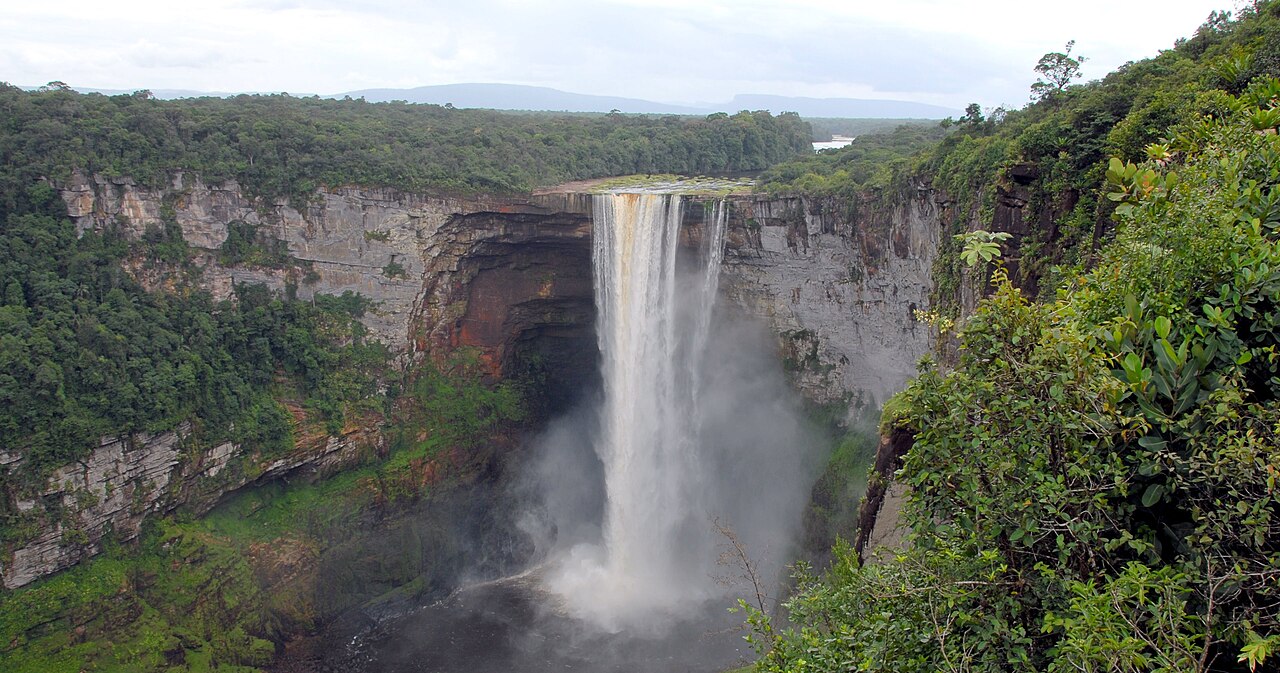
The anchor's published facts: Kaieteur Falls drops 741 ft (226 m) in a single leap from a width of about 371 ft (113 m) — among the most powerful single-drop waterfalls on Earth — into the gorge of the Potaro River, inside Kaieteur National Park, established in 1929 (among South America's oldest protected areas) and expanded in 1999 to the Protected Areas Commission's 62,700 hectares of unbroken Guiana Shield rainforest. The visit's published structure: day trips fly about 1 hour by Cessna from Georgetown's Ogle Airport (OGL) to the park airstrip, give roughly 2 hours on the ground across 3 rim viewpoints (Rainbow View, Boy Scout View, Johnson View) with a park guide, and cost US$270–395 per person as listed by operators in October 2026 (the price covers the round-trip flight, the guided walk and the park entrance fee, about US$35 of it) — with a hard 20 lb (9 kg) baggage limit on the Cessna. Reservations run 3–5 days ahead, and visits are weather-conditional: the strip is grass-and-gravel under a jungle sky. Entry to Guyana itself: the U.S. State Department records no visa required for stays of 90 days or less — and holds the country at Level 3 (Reconsider Travel) for crime (advisory reissued August 26, 2026), a tension this guide's planning answer addresses head-on.
Picture the place
Johnson View at 11 a.m.: the Potaro arriving flat and black, stepping off the cliff in 1 white sheet 741 ft tall, spray rising to meet you, and the gorge's swifts stitching in and out of the mist below your boots.
The easily missed detail
There are no guardrails. Kaieteur's rim viewpoints are bare rock ledges at the lip of the drop — you stand within meters of where the river leaves the world, guided, careful, and entirely trusted — a rawness no other falls of this class still offers, and the reason the guide's word is law on the rim. The second detail lives in the bromeliads at your feet: the giant tank bromeliads around the falls host the tiny golden rocket frog, found almost nowhere else, and the rock behind the curtain of water shelters the nests of white-collared swifts and the cave-dwelling guácharo-like swifts whose dusk flights are the falls' evening show. Look down, then look behind the water.
A practical rhythm
- September weekdays — Day-trip seats are easiest Tuesday–Thursday; weekends carry the diaspora's family trips
- Kaieteur + Orinduik combo — The 2-falls day (Orinduik's jasper terraces on the Ireng) when offered
- A spare day after — Interior flights everywhere in Guyana deserve a buffer day in Georgetown
What could complicate the plan
The honest headline is the advisory: Level 3 (Reconsider Travel) for crime — violent crime concentrated in Georgetown and at night, local police thinly resourced, and the State Department bars its own employees from Stabroek Market at all times and Bourda Market after dark (the UK's FCDO, notably, publishes no advice against travel — the traveler weighs both). The working system that travelers actually use: reputable operators and hotels, airport transfers arranged, no wandering at night, cash discreet — and the interior lodges (Iwokrama, Surama, Karanambu) operate in a different, calmer world entirely. The falls themselves impose their own: flights cancel for weather (September minimises, not eliminates), the rim is unfenced (children and vertigo are disqualifying mixes), and park visitation rules are the Patamona-informed Protected Areas Commission's — no ash-scattering, no extreme sports, guides mandatory on the trail circuit. Flow runs the other seasonality trap: come in deep dry season (March–April) and Kaieteur is at its most accessible but thinnest; come in June and it's at maximum thunder but your plane may not land — September is the negotiated peace. Malaria (interior regions) and yellow fever vaccination paperwork (certificate required if arriving from a risk country; vaccination recommended regardless) complete the medical prep, alongside Georgetown's wet-season street flooding, which September spares you.
What to do next
Book a September Kaieteur day trip with a licensed operator (Air Services Limited, Evergreen or Wilderness Explorers) 3–5 days out, and keep the following day unplanned in Georgetown.
Sources
- Guyana Protected Areas Commission — Kaieteur National Park (established 1929; expanded 1999 to 62,700 ha); the falls (741 ft / 226 m single drop; estimated maximum flow 663 m³/s); about 8,000 visitors a year; Patamona co-management input
- Guyana Hydrometeorological Service / Bureau of Statistics — the 2 wet and 2 dry seasons; September–October driest; Georgetown about 2,280 mm a year
- U.S. Department of State, Guyana (advisory August 26, 2026; Level 3, crime) — no visa required for 90 days or less; market restrictions for U.S. personnel
- Licensed operators' published day trips (October 2026) — US$270–395 per person covering flights, guided walk and park fee; 20 lb baggage limit; Ogle departures