India country guide When to visit
When is the best time to visit India for Jaipur?
The short answer
November through February — the India Meteorological Department's Jaipur figures give December a mean maximum of 76°F (24.4°C) against May's 105°F (40.5°C), and November averages well under a quarter inch of rain for the whole month.
The answer, with local context
India is not one climate, and the national picture decides the shape of a trip before Jaipur does. The country runs from high Himalaya to equatorial coast, and the southwest monsoon crosses it from south to north over roughly three months, so the same calendar month means opposite things in Kerala and in Rajasthan. The broad rule that holds nationally is that the October-to-March half of the year is dry and mild across the northern plains, hot and humid in the far south, and closed or snowbound in the high Himalaya, while June to September is monsoon season almost everywhere except Ladakh and the rain-shadow interior.
Jaipur sits in semi-arid Rajasthan, and the IMD's records make the seasonal swing stark. January is the coldest month, with a mean minimum of 46°F (7.8°C) and a mean maximum of 73°F (22.5°C). February rises to 78°F (25.7°C), March to 89°F (31.5°C), April to 99°F (37.2°C). May is the hottest month at a mean maximum of 105°F (40.5°C) and a mean minimum of 82°F (27.5°C) — nights that never cool down. June holds at 103°F (39.3°C) before the rain arrives.
The rain is concentrated and short. Jaipur's average annual total is 633 millimeters, about 24.9 inches, and the June-to-September monsoon delivers 555.8 millimeters of it — roughly 88 percent of the year's rain in four months. July alone averages 221 millimeters (8.7 inches) and August 195 millimeters (7.7 inches). The IMD puts the normal monsoon onset over Jaipur at about 25 June, with the earliest recorded onset on 16 June 2008 and the latest on 11 July 2006, and normal withdrawal at about 15 September with a variability of around nine days. October drops to 25 millimeters and November to 3.9 millimeters, which is why the cool season is also the clear season.
Picture the place
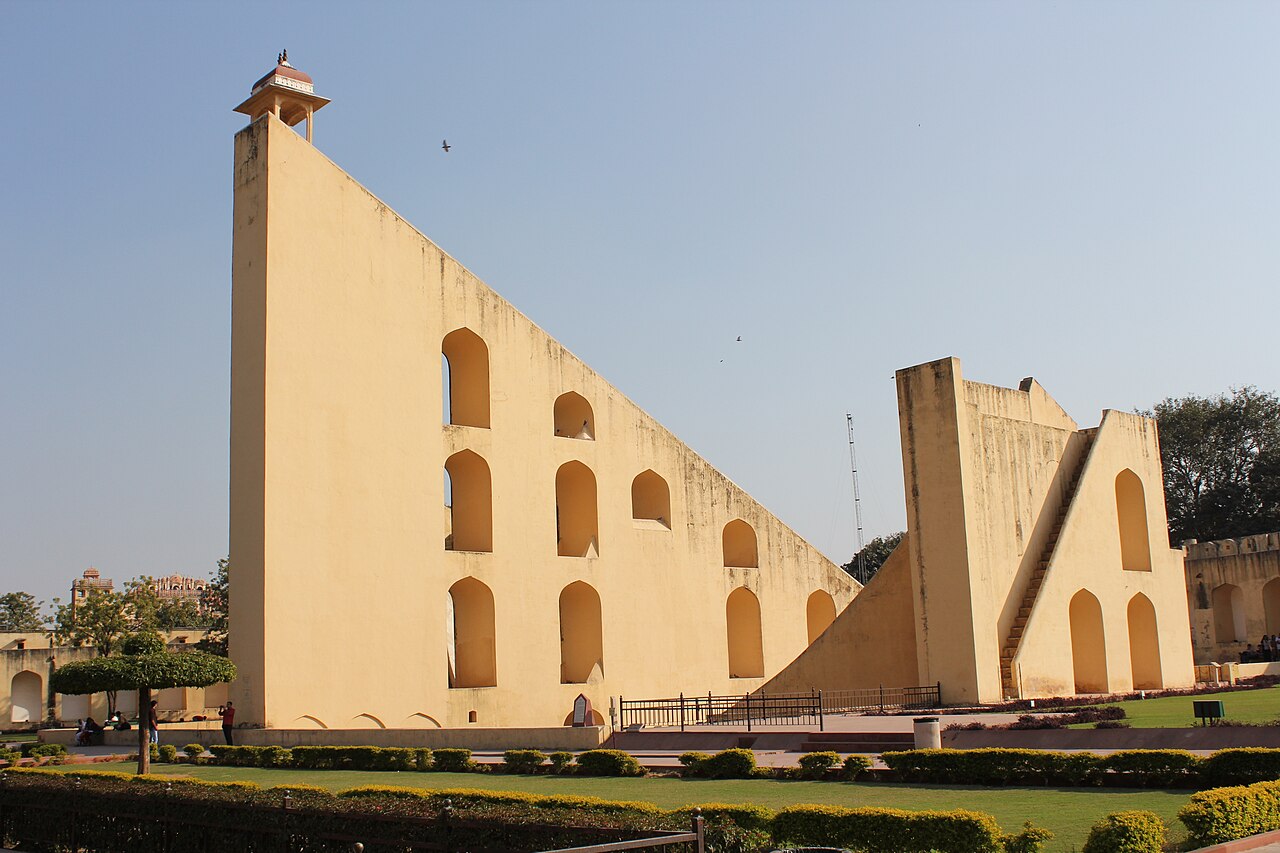
By late November the heat has gone out of the sandstone and the dust that hangs over the Aravalli foothills through May has largely settled. Mean maxima in the mid-70s Fahrenheit make the long walk along a bazaar avenue possible at midday rather than something to postpone until evening, and the low mornings — minima near the high 50s in November, falling to 46°F in January — mean an early start at an open-air observatory is genuinely cold.
The easily missed detail
Jaipur carries two separate UNESCO World Heritage inscriptions, and they reward different hours of the day. The Jantar Mantar was inscribed in 2010 at the 34th session of the World Heritage Committee under criteria (iii) and (iv), described by the Committee as the most significant and best preserved set of fixed monumental astronomical instruments built in India in the first half of the 18th century, with some instruments the largest of their kind ever constructed. Those instruments are sundials: they are read by shadow, so a clear sky in the cool season does far more for a visit than a comfortable temperature does. Jaipur City itself was inscribed separately in 2019 at the 43rd session under criteria (ii), (iv) and (vi) — built in a single phase on a grid-iron layout drawn from the Prastara plan of the Vastu Shastra, commissioned by Sawai Raja Jai Singh II, who ruled from 1700 to 1743, with the core public and royal spaces completed between 1727 and 1731 by the architect-planner Vidyadhar. India holds 44 properties on the World Heritage List in total.
A practical rhythm
- November to February — Mean maxima from 76°F down to 73°F and almost no rain. The only window in which the full walled city, the chaupars and the Jantar Mantar are comfortable on foot in the middle of the day.
- March and April — Still dry, mean maxima climbing from 89°F to 99°F. Workable if you keep to mornings and late afternoons.
- July to September — 8.7 inches of rain in July alone, but mean maxima fall to 94°F and 90°F, and the Aravalli hills turn green. The trade-off is heavy downpours and humidity.
What could complicate the plan
Entry rules decide more than weather. The US Department of State states that a visa is required for India and that travelers must enter with a visa in their passport; visas issued to US citizens are valid for 10 years. The passport must be valid for six months beyond the date of the visa application, with two blank pages. Short tourist stays of under 60 days may instead use the electronic travel authorization, which must be submitted at least four days before arrival. The State Department advises travelers to exercise increased caution in India due to crime and terrorism, with Level 4 — Do Not Travel applying to named regions including Jammu and Kashmir and the India–Pakistan border area. The CDC lists India among the destinations in its Global Measles travel health notice, Level 1 — Practice Usual Precautions, dated 28 May 2025.
What to do next
The India trip-planning question in this group works through visa timing and internal distances; the places-and-experiences question covers what else in the country is worth the cool-season weeks you have.
Sources
- India Meteorological Department, Jaipur, Climate of Jaipur — monthly mean maximum and minimum temperatures, annual and monthly rainfall, monsoon onset and withdrawal dates
- UNESCO World Heritage Committee, Decision 34 COM 8B.17 — Jantar Mantar inscription year, criteria and statement of value
- UNESCO World Heritage Committee, Decision 43 COM 8B.16 — Jaipur City inscription year, criteria, grid plan, Jai Singh II dates, construction period
- UNESCO World Heritage Centre, States Parties statistics — India's total of 44 inscribed properties
- US Department of State, India country information — visa requirement and validity, passport validity, e-Visa deadline, advisory wording
- US Centers for Disease Control and Prevention, Travel Health Notices — Global Measles notice level and date