Israel country guide Food and drink
What local dishes should I try in Israel, and where should I look for them?
The short answer
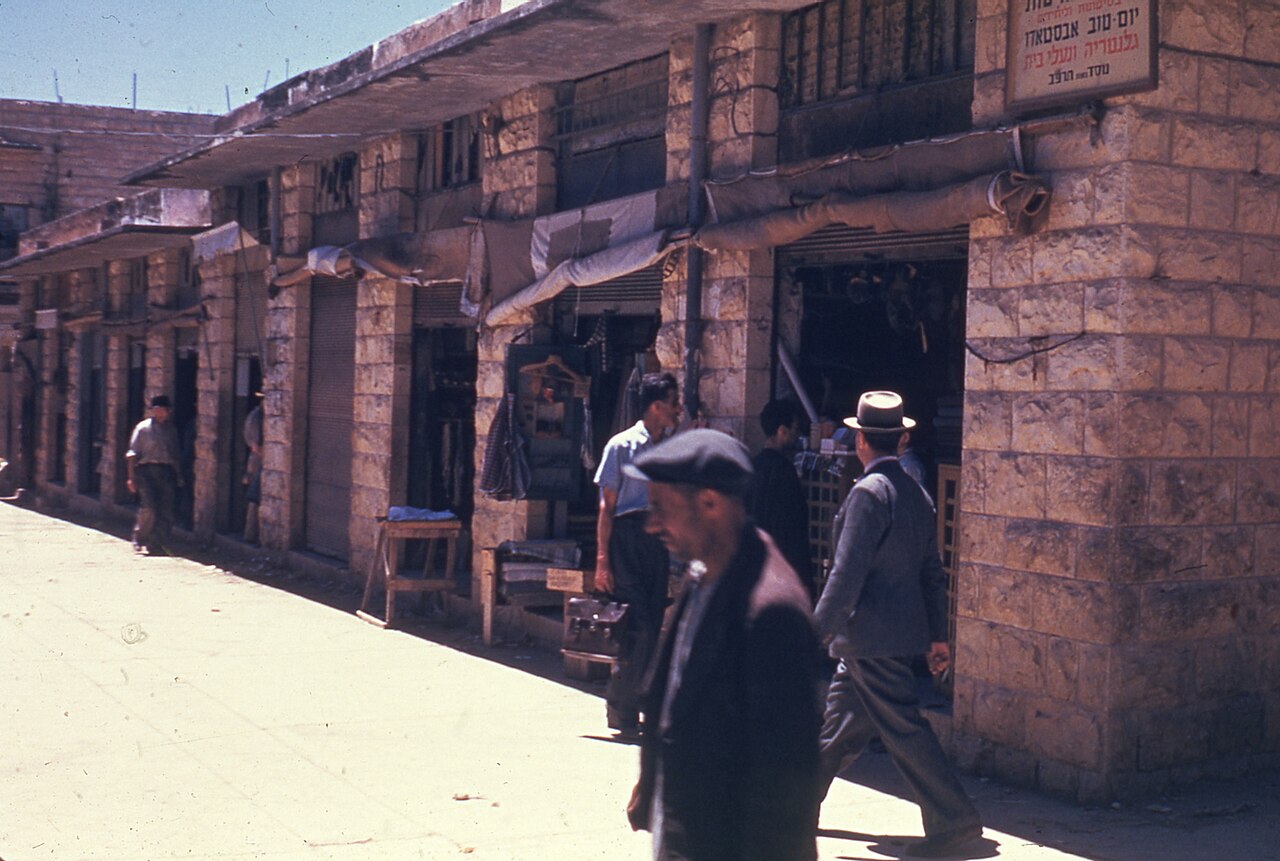
Build the eating around markets rather than restaurants, starting with Mahane Yehuda in Jerusalem — an alley market whose stalls and shopfronts are documented in photographs going back to the 1948 siege of the city, held in the National Library of Israel's Pritzker Family National Photography Collection.
The answer, with local context
Israel's food reflects a population assembled from many places within a single lifetime, and the market is where that shows most clearly. Mahane Yehuda's lanes — one of them now Hashaked Street — were already a working retail market with named tradesmen's shopfronts in February 1948, during the siege of Jerusalem, and the market has stayed in the same alleys since. That continuity is why it reads as a neighborhood institution rather than a food hall.
The coastal and northern markets offer a different range again. Acre's old city, a major Crusader port until 1291 and today a place with a mixed population, has markets shaped by that mix, and its position on the Mediterranean puts fish at the center of the menu rather than at the edge of it. Inland and southward, the register changes once more as the country drops from the Judean hills into desert — the Negev's historic trade role is recognized in the UNESCO inscription of the Incense Route and its desert cities, and spice remains a thread through the cooking of the south.
Geography sets the calendar. Israel's rain falls in the winter half of the year and effectively stops for the summer, which concentrates the fresh produce year into a sharp spring and a long, hot growing season. In the rift valley the heat is extreme: the Dead Sea basin lies nearly 400 meters (1,300 feet) below sea level, and evaporation there can lower the lake surface 2 to 3 centimeters in a single hot summer day.
Picture the place
Mahane Yehuda is a grid of narrow alleys rather than a hall, with produce stacked at waist height on both sides and almost no space to step aside. The 1948 photographs show the same geometry — stalls, corner shopfronts and signage — in lanes that are still recognizable.
The easily missed detail
The market's rhythm is set by the week, not the day. Friday afternoons before the start of Shabbat are the market's busiest and most intense hours and the point at which stalls begin closing; by Saturday the surrounding commercial life in Jerusalem largely stops. Planning market visits for a Thursday or an early Friday — and not for a Saturday — is the single most useful scheduling decision an eating-focused trip in Jerusalem can make.
A practical rhythm
- Jerusalem — Mahane Yehuda's alleys, in continuous use as a market since at least the 1940s, best on a weekday or early Friday.
- Acre — Mediterranean fish and the mixed culinary inheritance of a city that was a Crusader stronghold until 1291.
- The Negev — The spice and desert-trade thread, in the landscape of the inscribed Incense Route.
What could complicate the plan
Israeli public holidays and Shabbat both close businesses and can close crossings; the FCDO advises allowing extra time during Israeli holidays and the summer tourist season, and notes that West Bank checkpoints may close on Israeli public holidays. Entry requires an Electronic Travel Authorisation, in force since 1 January 2025, costing 25 NIS and valid for two years for stays of up to 90 days, with the passport expiring at least 90 days after arrival. The FCDO advises against all travel to parts of Israel and against all but essential travel to other parts, which affects which regional markets are reachable.
What to do next
The Israel places-and-experiences question lists the nine World Heritage properties that frame those market cities; the when-to-visit question sets out the seasonal split that governs the produce year.
Sources
- National Library of Israel, Meitar Collection, Pritzker Family National Photography Collection, via Wikimedia Commons — photograph of a Mahane Yehuda market alley during the 1948 siege of Jerusalem, dated 2 February 1948, with the street now named Hashaked
- UNESCO World Heritage List, properties in Israel — Incense Route desert cities and Old City of Acre inscriptions
- UK Foreign, Commonwealth and Development Office, Israel entry requirements — ETA terms, passport rule, holiday closures and delays, advice-against-travel areas
- NASA Earth Observatory, Dead Sea — rift valley elevation and summer evaporation rate