Israel country guide When to visit
When is the best time to visit Israel for Jerusalem Old City?
The short answer
March to May or late September to November — Israel's rain falls almost entirely in the winter half of the year, and the Old City is a place you cross on foot between four religious quarters, which makes the shoulder months the only ones that suit both the weather and the walking.
The answer, with local context
Israel is small but climatically layered, and the layers run by elevation rather than by latitude. Jerusalem stands on the Judean watershed, high enough that its winters are markedly colder and wetter than the Mediterranean coast's, and that snow falls there in some years. The Dead Sea basin, barely an hour away, lies nearly 400 meters (1,300 feet) below sea level — the lowest surface feature on Earth — where evaporation alone can drop the lake's surface by 2 to 3 centimeters on a hot summer day. The same week can therefore be mild in the hills, warm on the coast and punishing in the rift valley.
The rainfall pattern is the one thing that holds across the country: a dry summer and a wet winter, with precipitation concentrated between late autumn and early spring and effectively absent in the summer months. For the Old City that matters less for comfort than for footing — its lanes are stone, often stepped, and worn smooth by centuries of use.
The spring and autumn shoulders also sit between Israel's major religious holiday clusters, which is the more useful framing. Israeli public holidays close offices and can close crossings, and the FCDO notes that West Bank checkpoints may shut on Israeli public holidays and that extra time should be allowed during Israeli holidays and the summer tourist season.
Picture the place
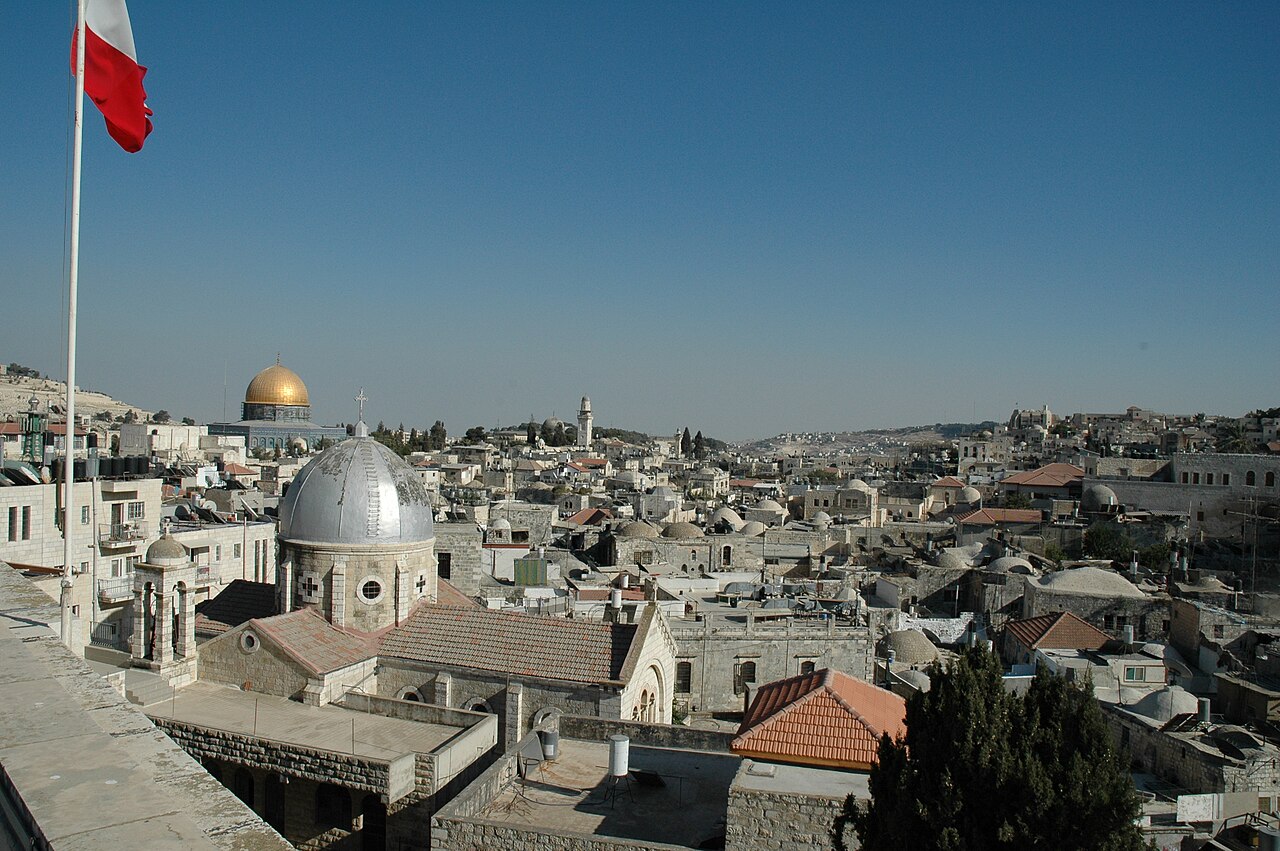
The Old City covers less than a square kilometer inside a ring of walls, and the gradient inside it is real — the ground falls away eastward toward the Kidron Valley, so a crossing between quarters is rarely level. The stone holds heat late in the day in September and stays cold in the shaded lanes well into the spring mornings.
The easily missed detail
The Old City of Jerusalem and its Walls was added to the World Heritage List in 1981, on a nomination proposed by Jordan, under criteria (ii), (iii) and (vi) — and it has been on the List of World Heritage in Danger continuously since 1982. It is one of very few properties anywhere to have spent its entire listed life in danger status. The practical consequence for a visitor is that the site is managed under contested and closely watched conditions: access to individual holy places is governed by religious authorities rather than by a single site operator, hours differ between the quarters, and prayer times rather than opening times determine when parts of it are open to visitors.
A practical rhythm
- March to May — Dry weather arriving, hill temperatures moderate, before the summer tourist season the FCDO flags for delays.
- Late September to November — The dry season's tail. The best pairing with a Dead Sea day, since the rift valley's summer heat has broken.
- December to February — Israel's wet months. Stone lanes are slick, and the Judean hills are at their coldest.
What could complicate the plan
Entry now requires an Electronic Travel Authorisation, in force since 1 January 2025, costing 25 NIS, valid for two years and covering stays of up to 90 days, applied for through the Israel Population and Immigration Authority. Tourists do not need a visa, and entry permission is granted for up to three months. The passport must expire at least 90 days after the arrival date. At Ben Gurion Airport travelers receive an entry card rather than a passport stamp, and it must be kept until departure. The FCDO advises against all travel to parts of Israel and against all but essential travel to other parts, and it reports that the Erez crossing is currently closed and that Rafah closes without warning. Lengthy questioning and searches at entry are possible, and some travelers are refused entry.
What to do next
The Israel places-and-experiences question in this group covers what else among the country's nine World Heritage properties is worth the trip; the trip-planning question deals with the ETA, crossings and holiday closures in detail.
Sources
- UNESCO World Heritage Centre documentation, Old City of Jerusalem and its Walls — 1981 inscription, nomination proposed by Jordan, criteria (ii), (iii) and (vi), Danger listing from 1982 to the present
- UK Foreign, Commonwealth and Development Office, Israel entry requirements — ETA requirement, fee, validity, passport rule, entry card, crossing status, holiday and season delays, advice-against-travel areas
- NASA Earth Observatory, Dead Sea — elevation below sea level, status as the lowest surface feature on Earth, summer evaporation rate