Japan country guide When to visit
When is the best time to visit Japan for Kyoto?
The short answer
Late March to mid-April, or the second half of November — the Japan Meteorological Agency's observations put Kyoto's average cherry flowering date at 26 March and average full bloom at 4 April, and both windows sit outside the baiu rainy season, which the JMA dates in the Kinki region from about 6 June to about 19 July.
The answer, with local context
Japan's climate runs the length of a 1,900-mile archipelago, and the single most useful national framework is the baiu — the early-summer rainy season that sweeps north across the country. The JMA's 1991–2020 averages have it reaching Okinawa around 10 May and ending there about 21 June; arriving in southern Kyushu about 30 May; in Kinki, which includes Kyoto, about 6 June, ending about 19 July; and in northern Tohoku about 15 June, ending about 28 July. Hokkaido is the one region the rainy season does not affect, which is why a late-June trip to Japan can mean six weeks of cloud in Kyoto and clear weather in Sapporo.
Kyoto's own calendar is built around two short, famous and precisely observed events. The flowering of the Somei-Yoshino cherry, the variety the JMA uses for its official observations in most regions, averages 26 March in Kyoto, with full bloom averaging 4 April — a nine-day gap between the two that is the practical length of the blossom window. Autumn color in the city's temple gardens peaks considerably later, in the second half of November, after the baiu and the typhoon season are both finished.
Between those, July and August are hot and humid in a basin city ringed by hills, and the baiu's end in mid-July runs straight into the hottest part of the year rather than relieving it.
Picture the place
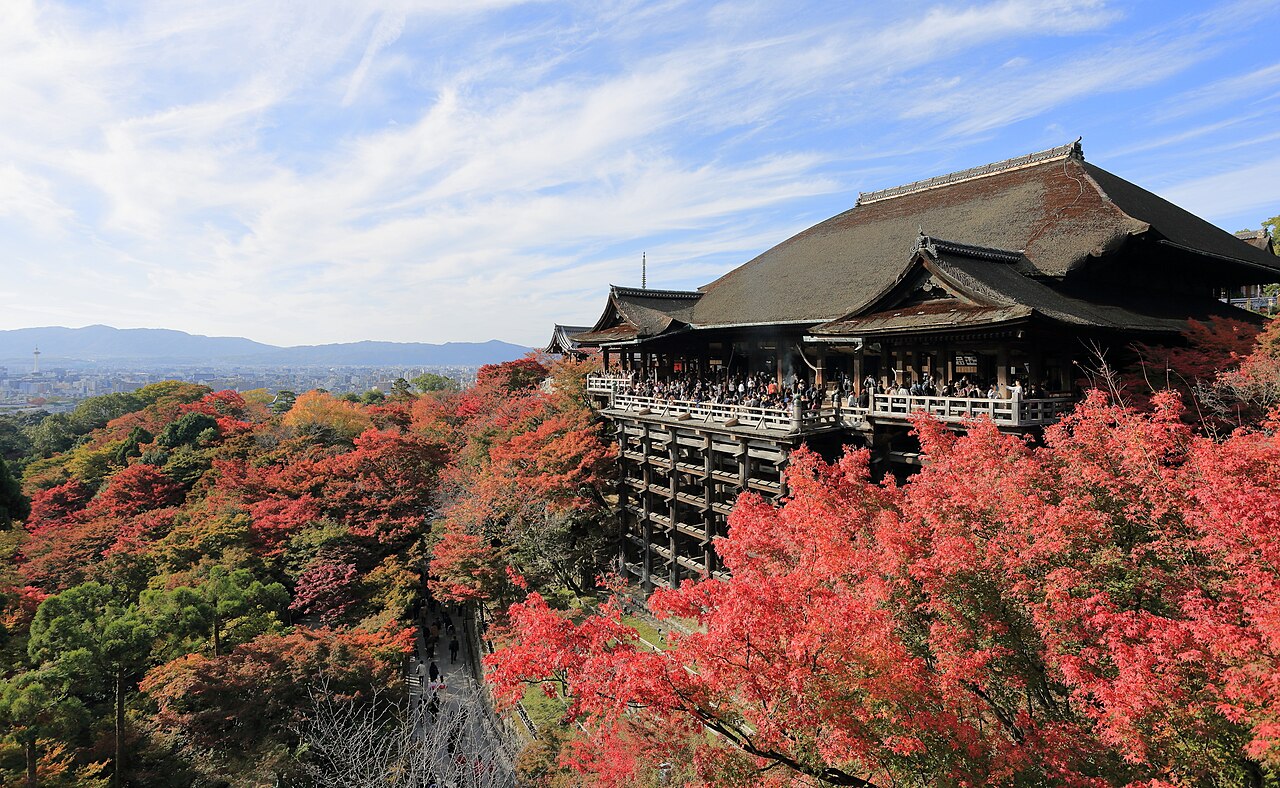
Kyoto sits in a basin closed on three sides by hills, which is why its summers hold heat and its winters hold cold. Kiyomizu-dera's main hall is built out from the eastern hillside on a timber platform, so the view from it in the second half of November looks down onto maple canopy rather than across at it.
The easily missed detail
Kyoto's accommodation tax changed substantially in March 2026, and it is charged per person per night on the room rate including service charges. The bands set by Kyoto City are 200 yen for a room rate under 6,000 yen, 400 yen from 6,000 to 19,999 yen, 1,000 yen from 20,000 to 49,999 yen, 4,000 yen from 50,000 to 99,999 yen, and 10,000 yen at 100,000 yen and above. The top two bands rose sharply — from 1,000 yen to 4,000 and 10,000 yen respectively — so a high-end stay during blossom week now carries a materially different tax bill than it did in February 2026.
The other detail worth knowing before you choose dates: the UNESCO property here is not one temple but seventeen. The Historic Monuments of Ancient Kyoto comprises 17 component parts — 16 religious establishments plus Nijo-jo castle — inscribed in 1994 under criteria (ii) and (iv). UNESCO notes the city was built in A.D. 794 on the model of the capitals of ancient China and served as Japan's imperial capital until the mid-19th century. The components are spread across Kyoto, Uji and Otsu, which is a travel question, not a walking one.
A practical rhythm
- Late March to mid-April — Average flowering 26 March, average full bloom 4 April. The shortest and most crowded window of the Japanese year.
- Second half of November — Autumn color at the hillside temples, with the rainy season and typhoon season both past.
- Avoid early June to mid-July — The baiu in Kinki runs from about 6 June to about 19 July, and it is a cloudy, rainy stretch rather than a few wet days.
What could complicate the plan
Blossom dates are averages, and the nine-day spread between average flowering and average full bloom in Kyoto means a trip booked to the day can miss the peak in either direction. Japan sits at Level 1 — Exercise normal precautions in the US Department of State's advisory, issued 15 May 2025, and Japan is listed among the destinations in the CDC's Global Measles travel health notice at Level 1 — Practice Usual Precautions, dated 28 May 2025. US citizens need no visa for tourist or business stays of up to 90 days but must show proof of a return or onward ticket, and airlines may deny boarding if the passport has less than six months of validity. An International Tourist Tax of 3,000 yen is payable on departure from Japan by aircraft or ship, regardless of purpose or nationality.
What to do next
The Japan trip-planning question in this group covers rail pass pricing and how far the 17 inscribed Kyoto components are from one another; the places-and-experiences question looks beyond Kyoto entirely.
Sources
- Japan Meteorological Agency, Baiu season information — 1991–2020 average baiu onset and withdrawal dates by region, including Kinki
- Japan Weather Association (tenki.jp), Kyoto cherry blossom page, based on JMA observations — average flowering and full-bloom dates for Kyoto and the Somei-Yoshino observation variety
- UNESCO World Heritage Centre, Historic Monuments of Ancient Kyoto — 17 component parts, 16 religious establishments plus Nijo-jo castle, criteria (ii) and (iv), A.D. 794 foundation
- Kyoto City accommodation tax bands effective March 2026, as published to guests — pre- and post-revision tax amounts and room-rate thresholds
- US Department of State, Japan travel advisory — advisory level and date, 90-day visa-free stay, onward ticket and passport conditions
- National Tax Agency of Japan — International Tourist Tax amount and scope
- US Centers for Disease Control and Prevention, Travel Health Notices — Global Measles notice level and date