Kenya country guide Places and experiences
What should a first-time traveler see in Kenya beyond the obvious highlights?
The short answer
Explore the flamingo lakes of the Great Rift Valley, watch elephants in Amboseli National Park, and discover the high-altitude landscapes of Mount Kenya for three experiences that differ from the Maasai Mara's savanna.
The answer, with local context
Kenya's Great Rift Valley contains internationally significant wetland ecosystems. UNESCO inscribed the Kenya Lake System in the Great Rift Valley in 2011, under natural criteria (vii), (ix), and (x). The property includes Lake Bogoria, Lake Nakuru, and Lake Elementaita, together covering 32,034 hectares. The lakes occupy a geologically active landscape shaped by tectonic and volcanic processes.
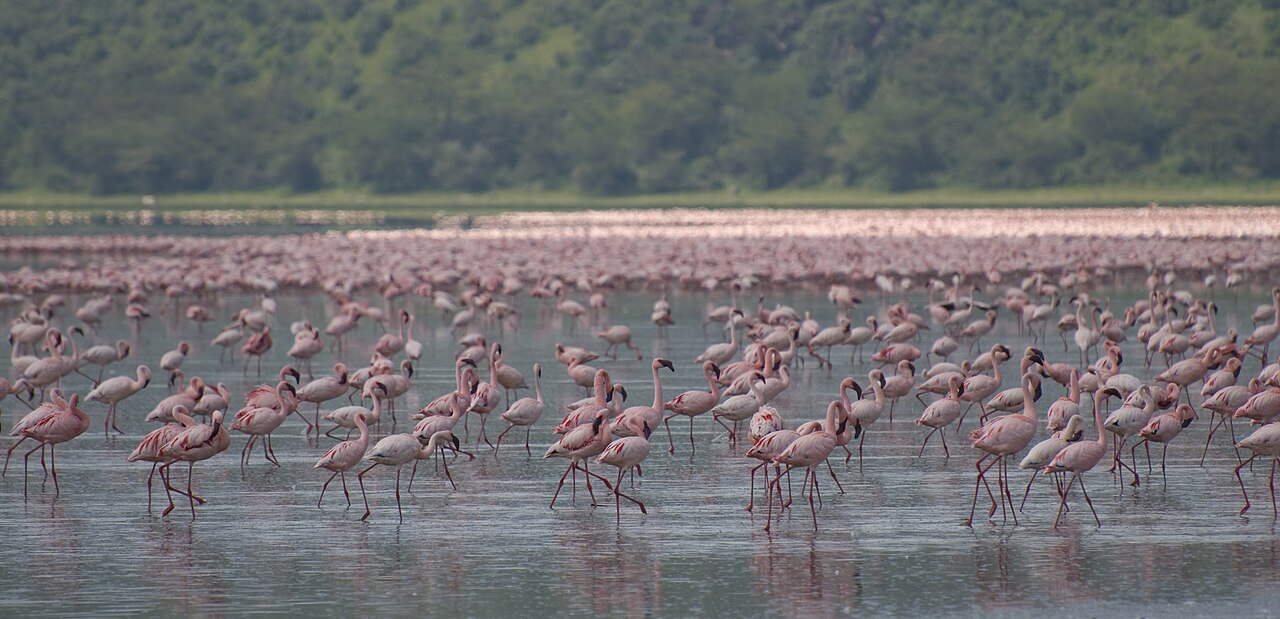
The system is particularly important for birds. UNESCO identifies 13 globally threatened bird species and more than 100 migratory bird species associated with the property. The lakes are internationally significant for lesser flamingos and great white pelicans. Lake Nakuru's surrounding protected landscape also supports rhinoceroses, giraffes, lions, and other mammals.
Amboseli National Park offers a different wildlife setting in southern Kenya. Kenya Wildlife Service identifies elephants as a major attraction and publishes 6 a.m.–6 p.m. gate hours for ordinary daytime access. The park's rules specify a 40 km/h (25 mph) speed limit, prohibit off-road driving, and instruct visitors to keep at least 20 meters (66 feet) from wildlife.
The currently published nonresident adult entry price is US$90, covering park admission rather than accommodation, vehicles, or commercial safari services. The nonresident child rate is US$45. Amboseli's open plains, swamps, and the backdrop of Mount Kilimanjaro in neighboring Tanzania create a distinctly different wildlife landscape from the forested slopes of central Kenya.
Mount Kenya National Park/Natural Forest provides the mountain alternative. UNESCO first inscribed the property in 1997, with a significant boundary extension in 2013 and a further minor modification in 2026. The current listing applies criteria (vii) and (ix). The protected environment includes alpine and subalpine ecosystems, volcanic landforms, and distinctive mountain vegetation.
Kenya also has important cultural heritage, including the Sacred Mijikenda Kaya Forests, inscribed in 2008, and Lamu Old Town, inscribed in 2001. These sites deserve historical recognition, but Lamu County is presently included in the U.S. State Department's Level 4: Do Not Travel areas. It should be presented as a heritage-reference destination, not an ordinary itinerary recommendation.
Picture the place
The Rift Valley lakes sit among escarpments and volcanic terrain. Amboseli's elephants move across open plains and wetlands beneath Kilimanjaro, while Mount Kenya's upper slopes rise into a markedly colder mountain environment.
The easily missed detail
The three UNESCO Rift Valley lakes form one serial World Heritage property, rather than three unrelated listings. Its outstanding value concerns the ecological relationship among the lakes, including movements of flamingos between suitable feeding areas. A visit to one lake cannot be assumed to reproduce the same bird concentrations at all times.
A practical rhythm
First stage — Lake Nakuru: Explore the protected lake landscape and its wildlife by an authorized route.
Second stage — Amboseli: Use an early game drive to observe elephants and wetland habitats.
Third stage — Mount Kenya foothills: Choose an accessible lower-altitude forest or mountain landscape rather than beginning with a technical summit expedition.
What could complicate the plan
The destinations are widely separated, and Mount Kenya's high-altitude conditions require different preparation from a lowland safari. Kenya Wildlife Service prohibits leaving vehicles in undesignated areas inside Amboseli. Wildlife distances, park admissions, and road conditions are operational constraints. The national Level 3 advisory and the Level 4 restricted counties also limit which cultural destinations are appropriate for a general travel guide.
What to do next
develops a manageable route through these regions. explains where the Maasai Mara fits into Kenya's seasonal travel pattern.
Sources
- UNESCO World Heritage Centre, Kenya Lake System in the Great Rift Valley — inscription, criteria, three component lakes, and wildlife.
- UNESCO World Heritage Centre, Mount Kenya National Park/Natural Forest — inscription, subsequent boundary changes, and ecosystems.
- Kenya Wildlife Service, Amboseli National Park — park rules, operating hours, and admission categories.
- U.S. Department of State, Kenya Travel Advisory — regional travel restrictions.
- UNESCO World Heritage Centre, Sacred Mijikenda Kaya Forests — cultural designation and protected heritage.