Laos country guide Food and drink
What local dishes should I try in Laos, and where should I look for them?
The short answer
Laap, the minced-meat salad that is the national dish; tam mak hoong, the fierce padaek papaya salad; and khao piak sen for breakfast — all of it orbiting sticky rice, in the morning markets and night markets where Laos actually cooks.
The answer, with local context
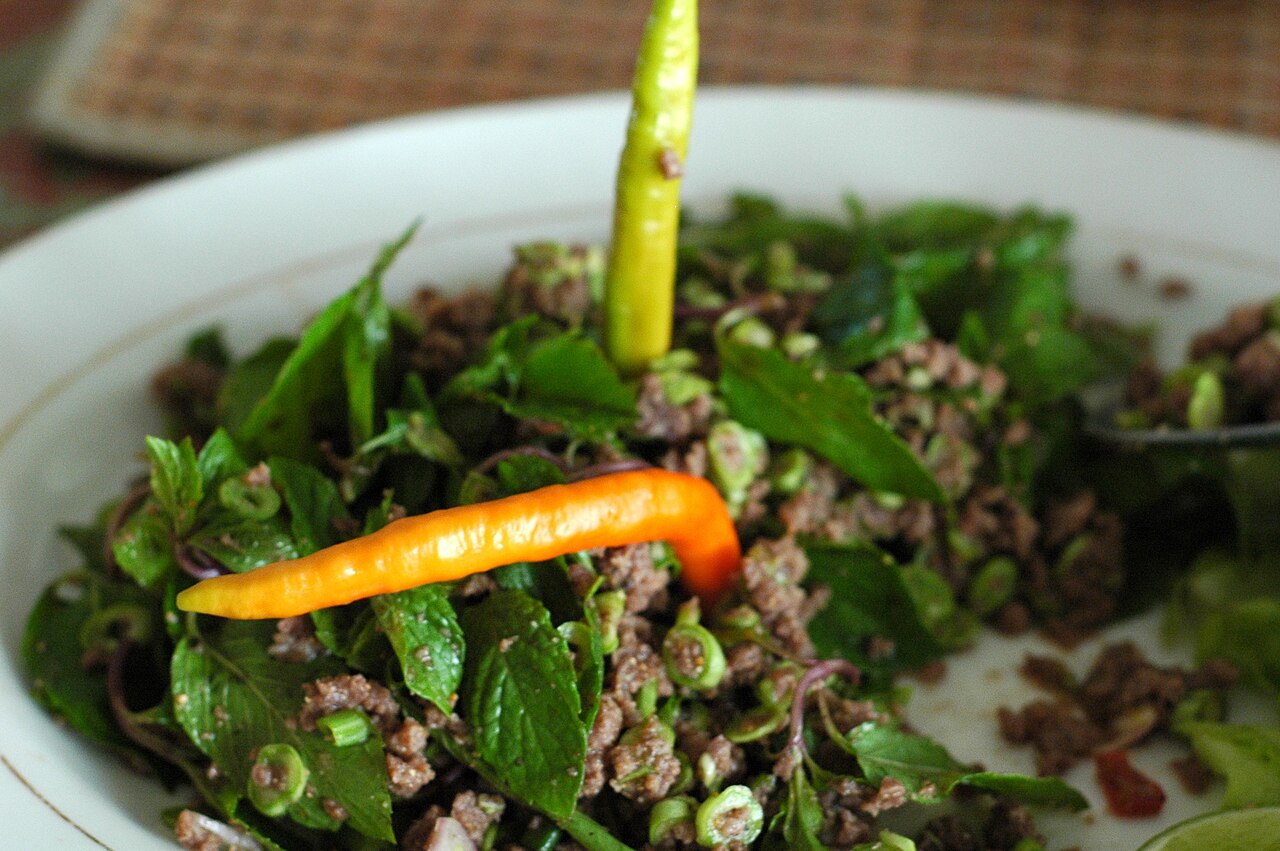
Every Lao meal is built as a system, and the center is not a dish but a basket: khao niao, sticky rice, steamed and served in a woven thip khao basket on a low rattan table, the pha khao. Laos eats more sticky rice per person than any country on Earth — the Lao call themselves luk khao niao, "children of sticky rice" — and the technique is the meal's grammar: pinch a ball of rice with your fingers, and use it to carry every other flavor on the table. The dish it carries first should be laap, also spelled larb: minced pork, chicken, beef, duck or fish tossed warm with lime juice, fish sauce, mint and shallots and bound with khao khua, toasted ground rice that gives the salad its nutty backbone. Laap's name puns on the Lao word for good fortune, which is why it anchors weddings and blessings; order it in a market eatery anywhere in the country and you are eating the national dish in its natural habitat.
Around it, the supporting canon: tam mak hoong, green papaya pounded — tam means to pound — with chili, lime and padaek, the Lao fermented fish sauce that makes this salad deeper and more pungent than Thailand's som tam; in Luang Prabang the papaya is cut in flat strips, a local signature. Khao piak sen is the breakfast bowl — thick, chewy rice-and-tapioca noodles in a clear chicken broth, eaten at dawn stalls across Vientiane and every provincial town. Khao poon, its festival cousin, runs fresh rice noodles — the dough traditionally fermented for three days — through a coconut curry broth to feed a crowd. Mok pa, fish with herbs and chili steamed inside a banana leaf, is the dish to order wherever Mekong fish is the catch of the day.
The drinks and the geography finish the education. Beerlao, brewed by the Lao Brewery Company since 1973, is a national institution poured everywhere; lao-lao, the village rice whisky distilled from sticky rice, is the countryside's stronger welcome. Coffee comes from the Bolaven Plateau in the south, where high-elevation farms around Paksong grow some of the country's most valuable beans — served strong and sweetened with condensed milk, it is the drink of the southern loop's roadside stops. And the French protectorate decades left one edible monument: the baguette, sold from carts in Vientiane and every market town, stuffed as khao jee sandwiches. Where to look is a single rule that works nationally: the morning market is the day's first kitchen — go at seven for noodles and grilled meats; the night market is its last; and in between, the roadside stall with the sticky-rice baskets on every table is the one to trust.
Picture the place
At a Vientiane morning market the steam comes up in columns from the noodle pots, vendors pound papaya to order in mortars taller than their stools, and every plastic table carries the same small woven basket — the meal assembled in the order Laos has always assembled it: rice first, everything else after.
The easily missed detail
Sticky rice explains a menu mystery: dishes that seem underseasoned or ferociously hot in isolation are calibrated for the rice ball that carries them. Laap's lime and chili, tam mak hoong's padaek funk — each is dosed for a bland, chewy mouthful of khao niao between bites. Judge a Lao dish on its own spoonful and you will misjudge it; judge it the Lao way, pinched up with rice, and the seasoning snaps into balance.
A practical rhythm
- Morning — Breakfast where the day starts: khao piak sen at a morning-market stall, with a strong Lao coffee — the combination every provincial town serves from first light.
- Midday — Midday is laap hour: a market eatery or family restaurant, the salad ordered with sticky rice and a plate of raw herbs and vegetables, and a Beerlao if the afternoon allows it.
- Evening — Evenings go to the night markets: tam mak hoong pounded to order, grilled Mekong fish, mok pa in its banana leaf — and in the south, a Bolaven coffee at a Paksong café the next morning to close the loop.
What could complicate the plan
Padaek is an acquired frontier: the fermented fish sauce that defines Lao cooking is unpasteurized and intensely flavored, and the raw-fish and raw-meat versions of laap that appear at village celebrations are dishes travelers should admire rather than eat — order laap cooked, as most restaurants serve it by default. The heat is structural, not incidental: "a little spicy" in a Lao market means something real, and tam mak hoong is the usual place visitors learn it. And the food geography runs on market hours — miss the morning market and you have missed breakfast's best version entirely, because the noodle stalls pack up when the produce sellers do.
What to do next
In each town, walk the morning market once before you eat anywhere else, order laap with sticky rice at a market eatery, and save one southern day for the Bolaven's coffee stops between the waterfalls.
Sources
- Lao Ministry of Information, Culture and Tourism (Tourism Laos) — laap as the national dish and the morning- and night-market food culture of Vientiane, Luang Prabang and the provincial towns
- Wikipedia, "Lao cuisine" (encyclopedic reference) — sticky rice's place in Lao identity (luk khao niao) and the highest per-capita consumption in the world; the three-day fermentation of khao poon noodles; mok pa and the pha khao table
- Lao Brewery Company — Beerlao, brewed since 1973; the Bolaven Plateau coffee-growing region of Champasak and Salavan provinces