Laos country guide Places and experiences
What should a first-time traveler see in Laos beyond the obvious highlights?
The short answer
The three other UNESCO sites the Luang Prabang crowds skip — the Plain of Jars in Xieng Khouang, Vat Phou in Champasak, and the new Hin Nam No karst — plus the Kong Lor river cave, the Bolaven Plateau and the Mekong's island south around Khone Phapheng Falls.
The answer, with local context
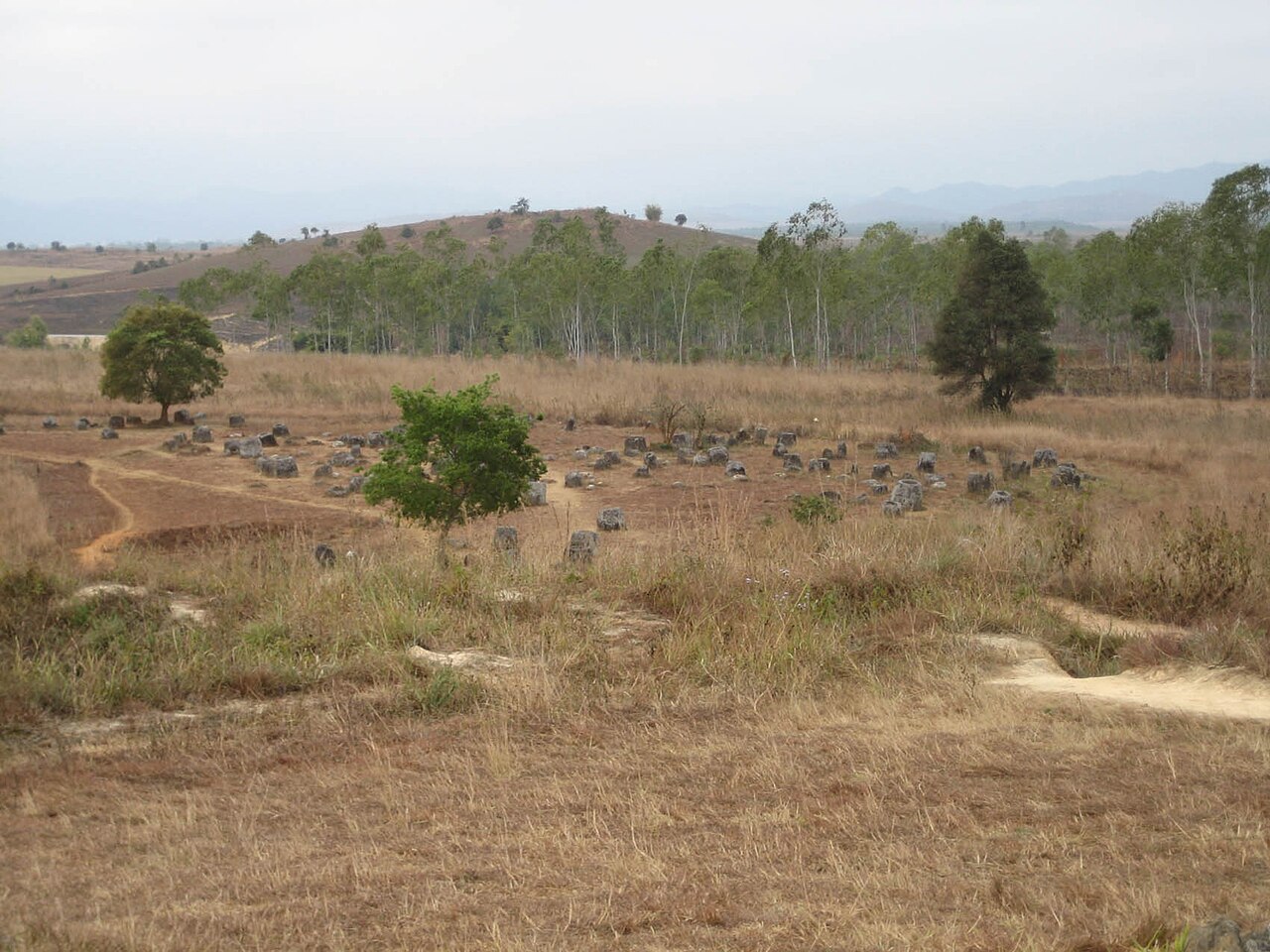
Laos has four World Heritage properties, and most visitors see exactly one. Begin in the northeast, on the Xieng Khouang plateau, where the Plain of Jars spreads more than 2,100 tubular stone jars across dozens of sites — an Iron Age funerary landscape dated from 500 BCE to 500 CE, inscribed by UNESCO in 2019 as a serial property of 15 components holding 1,325 of the jars, some standing 10 feet (3 m) tall and weighing several tons, beside their quarries and stone-disc lids. Sites 1, 2 and 3 near Phonsavan are the cleared, visitable fields. The context around them matters: Laos is, per capita, the most heavily bombed country in history, and the COPE Visitor Centre in Vientiane — run alongside the national UXO program — explains the unexploded ordnance that still shapes rural life; at the jar fields, the marked paths are not a suggestion.
The south holds the country's deepest history. Vat Phou, inscribed in 2001 within the Champasak Cultural Landscape, is a temple complex built up between the 5th and 15th centuries under the Chenla and Khmer empires — older at its roots than Angkor's great temples — laid out on a sacred axis from the lingam-shaped summit of Phu Kao mountain down to the Mekong, with palaces, terraces and reservoirs across the plain. Newest of all is Hin Nam No National Park in Khammouane province, inscribed in 2025 as Laos's fourth World Heritage property and its first natural one, a transboundary extension of Vietnam's Phong Nha-Ke Bang: a wilderness of limestone karst, caves and rare primates that almost no itinerary yet includes. The same province hides Kong Lor Cave, where the Hinboun River runs 4.7 miles (7.5 km) underground and local longboats carry visitors through the mountain in darkness.
The living landscapes complete the list. On the Bolaven Plateau above Pakse — volcanic highlands around 3,600 feet (1,100 m) — coffee farms ring waterfalls, among them Tad Fane, where twin streams drop some 394 feet (120 m) into a jungle gorge. At the country's foot, where the Mekong braids into Si Phan Don, the 4,000 Islands, the river pours over Khone Phapheng Falls — at roughly 6.7 miles (10.8 km) across, the widest waterfall in Southeast Asia — and a small, critically endangered pod of Irrawaddy dolphins still surfaces in the deep pools below Don Khon. None of these places is hidden; all of them are simply one bus ride further than the standard circuit turns around.
Picture the place
At Site 1 on the Plain of Jars the grass runs to the horizon in every direction and the jars stand in it like a harbor of stone boats — some upright, some tipped, some split by roots or shrapnel — in a silence that belongs to a civilization no one has yet learned to read.
The easily missed detail
The jars' mystery is double, and the second half is modern: the same plateau that holds Southeast Asia's strangest Iron Age relics was one of the most bombed landscapes of the 1964–73 war, and the cleared jar sites are islands in ground that clearance teams are still working. The craters between the jars are part of the exhibit — Laos is the rare destination where the 2,000-year-old monument and the 60-year-old war share one field of view.
A practical rhythm
- Morning — Mornings at the jar fields: Site 1 in the early light, when the plateau is cool and the grass still holds the night's dew, before the day-trip vehicles arrive from Phonsavan.
- Midday — Midday goes underground or indoors: Kong Lor's river cave in the heat of the day, or the COPE Visitor Centre in Vientiane, which gives every rural road you travel afterward its proper weight.
- Evening — Evenings in the south are the plateau's hour: Pakse's riverside at the Xe Don confluence, with Bolaven coffee country in the hills behind and the falls saved for the morning after.
What could complicate the plan
Distance is the tax on all of it: Laos is landlocked and mountainous, Phonsavan is a full day's drive from Luang Prabang, and the south — Pakse, Champasak, the islands — is effectively a second trip unless you fly domestically or allow two weeks. UXO discipline is non-negotiable in Xieng Khouang and along the old Ho Chi Minh Trail in the east: cleared sites and marked paths only, and nothing picked up from the ground, ever. And Hin Nam No, for all its 2025 inscription, has visitor infrastructure to match its obscurity — go with a local operator arranged in Thakhek rather than expecting a gate, a ticket desk and a trail map.
What to do next
Add one region, not five: pair Phonsavan's jar fields with a Luang Prabang trip, or build the south as its own loop — Pakse, the Bolaven, Vat Phou and the 4,000 Islands — and give each the days its roads demand.
Sources
- UNESCO World Heritage Centre — the Megalithic Jar Sites in Xiengkhuang (inscribed 2019; 15 components, 1,325 jars, 500 BCE–500 CE); Vat Phou and the Champasak Cultural Landscape (2001; 5th–15th centuries); Hin Nam No National Park (2025), Laos's first natural inscription
- COPE (Cooperative Orthotic and Prosthetic Enterprise) and the National Regulatory Authority for UXO, Vientiane — Laos as the most heavily bombed country per capita, and the clearance status of the jar sites
- Lao Ministry of Information, Culture and Tourism — the Bolaven Plateau and Si Phan Don visitor regions, Tad Fane and Khone Phapheng Falls