Laos country guide When to visit
When is the best time to visit Laos for Luang Prabang?
The short answer
December — deep in the cool, dry season, when Luang Prabang's days sit at 81°F (27°C), its misty mornings start at 59°F (15°C), the Mekong still runs high from the monsoon, and the whole country is open at once.
The answer, with local context
Laos runs on three seasons, not two, and choosing a month means choosing which country you get. The World Meteorological Organization's 1991–2020 normals for Luang Prabang — the anchor city for most first trips — set out the cool, dry heart of the year: December averages a high of 81°F (27.4°C) and a low of 59°F (15.0°C), January is nearly identical at 83°F (28.4°C) by day, and rain is close to absent in both. November opens the season slightly warmer, at an 86°F (29.9°C) high, and brings the That Luang Festival to Vientiane at the November full moon, the country's great national celebration around its golden stupa. The dry season runs nationally from November to April, and December is when every region aligns: the south's heat is at its mildest, the northern highlands are cold at night but not yet at their January extremes, and the Mekong and its tributaries still carry monsoon water, so the slow boats, the Pak Ou caves trip and the river life of the 4,000 Islands all run at their best.
The months to weigh against it are specific. The wet season, May to October, delivers August as the wettest month — Luang Prabang averages around 13 inches (330 mm) of rain — and turns the Kuang Si Falls thunderous while making rural roads, especially in the south, slow and sometimes impassable. Stranger is the third season: from late February to mid-May, agricultural burning across the northern hills fills Luang Prabang's valley with smoke haze just as the heat peaks — April is the country's hottest month, with Luang Prabang averaging a 95°F (35.2°C) high — which is why the city's famous view from Mount Phousi so often disappears in spring. Mid-April's Pi Mai, the Lao New Year water festival, is the one joyous reason to brave that heat.
Luang Prabang rewards the December choice in its details. UNESCO inscribed the town as a World Heritage site in 1995 for its fusion of traditional Lao and French colonial architecture, and December is when that streetscape is walkable all day: river mist burns off by mid-morning, the dawn alms ceremony happens in cool air, and the night market runs in dry comfort. Two hours south by the Laos–China Railway — opened on December 3, 2021, and still the country's transport revolution — Vientiane and Vang Vieng share the same dry skies, so a December trip strings the whole northern circuit together without a single weather gamble.
Picture the place
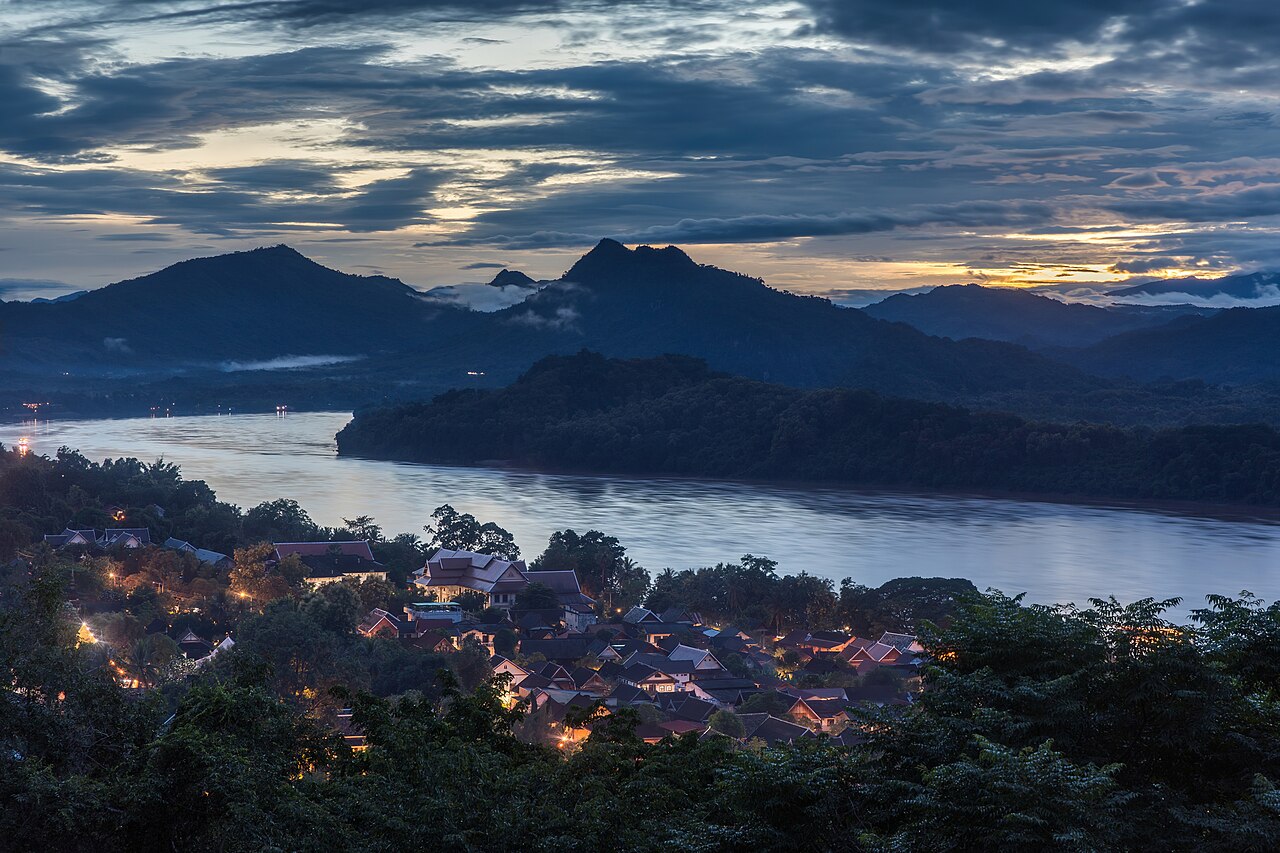
At dawn in December the Nam Khan wears a band of mist, the monks' alms line files orange through it past the colonial shophouses, and by nine the fog has lifted off the golden roof of Wat Xieng Thong into a sky that will stay blue until the evening chill brings the market crowds out in jackets.
The easily missed detail
The "burning season" is the fact standard month-by-month charts bury: Laos's worst air of the year is not in the monsoon but in the clear, dry weeks of March and April, when field-burning smoke pools in the northern valleys. A traveler who books Luang Prabang for the March sunshine on a generic Southeast Asia chart can find the mountains invisible for days — the dry season's second half is a different, harsher country than its first.
A practical rhythm
- Morning — December mornings begin in the mist: the alms ceremony at dawn, then the morning market and the temples as the sun burns through, in the day's coolest, clearest air.
- Midday — Midday is river time: the boat up the Mekong to the Pak Ou caves while the water is high and the light is hard, or the turquoise tiers of Kuang Si Falls in their post-monsoon strength.
- Evening — Evenings cool fast to the high 50s Fahrenheit (around 15°C): the night market, a riverside dinner, and a jacket kept to hand.
What could complicate the plan
December is a shared conclusion — it overlaps the Christmas and New Year travel peak, and Luang Prabang's small stock of heritage hotels books out and prices up accordingly; reserve early and expect the Mekong slow boats and the railway's morning trains to fill. The cool season's cold is real at altitude: Phongsali and the Xieng Khouang plateau can approach freezing at night in December and January, so a northern loop needs genuine warm layers, not a traveler's afterthought. And if your dates slip into late February, pivot south — the smoke is a northern problem, and Champasak and the Bolaven Plateau stay clearer weeks longer.
What to do next
Take December, enter through Luang Prabang for four or five nights, run Vang Vieng and Vientiane down the railway line, and leave April's Pi Mai and the wet season's waterfalls to a second trip.
Sources
- World Meteorological Organization (WMO) 1991–2020 climate normals for Luang Prabang (via NOAA NCEI) — December mean high 81°F (27.4°C) and low 59°F (15.0°C); April as the hottest month at a 95°F (35.2°C) mean high; August the wettest at about 13 inches (330 mm)
- UNESCO World Heritage Centre — the Town of Luang Prabang, inscribed in 1995 for its fusion of Lao and colonial architecture under criteria (ii), (iv) and (v)
- Laos–China Railway Company — the line's opening on December 3, 2021, linking Vientiane, Vang Vieng and Luang Prabang