Lofoten Islands / Norway When to visit
When should I visit the Lofoten Islands for northern lights?
The short answer
Late September to mid-October — true darkness has returned to every island, the fjords are still unfrozen for reflection shots, and the equinox weeks carry some of the year's strongest aurora activity before the winter storm season settles in.
The answer, with local context
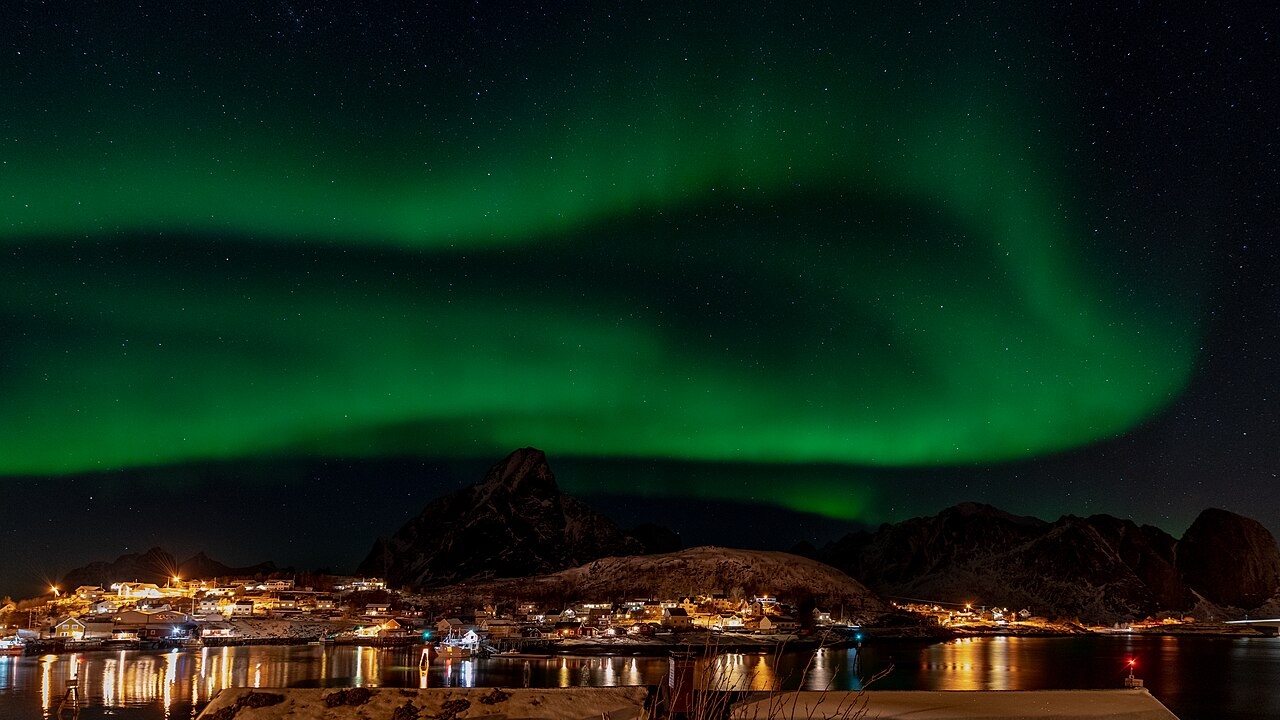
The aurora needs three things — darkness, activity and clear sky — and Lofoten's answer differs by island shore, so take the archipelago in parts. Darkness: at 68°N the sun stops setting in late May and true night returns only gradually; astronomical darkness (the sun 18° below the horizon) is back by mid-September across the islands, giving 6+ hours of full dark by the equinox and lengthening fast. Activity: geomagnetic activity statistically peaks around the equinoxes (the Russell–McPherron effect, tracked by the Norwegian Centre for Space Weather at UiT Tromsø, whose forecasts the islands use), so late September and October hold an activity edge over the deep-winter months that brochures rarely mention. Sky: here Lofoten is Atlantic — the same Gulf Stream that keeps January near freezing (about 32°F/0°C in Svolvær, absurdly mild for the latitude) also brews cloud, and the outer (western and northern) coasts — Uttakleiv and Haukland beaches on Vestvågøy, Skagsanden on Flakstadøya, the Eggum headland — sit in a slightly drier lee than the fjord-bottom villages and give the aurora its two classic Lofoten frames: over white sand and surf, or reflected in still fjord water at Reine and in the east at Svolvær's Svinøya shore.
September–October's operational edges are decisive. The roads are ice-free, the rorbu are at shoulder prices, the sea has not frozen, and night temperatures hover at 35–45°F (2–7°C) — cold enough to stand out in, warm enough to do it for hours. The villages still run most services, the Trollfjord boats and fishing trips sail, and the same trip doubles as ruska season: the birch hillsides turn gold in the month's first half. Stay a minimum of four to five nights — the honest statistic of aurora travel is that cloud, not the sun, decides, and each extra night compounds the odds far more than any forecast app. Check the UiT space-weather service and MET Norway's cloud forecasts nightly, watch from 9 p.m. to 1 a.m. when the oval most often crosses, and drive the E10's short hops between shores when one sky closes and another opens — Lofoten's size is an aurora asset: three weather systems can sit over the chain at once.
The winter case is the famous one, and it is genuine: from November to early April the polar night (roughly December 7 to January 5 in Svolvær, when the sun never clears the horizon) gives up to 19 hours of darkness, the snowscape doubles the light's stage, and February–March brings the year's most stable high-pressure spells plus the skrei fishery to fill the days. Its costs are the storms (the same months bring the islands' fiercest Atlantic weather, ferry cancellations and closed roads), the cold snaps inland of the shore, and peak prices on the photogenic west-end cabins. If your trip exists only for the lights, choose September–October for the balance; if it exists for the lights over snow with the cod season running, choose February. Either way, the lights are a probability you buy by the week, never a booking.
Picture the place
Skagsanden beach at midnight in late September: the tide out, the wet sand mirroring a green arc that doubles itself in the shallows, and the Flakstad peaks holding the horizon black.
The easily missed detail
Lofoten's aurora secret is its latitude luck: the islands sit almost exactly under the auroral oval's statistical center on active nights (the oval's quiet-time home is around 67°N magnetic), so displays here can start directly overhead and fill the whole sky — and, on very active nights, the lights also appear to the south, which first-timers never think to check. Face every direction once an hour; the corona overhead, not the postcard arc, is the show Lofoten regulars wait for. And the "dark" season's bonus runs all winter: the polar-night weeks trade sunrise for hours of blue Arctic twilight, the photographer's light that never ends.
A practical rhythm
- Base at a shore, not a village center — Rorbu on the Svinøya shore (east), at Reine (west) or by Haukland (center): dark sky from your own jetty in all three
- Five nights minimum — The unit of aurora travel is the week-ish stay; a two-night dash is a coin flip against the Atlantic
- Nights in two moves — First watch 9 p.m.–midnight from the cabin shore; a drive to the opposite coast after midnight if the first sky fails
What could complicate the plan
Cloud is the archipelago's tax on everything, and September–October pays it too: a stuck Atlantic low can blank a whole stay (the reason the five-night rule exists). The famous west-end viewpoints (Reinebringen) are daylight sights — the aurora frames are the beaches and fjord shores, and their parking lots are unlit and icy later in the season. Light discipline matters: village streetlights and the E10's traffic wash the southern sky from some shores, so walk five minutes from the lamps before judging a night. And no honest guide can promise the lights: anyone who does is selling, not informing.
What to do next
Book five late-September nights split between a west-end and a center-or-east shore, load the UiT forecast and a cloud app, and plan each day as if the night will perform — then let it surprise you.
Sources
- Norwegian Centre for Space Weather, UiT The Arctic University of Norway — aurora forecasts for the islands and the equinox activity peak (Russell–McPherron effect)
- Norwegian Meteorological Institute (MET Norway) — Lofoten's night-return dates, polar night (about Dec 7–Jan 5 at Svolvær) and cloud climatology for the outer coast
- Visit Lofoten — the aurora season (late August–April), the beach and fjord viewpoints (Skagsanden, Uttakleiv, Haukland, Reine)
- Norwegian Polar Institute — the auroral oval's position over northern Norway at about 67°N magnetic latitude