Luxembourg country guide Trip planning
How can I plan a memorable first trip to Luxembourg without rushing?
The short answer
Five or six days, split between the capital and the Moselle — long enough to walk the UNESCO fortress property inscribed in 1994 without hurrying, and to drive the 42 km wine route between Schengen and Wasserbillig as a trip rather than an errand.
The answer, with local context
Entry is simple and the rules are published. The State Department's Luxembourg advisory, issued 8 April 2026, records a Level 1 "exercise normal precautions" overall and states that no visa is required for stays of 90 days or less. Your passport must be valid at least 3 months beyond your departure from the Schengen area and carry 2 blank pages, and you should be ready to show sufficient funds, an onward or return ticket, and hotel bookings or invitation letters. You may carry up to 10,000 euros in cash either way.
The European Commission sets the limit that actually constrains a longer European trip. Short stays are capped at 90 days inside any rolling 180, and the Commission's own method is to take each day of your stay, look at the 180 days before it, and check the running total. The area it covers runs to 29 countries, of which 25 are EU Member States; Cyprus and Ireland are EU members that sit outside it, so days there do not count, while days in Iceland, Norway, Switzerland and Liechtenstein do.
For the itinerary itself, the capital gives you UNESCO's "City of Luxembourg: its Old Quarters and Fortifications," inscribed in 1994 under criterion (iv) and decision 18 COM XI, built on a rocky outcrop at the confluence of the Alzette and Pétrusse. Underneath it runs a casemate system of over 23 km, which the Luxembourg City Tourist Office opens for guided tours on a schedule that thins markedly in winter. The Moselle gives you 340 wineries across 1,246 hectares. Echternach gives you the Hopping Procession, inscribed by UNESCO in 2010 and held on the Tuesday of Pentecost.
Picture the place
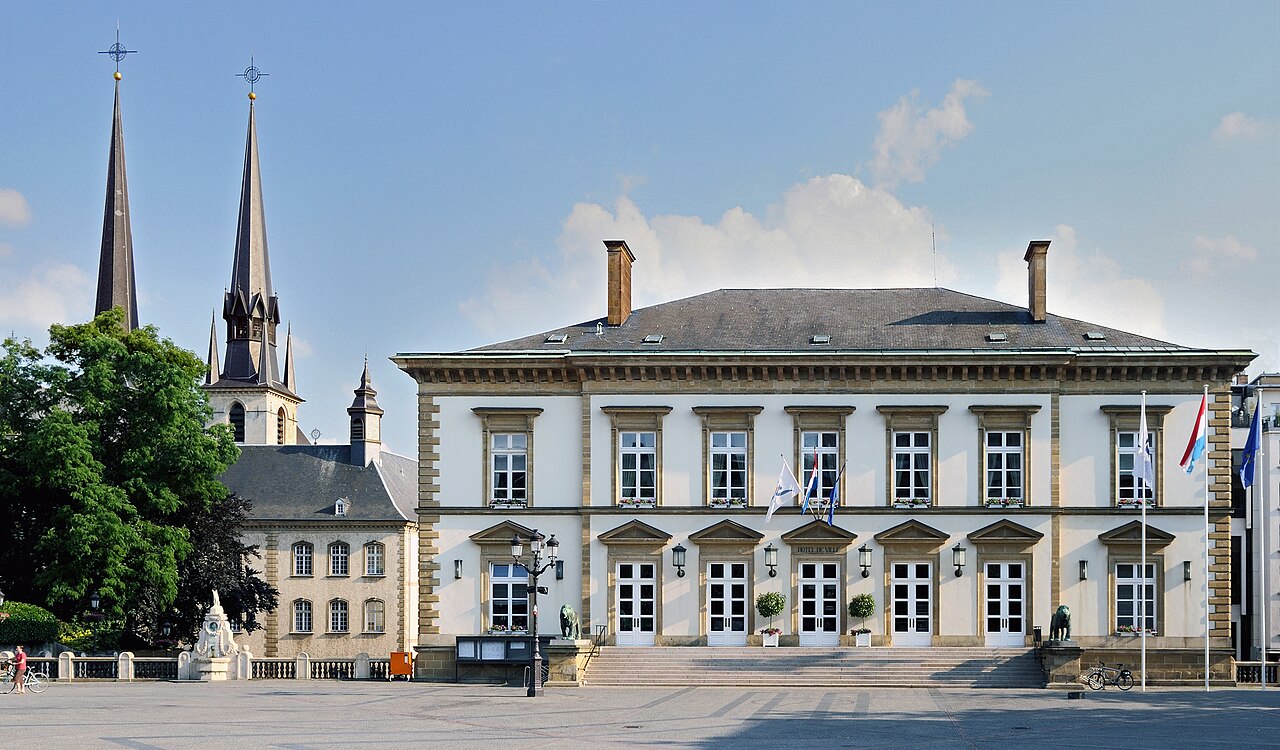
The capital's historic core sits on a plateau with cliffs on three sides, and the valley floor below holds its own streets and the Neumünster Abbey. UNESCO describes an outcrop that needed artificial defences mainly on the west, which is why the walk from the Upper Town down into the valley feels like leaving one city for another rather than crossing a district line.
The easily missed detail
The Commission's guidance is to get your passport stamped on entry and exit and, if a stamp is missing, to show evidence such as boarding passes and ask border guards to add the date and location. Entry stamps carry a "+" prefix and exit stamps a "-", with dates written day-month-year, so +010124 reads as 1 January 2024. Learning to read your own stamps is worth the 2 minutes it takes, because a Luxembourg leg is almost never a whole trip.
A practical rhythm
- Days 1–3, the capital — The 1994 inscription covers both the Upper Town and the fortifications, and the Bock Casemates are a timed guided visit rather than a walk-in.
- Day 4, the Moselle — The 42 km route from Schengen to Wasserbillig is a day's drive with stops, not a detour.
- Days 5–6, the east and north — Echternach and the Ardennes, with the caveat below.
What could complicate the plan
One region carries a higher warning than the country. The State Department rates the north and east at Level 2 rather than Level 1, because munitions from the two World Wars are still in the ground there, and the sensible response is to keep to marked paths in the Ardennes rather than to skip the region. Biometric registration — fingerprints and a facial image at Schengen entry and exit — has applied to most US citizens on short stays since 12 October 2025, so allow extra time at the border. In November the Bock Casemates guided tours fall back to windows of 11:30 to 12:30 and 14:30 to 15:30 on Saturdays and Sundays plus one Friday afternoon, which means a late-autumn trip built around the underground fortress has to be planned around the tour timetable rather than your own.
What to do next
The Luxembourg when-to-visit answer sets out how the fortress and vineyard seasons line up, and the places-and-experiences answer covers Echternach and the Moselle in the detail a 5-day plan needs.
Sources
- US Department of State, Luxembourg travel advisory — Level 1 and Level 2 regional caution, visa and passport rules, proof-of-funds requirement, biometric date
- European Commission, Schengen short-stay calculator — 90-in-180 rule, count-back method, 29-country membership, stamping guidance
- UNESCO World Heritage Centre — 1994 inscription, criterion (iv), decision 18 COM XI, site topography
- Luxembourg City Tourist Office — casemate extent and winter guided-tour windows
- AOP Luxembourg, Vins et Crémants (Government of Luxembourg) — winery count, hectares, wine route length
- UNESCO Intangible Cultural Heritage — procession inscription year and date