Maasai Mara / Kenya Things to do
When should I visit the Maasai Mara for wildlife?
The short answer
July through October is the principal window for seeking migrating wildebeest in the Maasai Mara, but lions, elephants, giraffes, zebras and other resident animals provide wildlife-viewing opportunities at other times of year.
The answer, with local context
The famous migration is a movement within the broader Serengeti–Mara ecosystem, linking Tanzania’s Serengeti with Kenya’s Maasai Mara. According to the Mara Conservancy, wildebeest migration into and through the Mara usually begins around June or July and can continue until November. River crossings occur during this broad period, but the herds do not follow a published daily calendar.
The seasonal distribution of grass and rainfall helps explain the movements. The Mara receives two principal rainfall periods, with a prominent long-rains peak around April and a smaller short-rains peak later in the year. Scientific work published in PLOS Climate documents considerable differences in rainfall between the relatively dry July–October period and wetter months.
The latest completed monthly wildlife report available from the Mara Conservancy is its October 2026 report, published November 2, 2026. The conservancy recorded 45.3 mm (1.78 inches) of rain during the second half of October and described tens of thousands of wildebeest still present in the area, concentrated near the international border. That is a documented observation from October 2026, not a prediction of where the herds will be in a future October.
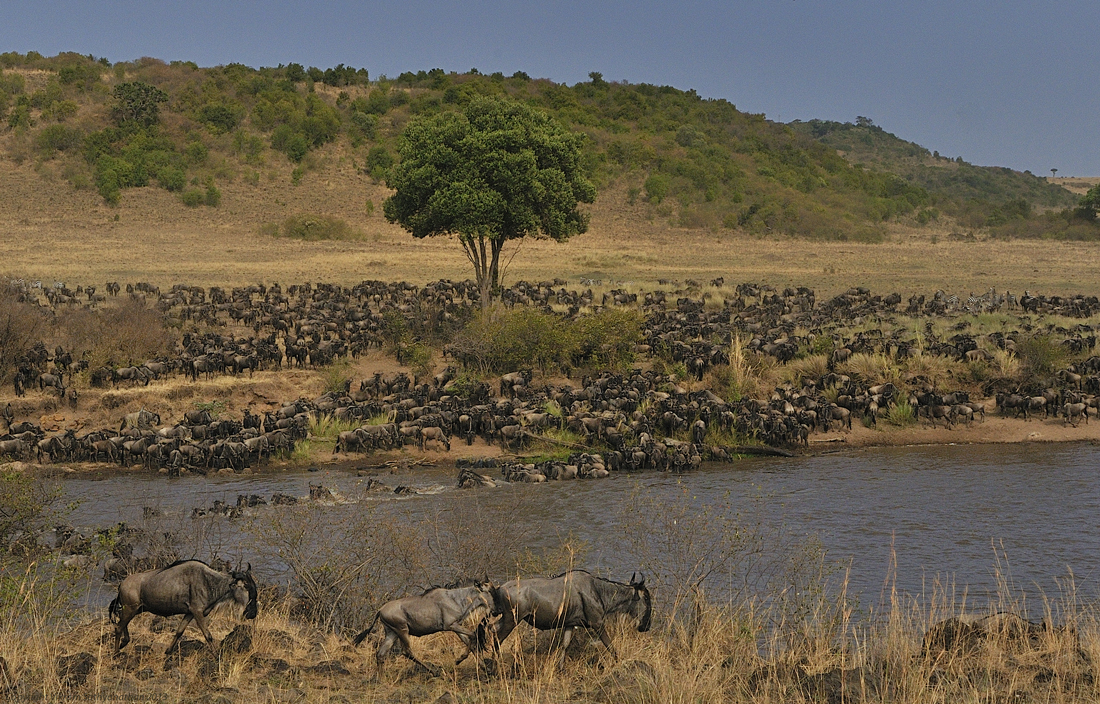
The most dramatic wildlife behavior often occurs around the Mara River, where animals may approach, retreat and gather before crossing. The river also contains significant hazards, including steep banks and aquatic predators. The Mara Conservancy explicitly states that crossings are difficult to predict even when large numbers of wildebeest are present nearby.
For travelers more interested in carnivores than migration spectacle, the Mara’s year-round resident wildlife matters. Lions, leopards and cheetahs are not dependent on a visitor arriving during one particular crossing. The presence of elephants, giraffes and resident grazers also makes an itinerary outside the busiest migration period scientifically and visually rewarding.
Picture the place
Large wildebeest herds gather across broad grassland, while the Mara River cuts through a more enclosed corridor with steep banks. Near a crossing, moving animals can concentrate in a narrow section of terrain that is very different from their dispersed grazing pattern on the plains.
The easily missed detail
A predicted migration month is not a booked wildlife performance. The conservancy prohibits vehicles from obstructing animals at river crossings and forbids visitors from leaving vehicles at undesignated points. Moving a vehicle too close can redirect a herd toward unsafe riverbanks, so observing from a lawful distance is part of responsible wildlife viewing.
A practical rhythm
Early morning — Open plains: Search for grazing herds and carnivores before the middle of the day.
Later morning — River habitat: Visit an authorized Mara River viewing route without blocking animal approaches.
Another day — Resident wildlife: Concentrate on elephants, giraffes, big cats and birds instead of spending the entire safari waiting for a crossing.
What could complicate the plan
The Mara Conservancy’s official site controls game-drive conduct in the Triangle, and migration crossings may be absent even during peak months. Kenya’s Level 3 U.S. travel advisory issued October 19, 2026 adds a separate travel-planning consideration. Wildlife conditions and conservation regulations must both be reviewed before arranging a safari.
What to do next
compares the whole-year weather and fee pattern. explains the reserve’s vehicle rules and the different habitats worth exploring.
Sources
- Mara Conservancy, Wildebeest Migration — migration months, crossing behavior and visitor restrictions.
- Mara Conservancy, October 2026 Monthly Report — latest completed observation of rainfall and wildebeest numbers.
- PLOS Climate, Mara–Serengeti Rainfall Research — rainfall seasonality and ecological context.
- Narok County Government, County Annual Development Plan — migration and regional climate.
- U.S. Department of State, Kenya Travel Advisory — advisory level and issue date.