Machu Picchu / Peru Trip planning
How should I plan a responsible first visit to Machu Picchu?
The short answer
Buy your named ticket only on the Ministry's TuBoleto platform the week sales open, walk a single circuit as the rules require, sleep low before you climb, and — if you trek the Inca Trail — choose an operator by its obedience to the porter law: 20 kilograms (44 lb) maximum load, set by Law 31614.
The answer, with local context
Responsibility at Machu Picchu begins with the ticket, because the site is protected precisely by its scarcity. UNESCO reported in 2024 that the citadel's carrying capacity had been reached, and the system built on the 2015 carrying-capacity study admits 4,500 visitors a day, 5,600 on high-season dates — sold only through TuBoleto, the Ministry of Culture's platform, with lookalike sites reselling at a surcharge the sanctuary never sees. Tickets carry your name and passport number, are checked against your ID at the gate, and cannot be transferred or changed: the discipline of buying early, exactly, and only from the state is the first conservation act of the trip. One thousand tickets a day are held back for in-person sale in Aguas Calientes, and they are a safety net, not a strategy — they generally mean queuing a day ahead for next-day entry.
The ground rules deserve the same literal obedience, because they are the conservation plan in daily form: keep to your circuit's one-way route, stay off the walls and terraces, carry water in a reusable bottle, take every wrapper back down the mountain, and leave the drone at home — drones are prohibited in the sanctuary, as are food, glass and fires on its trails. The rules protect more than masonry: the Historic Sanctuary declared in 1981 covers 32,592 hectares (80,537 acres) of cloud forest inscribed by UNESCO in 1983 as a mixed cultural and natural property, home to the spectacled bear and the Andean cock-of-the-rock, and the citadel's stones occupy only its most famous hectare.
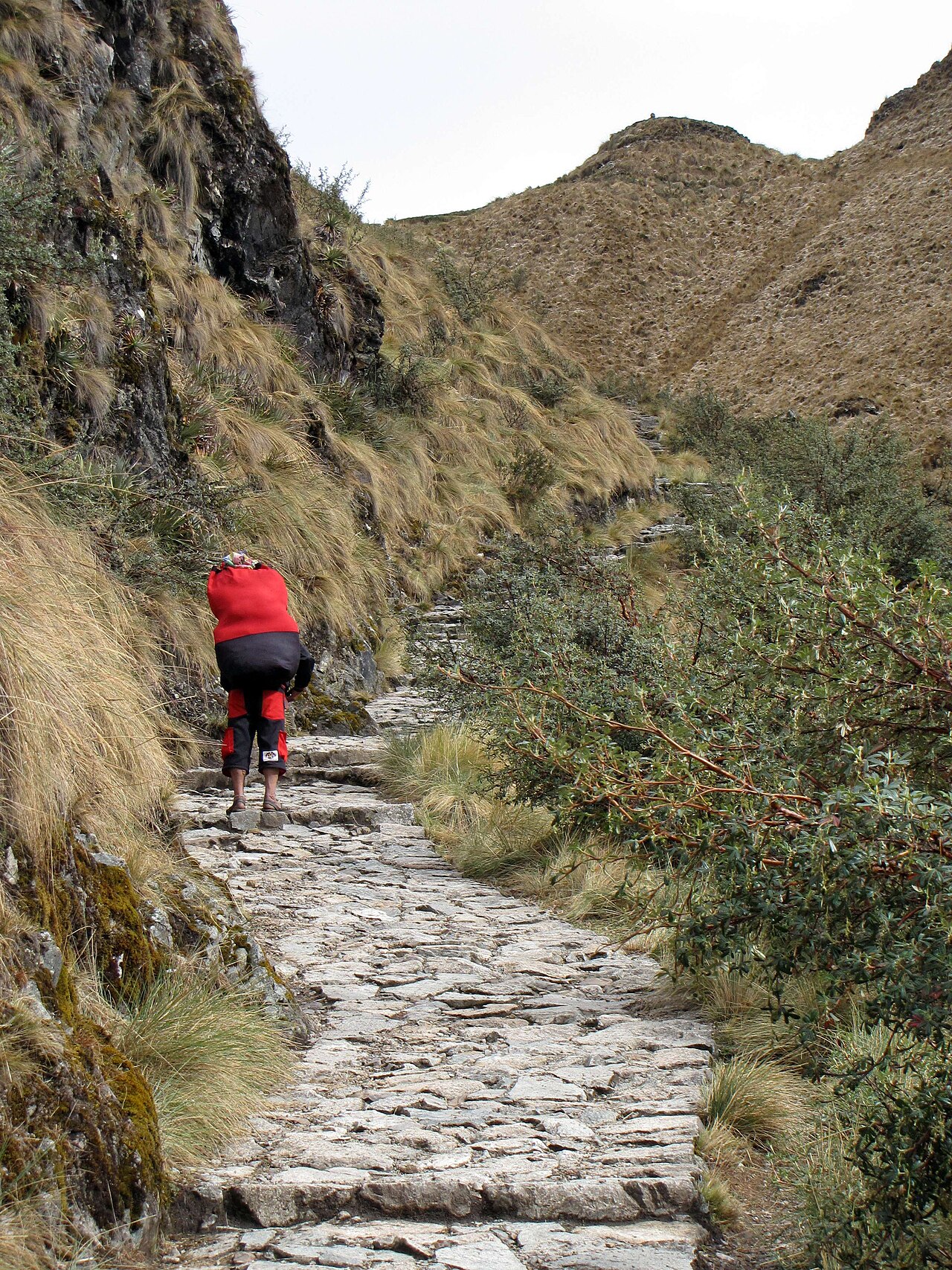
If the Inca Trail is part of the plan, responsibility has faces and names. The trail's governing regulation — the Reglamento approved in 2017 and amended since — allows 500 people a day on the classic routes, of whom only about 200 are trekkers; the other 300 are the guides, cooks and porters who carry the expedition. Independent trekking is banned: every hiker walks with a licensed operator and an official guide, rangers verify permits against the database at the Km 82 and Km 104 checkpoints, groups are capped at 16 trekkers, and the whole network closes each February. The porters' protection is statutory: Law 31614 of 2022 caps a porter's load at 20 kg (44 lb) for men and 15 kg (33 lb) for women, sets a minimum age of 18 and a minimum daily wage of 3 percent of the national tax unit (UIT) — about S/138 a day. Asking an operator, before you book, how it complies with that law is the single most consequential question of the trek.
Picture the place
On the trail's second morning the porters pass at their unhurried trot on the climb to Warmiwañusqa — Dead Woman's Pass, at 13,828 feet (4,215 m) — each load a legal 20 kilograms of tents and food, each man in the sandals-to-boots spectrum of a workforce that walks this road weekly, while the trekkers they serve stop every hundred yards to breathe.
The easily missed detail
Altitude rewards the responsible order of nights: the citadel stands at 7,972 feet (2,430 m), nearly 3,200 feet (975 m) below Cusco's 11,152 feet (3,399 m). Sleeping the first nights in the Sacred Valley or Aguas Calientes and visiting Cusco afterward is kinder to your body and, not incidentally, to the site — an acclimatized visitor walks the circuits slowly instead of being hurried off them by headaches and an early train. The published medical guidance is blunt about the arithmetic: risk begins around a sleeping altitude of 2,450 m, symptoms usually show 2 to 12 hours after arrival, acclimatization takes 3 to 5 days, and the first 48 hours call for mild exertion and little alcohol — which is exactly the window most Cusco itineraries spend climbing stairs.
A practical rhythm
- Morning — Arrive at the gate for your named slot with passport in hand and the ticket's 30-minute grace period treated as an emergency margin, not a plan — late beyond it means refused entry.
- Midday — Walk the circuit once, completely, at the pace the route sheet allows, and let the site's arithmetic work: one visitor who keeps to the path does measurably less harm than the same visitor shortcutting between terraces.
- Evening — Spend the night in the valley, not on a day-trip's rails: money that sleeps in Aguas Calientes or the Sacred Valley pays the guides, porters and market cooks of the sanctuary's own communities.
What could complicate the plan
The system's honesty is its rigidity: a misspelled name, a passport renewed after booking, a route chosen in haste — none can be corrected at the gate, and sold-out means sold out. The February closure catches trail planners who assumed the citadel's year-round opening covered the trek. And the porter law has an enforcement gap you can help close: loads are weighed at checkpoints, but the traveler who books the suspiciously cheap trek is funding the overweight duffel — the responsible price includes the legal load.
What to do next
Open a TuBoleto account now, set a reminder for the December sales opening, and write the porter-law question into your first email to any trek operator.
Sources
- Ministerio de Cultura (Peru) — the TuBoleto platform as the sole official sales channel; named, non-transferable, ID-checked tickets; 1,000 tickets a day reserved for in-person sale in Machupicchu Pueblo; the Inca Trail regulation (approved 2017, as amended) capping the classic routes at 500 people a day including crew, with licensed operators and official guides mandatory
- Congress of the Republic of Peru, Law 31614 (2022) — porter protections: maximum loads of 20 kg for men and 15 kg for women, minimum age 18, and minimum pay of 3 percent of the UIT per day
- SERNANP — checkpoint verification of trail permits at Km 82 and Km 104, and the Inca Trail network's annual February closure
- UNESCO — the Historic Sanctuary of Machu Picchu, 32,592 hectares declared in 1981 and inscribed as a mixed property in 1983; UNESCO's 2024 reporting that the citadel's carrying capacity has been reached