Machu Picchu / Peru Food and drink
Where should I eat in Machu Picchu, and which local food or drink is worth trying?
The short answer
Not inside the citadel — the Ministry's rules prohibit food on the circuits entirely — but at its edges: the Tinkuy buffet at the Sanctuary Lodge by the gate if the day is split, and down in Aguas Calientes for the real meal, where the dish to order is the Urubamba's trout.
The answer, with local context
Start with the prohibition, because it organizes everything: under the Ministerio de Cultura's Normas de Conducta, food may not be brought into or eaten inside the archaeological site — water in a reusable bottle is the exception, and daypacks are limited to 40 × 35 × 20 cm. At the gate itself there are exactly two options, both run by the Belmond Sanctuary Lodge, the only hotel at the entrance: a snack bar, and the Tinkuy buffet restaurant, a full Peruvian-and-international spread that has most recently run about $45 per adult — priced, transparently, for the convenience of not descending to town between two entry slots. The lodge's second restaurant, Tampu, serves à la carte plates — fresh trout with native potatoes among them — a few steps from the turnstiles.
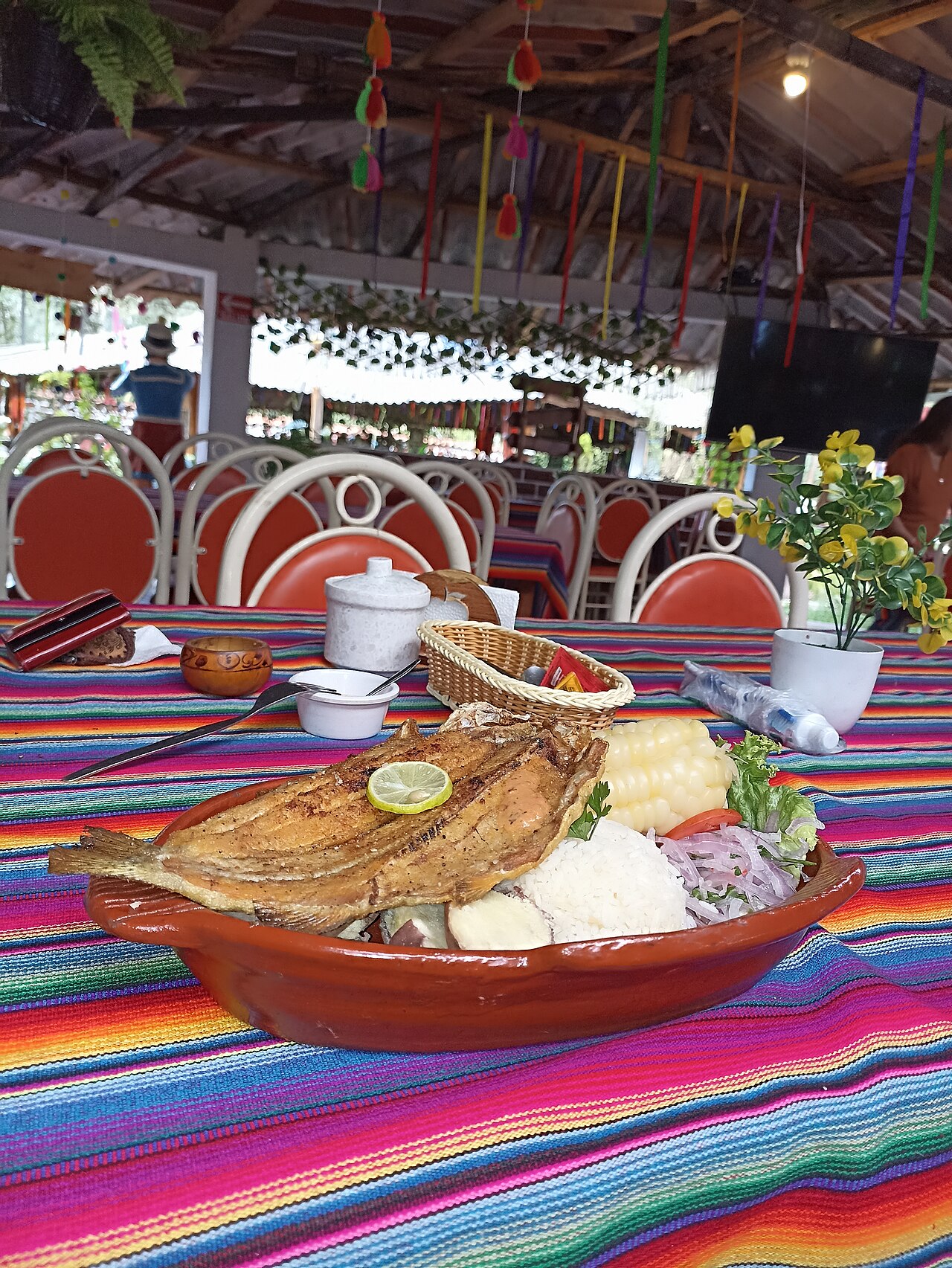
The town below, Aguas Calientes — officially Machupicchu Pueblo — is where the eating actually happens, a 25-to-30-minute bus ride down the switchbacks. Its geography is its menu: the town sits in the ceja de selva, the "eyebrow of the jungle," where the Andes fall toward Amazonia, and Andean staples — potatoes, corn, quinoa — meet jungle fruits, cacao and river fish on the same table. The fish is the headline: trout from the Vilcanota-Urubamba river system, the town's star ingredient, served grilled with Andean herbs and native potatoes, in a mountain-style ceviche cured in lime, or as tiradito. The Franco-Peruvian bistro Indio Feliz is the town's long-standing classic for it; the riverside Mapacho pairs local plates with its own craft beer; and alpaca, the highlands' other red meat, appears across the menus of the better kitchens.
The budget answer is upstairs: on the second floor of the municipal market, the comedores serve the menú del día — soup, a main course and tea — for a fraction of restaurant prices, in a town where à la carte mains at the established restaurants run about S/40–90 and set menus S/25–55. And the town keeps archaeological hours: most hotels serve breakfast from 4:30 a.m. so that guests make the first buses and the 6:00 a.m. entry slots fed — the surest sign that in Aguas Calientes, the citadel sets the mealtimes.
Picture the place
At a second-floor market comedor the steam of the day's soup fogs the windows over the Urubamba, porters and shopkeepers eat shoulder to shoulder at the long counters, and the trout arrives whole and crackling from the fryer with a mound of rice and choclo — the working lunch of the town that feeds the wonder.
The easily missed detail
The trout is an import wearing a local crown: rainbow trout were introduced to Peru's mountain rivers and hatcheries from North America in the 20th century, took to the cold, oxygen-rich Andean water completely, and became so completely the region's fish that its ceviche now stands in for the coastal original a mountain range away from the sea. Order it without guilt — in the ceja de selva it is the local catch, whatever its passport says.
A practical rhythm
- Morning — Eat the 4:30–5:00 a.m. hotel breakfast without embarrassment: with food banned inside, the pre-entry meal is not a nicety but the fuel for a 2-hour-30-minute circuit and, for mountain tickets, a serious climb.
- Midday — Between two slots, the choice is arithmetic: Tinkuy at the gate if the gap is short, the bus down and a market menú if it runs to hours — eating in town and re-ascending costs two bus rides and the better part of the interval.
- Evening — The town's kitchens peak after the last train: trout at Indio Feliz or a riverside table at Mapacho, and an early bed, because breakfast in this town starts before five.
What could complicate the plan
The gate prices are the standing complication — the buffet and snack bar charge for altitude and monopoly, and a family lunch there costs several times the same food in town. Quality control cuts the other way: Aguas Calientes has over a hundred restaurants competing for a captive, one-night audience, and the touts on the station steps are not a quality signal — the market comedores and the long-established bistros are the safer bets. Finally, the no-food rule is enforced at the turnstiles: the box lunch your hotel offers is for the train or the designated area outside the gate, not for the terraces.
What to do next
Book the town dinner for the night before your entry, breakfast at five, and save the trout ceviche for the celebratory lunch after you come down.
Sources
- Ministerio de Cultura (Peru), Normas de Conducta — food prohibited inside the archaeological site; water in a reusable bottle permitted; daypacks limited to 40 × 35 × 20 cm
- Belmond Sanctuary Lodge — the Tinkuy buffet and Tampu restaurants at the entrance gate, the only full-service dining at the site, with the buffet most recently at about $45 per adult
- Municipalidad de Machupicchu — the municipal market in Machupicchu Pueblo, whose second-floor comedores serve the menú del día of soup, main course and tea