Machu Picchu / Peru Things to do
What are the most worthwhile things to do in Machu Picchu on a first visit?
The short answer
Walk Circuit 2, the classic route through the ceremonial heart — the Guardian's House viewpoint, the Temple of the Sun, the Intihuatana and the Sacred Plaza — and, if your legs and the ticket lottery allow, add one mountain: Huayna Picchu, whose summit stands 1,158 feet (353 m) above the ruins.
The answer, with local context
The first thing to understand is that you no longer wander Machu Picchu: since June 1, 2024, under Ministerial Resolution 000528-2023-MC, the visit runs on three circuits divided into ten routes, and your ticket names one route and one entry hour, with a maximum stay printed on the Ministry's route sheets — 2 hours 30 minutes for most routes, counted from the gate. Four routes (the Sun Gate, the Inca Bridge, the Great Cavern and Huchuy Picchu) open only in high season. The citadel itself is the royal estate built around 1450 for the emperor Pachacuti — a construction of roughly thirty years, at 7,972 feet (2,430 m) above sea level, with some 200 buildings and more than 700 terraces — set inside a protected sanctuary of 32,592 hectares that was declared in 1981 and inscribed as World Heritage in 1983.
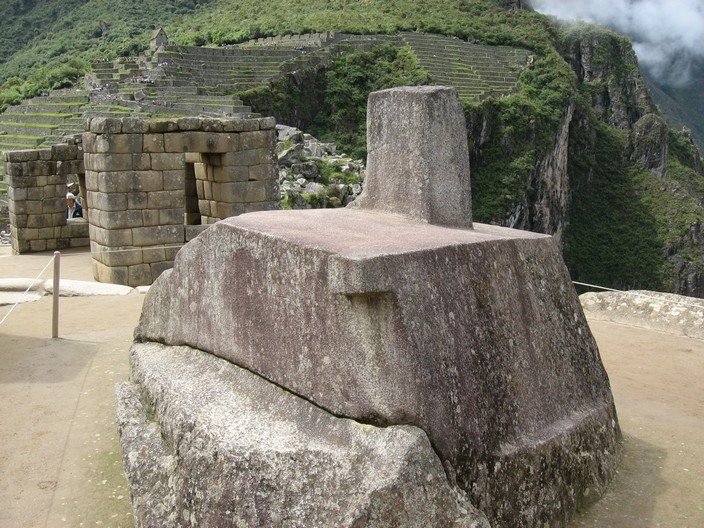
Circuit 2 is the first visit's correct default, because it strings the masterpieces in their intended order: the agricultural terraces and the Guardian's House, where the classic postcard view opens; then the urban sector's ceremonial core — the Temple of the Sun, the citadel's only curved wall, built over the Royal Tomb and aligned so the June solstice sunrise enters its window; the ritual fountains descending through the city; the Sacred Plaza with the Temple of the Three Windows and the Principal Temple; and above them the Intihuatana, a 6-foot (1.8 m) pillar carved from a single piece of granite, the "hitching post of the sun," where Inca astronomers tied the sun in place at the solstices. It is one of the very few such ritual stones the Spanish never found and destroyed — Machu Picchu's remoteness saved it — and its modern scar is the site's great cautionary tale: in September 2000 a 992-pound (450 kg) crane filming a beer commercial toppled onto the stone and chipped off a piece the length of a ballpoint pen, after which it was cordoned off for good. You view it now from behind the rope, untouchable.
The mountains are the second act. Huayna Picchu, on Route 3-A, climbs by Inca staircases — in places near-vertical, with a handrail cable — to a summit at 8,835 feet (2,693 m) with the citadel laid out below in full plan; its ticket is separate and the most contested on the platform. The alternatives divide by temperament: Machu Picchu Mountain, on Route 1-A, is the longer, higher, emptier climb; the Sun Gate, Intipunku, is the Inca Trail's arrival door, reachable in high season on Route 1-C, where the citadel appears suddenly, whole, at the turn of the path.
Picture the place
From the Guardian's House terrace the estate reads as its builders arranged it: the terraces stepping down the ridge in green ranks, the urban stone below in two halves across the central plaza, and Huayna Picchu rising behind like a wave about to break — the whole composition held between two peaks over a canyon that drops to the river on both sides.
The easily missed detail
Hiram Bingham, whose 1911 expedition announced the site to the world, misidentified it: he believed he had found Vilcabamba, the lost last refuge of the Incas, and went to his grave with the theory. The citadel he publicized was a royal estate hiding in plain sight — local families were farming its terraces when he arrived, and the "discovery" was a reintroduction. The stones were never lost; only the world's attention was.
A practical rhythm
- Morning — Circuit 2 in a mid-morning slot gives the full ceremonial sequence in clearing light — Temple of the Sun, fountains, Sacred Plaza, Intihuatana — inside the 2-hour-30-minute allowance without hurrying the climbs.
- Midday — Mountains belong to the dedicated tickets: Huayna Picchu's entries are morning-gated, and Machu Picchu Mountain's longer route needs the early hours — neither bolts onto a midday Circuit 2 by design.
- Evening — With the last slot, return your attention to the terraces: the agricultural sector in raking light, the llamas grazing the central plaza, and the site emptying toward the final bus down the switchbacks.
What could complicate the plan
The route system is enforced, and its traps are specific: a Circuit 1 ticket gives the panorama without the temples, a Circuit 3 ticket the lower city without the postcard terrace, and no ticket upgrades exist at the gate — the route chosen online, weeks earlier, is the visit you get. Huayna Picchu's slots sell out first of all, commonly months ahead in dry season. Prices move by resolution: the standard adult entry most recently stood at S/152 (about $40) for the citadel routes, with the Huayna Picchu route at S/200 (about $53) — each covering entry for that named route and hour only — so confirm the current fare on the official platform before budgeting.
What to do next
Buy Circuit 2 first — it is the visit everything else ornaments — then fight for Huayna Picchu on the same morning if the platform allows, and let the responsible-planning answer handle the rest of the booking discipline.
Sources
- Ministerio de Cultura (Peru) — the circuit system in force since June 1, 2024 under Ministerial Resolution 000528-2023-MC: three circuits, ten routes, named entry hours, maximum stays per route (2 hours 30 minutes for most), and four routes open only in high season
- UNESCO World Heritage Centre — the Historic Sanctuary of Machu Picchu: the citadel at 7,972 feet (2,430 m), a royal estate of the emperor Pachacuti within a protected sanctuary of 32,592 hectares declared in 1981 and inscribed in 1983
- US Centers for Disease Control and Prevention, CDC Yellow Book 2026, High-Altitude Travel and Altitude Illness — unacclimatized travelers at risk from a sleeping altitude of about 2,450 m (8,000 ft), symptoms typically beginning 2 to 12 hours after arrival and resolving in 12 to 48 hours without further ascent, acute acclimatization taking 3 to 5 days, and mild exercise with limited alcohol advised for the first 48 hours