Moldova country guide Places and experiences
What should a first-time traveler see in Moldova beyond the obvious highlights?
The short answer
The cave monasteries and the two surviving medieval fortresses — Moldova's Ministry of Foreign Affairs and European Integration names Tipova, Japca, Butuceni and Saharna among the country's cave monasteries, and Soroca and Tighina as the 2 preserved medieval fortresses.
The answer, with local context
Moldova has no inscribed UNESCO World Heritage property of its own that functions as a visitor destination, which means the country's best sites come without the apparatus of a major listing. That is the opportunity. Orheiul Vechi, on the Tentative List since 22 February 2017, is the richest of them, and UNESCO's dossier for it describes about 200 caves carved into limestone escarpments with the earliest dug in the 15th century AD, many serving as monks' shelters, some laid out like churches, and religious texts and symbols engraved on the walls from the medieval period onward.
The archaeological depth there is unusual. The dossier lists a Late Paleolithic camp from roughly 30,000 to 20,000 BC, Cucuteni Copper Age occupation around 4,500 to 4,000 BC, an Early Iron Age layer around 1,200 to 900 BC, a Getae Middle Iron Age layer around 400 to 200 BC, early medieval occupation from about 500 to 1,300 AD and 2 urban medieval settlements from about 1,300 to 1,550 AD. The richest and best-preserved remains date from the 12th to 16th centuries, when a fortified rural settlement stood on the summit in the 12th and 13th.
The Moldovan town of Orhei was built after about 1368 to 1369 on the Mongol remains, fortified with earth and timber. Those fortifications were destroyed in the mid-16th century, the town declined, and it was finally abandoned in the 18th century when its residents moved to Trebujeni — which is the village you can still visit.
The ministry page adds that Moldova was called the "Southern Tebaida" in the 19th century for the density of its churches and monasteries, a name that explains why the cave sites cluster the way they do.
Picture the place
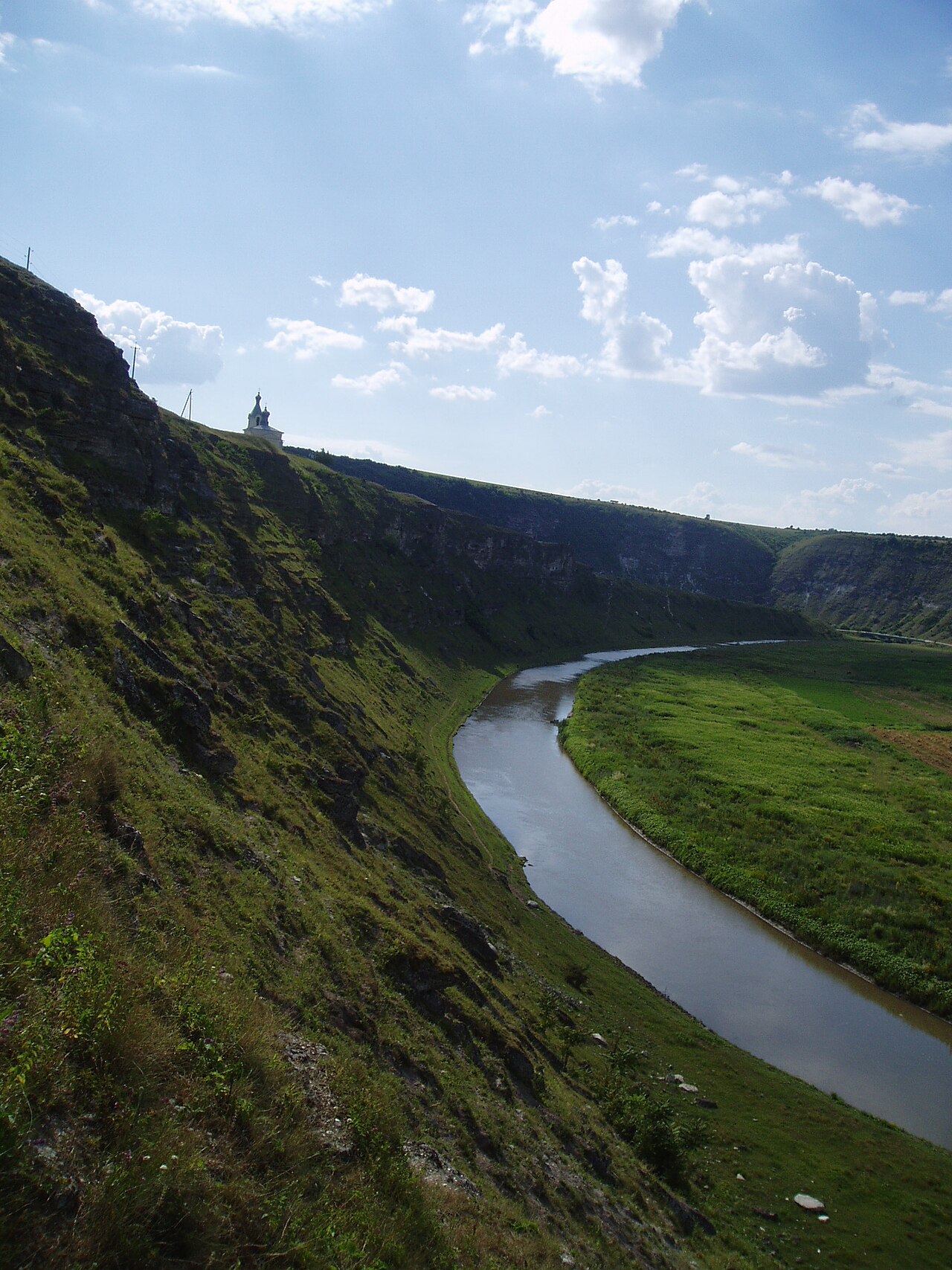
The caves are cut into vertical limestone faces above the Răut, and at Butuceni the promontory itself climbs from about 1 meter at one end to roughly 120 meters at the other, so the monastic cells sit partway up a cliff with the river's meander below and chernozem farmland above. The 1904 Orthodox church standing near the Getae sanctuary is the only intact building in the group.
The easily missed detail
Orheiul Vechi's Tentative List dossier is internally specific about one thing that reframes the site: the circular Getae sanctuary on the Butuceni fortress, from roughly 500 to 300 BC, is described as the earliest of its type in the Getae world. The fortress itself measures about 3,000 meters by 100 meters, with ditches and ramparts. Visitors come for the cave monastery and leave without realizing the ridge they walked along is an Iron Age defensive work with a first-of-its-kind shrine on it.
A practical rhythm
- Orheiul Vechi — About 55 km north of Chișinău, and a landscape to walk rather than a building to enter. Give it most of a day.
- The cave monasteries — Tipova, Japca and Saharna are separate sites from Butuceni, and each needs its own drive.
- Soroca and Tighina — The 2 surviving medieval fortresses, and the pair to treat with care for the reason below.
What could complicate the plan
The 2 fortresses are not equally straightforward. The State Department's advisory of 29 November 2024 rates the Transnistria breakaway region at Level 3, "Reconsider travel," a step above the Level 2 it applies to Moldova as a whole — so check both fortress locations against the advisory's regional boundary before you plan a drive to either. The advisory also prohibits photographing military sites or security personnel in the breakaway region, and records that Ukraine has closed the border crossings that once allowed entry from the east. Away from that, FAO's July 2026 country brief notes low rainfall and high temperatures between May and June 2026 depressing crop development in the central and southern regions — a reminder that the rural roads to these sites run through working farmland whose condition varies with the season.
What to do next
The Moldova when-to-visit answer sets out the harvest and wine-festival calendar that decides your month, and the trip-planning answer covers distances from Chișinău and the Transnistria question in practical terms.
Sources
- UNESCO World Heritage Centre, Tentative List 6220 — cave count and dating, full archaeological chronology, Getae fortress dimensions and sanctuary, Şehr al-Cedid and Orhei history, 1904 church
- Ministry of Foreign Affairs and European Integration of the Republic of Moldova — named cave monasteries and fortresses, "Southern Tebaida," distance from Chișinău
- US Department of State, Moldova travel advisory — Level 2 and Level 3 designations, Transnistria identification and photography rules, closed Ukrainian crossings
- FAO Global Information and Early Warning System, Republic of Moldova country brief, reference date 14 July 2026 — 2026 rainfall and temperature conditions by region