Moldova country guide When to visit
When is the best time to visit Moldova for Orheiul Vechi?
The short answer
September and early October — the grain harvest is finished, National Wine Day has been held annually since 2002 on the first Saturday and Sunday of October, and the Răut canyon that shapes Orheiul Vechi is at its most walkable once the summer heat breaks.
The answer, with local context
Moldova's year is agricultural, and FAO's Global Information and Early Warning System sets out the calendar precisely. In its country brief with a reference date of 14 July 2026, winter cereals — mainly wheat — began harvest in July with the work expected to conclude in August. Other spring cereals, mainly barley, finished planting in June for an August-to-September harvest. Maize is planted in May and harvested from October. That leaves September as the hinge month: the fields are cut, the maize is not yet in, and the wine calendar is about to open.
The wine calendar is the other half of the answer. Moldova's Ministry of Foreign Affairs and European Integration records National Wine Day as an annual event since 2002, held on the first Saturday and Sunday of October, and notes Moldovan wine is sold in more than 50 countries. The State Agency on Intellectual Property lists 3 protected wine-growing geographical indications — Valul lui Traian, Codru and Ştefan Vodă — plus Divin for old wine brandy produced throughout the country, all protected in the EU as of 18 October 2016.
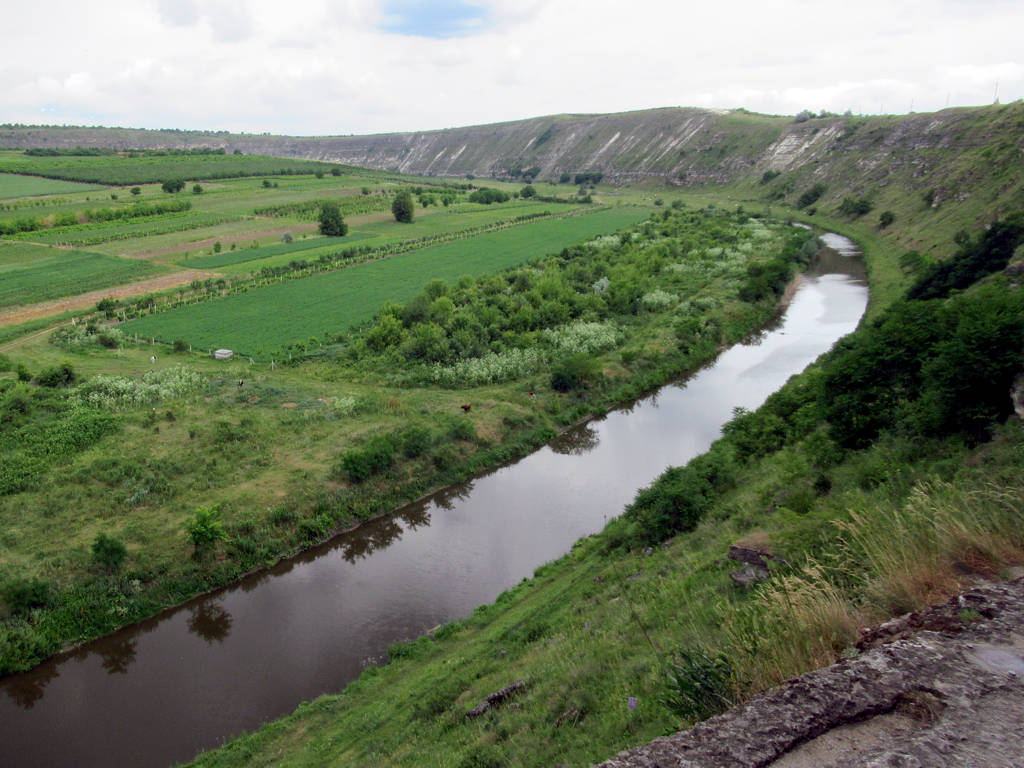
Orheiul Vechi itself is about 55 km north of Chișinău and is a landscape rather than a monument. UNESCO's Tentative List dossier, submitted by Moldova's Ministry of Culture on 22 February 2017 and proposed under criteria (ii) and (v), describes an amphitheatre roughly 3,500 meters east to west by 1,500 meters north to south, carved by the Răut river. The river is 15 to 20 meters wide and its deeply embedded meanders run about 7,000 meters through limestone, with the downstream left bank rising to between 100 and 148 meters. Access is through 2 natural passages, about 80 meters and about 300 meters wide.
Picture the place
The Butuceni promontory runs about 3,000 meters inside a sharp loop of the Răut, climbing from roughly 1 meter at its western end to about 120 meters at the eastern. Across the water the Peștera promontory is an oval about 2,500 meters by 850 meters with gentle slopes under black chernozem soil. About 200 caves are cut into the limestone escarpments, the earliest dug in the 15th century AD, and a still-standing Orthodox church dating from 1904 sits near both the Getae sanctuary and the cave churches.
The easily missed detail
Orheiul Vechi is not a World Heritage Site. It is on Moldova's Tentative List, where it has sat since 22 February 2017, which means it carries none of the visitor management, signage or capacity control that an inscribed property usually brings. The dossier's own value statement helps explain why it was nominated: the Getae fortress on Butuceni, from roughly 500 to 300 BC and measuring about 3,000 meters by 100 meters, includes a circular sanctuary described as the earliest of its type in the Getae world. The Golden Horde town of Şehr al-Cedid, founded in the first half of the 14th century and abandoned in 1368, left fortifications, a palace, a mosque, a caravanserai, a mausoleum, 3 baths and houses.
A practical rhythm
- July and August — Harvest months and the hottest stretch. FAO reports that low rainfall and high temperatures between May and June 2026 constrained maize development, so late summer here can be genuinely dry.
- September — Grain is in, maize is not, and the canyon walking is at its best.
- First weekend of October — National Wine Day, held on the Saturday and Sunday, has run annually since 2002.
What could complicate the plan
The State Department's Moldova travel advisory, issued 29 November 2024, places the country at Level 2, "Exercise increased caution while traveling to Moldova," citing the unresolved conflict between the breakaway region of Transnistria and the central government, and puts Transnistria itself at Level 3, "Reconsider travel." UNESCO's dossier places Orheiul Vechi on the lower Răut about 14 km upstream of that river's confluence with the Dniester, so check any planned side trip toward the Dniester against the advisory's regional boundary before committing to it. The site itself has a separate difficulty: it is on the Tentative List rather than the World Heritage List, so there is no inscribed-property visitor management, and the terrain is unforgiving. The Butuceni promontory climbs from roughly 1 meter at its western end to about 120 meters at its eastern, and the only ways into the amphitheatre are 2 natural passages about 80 meters and about 300 meters wide. This is walking on gradients across open limestone, not a signposted circuit.
What to do next
The Moldova places-and-experiences answer covers the cave monasteries and fortresses that pair with Orheiul Vechi, and the food-and-drink answer picks up the wine designations named here.
Sources
- UNESCO World Heritage Centre, Tentative List 6220 — submission date, proposed criteria, canyon and promontory dimensions, cave count, archaeological chronology
- FAO Global Information and Early Warning System, Republic of Moldova country brief, reference date 14 July 2026 — planting and harvest months, 2026 rainfall and temperature note
- Ministry of Foreign Affairs and European Integration of the Republic of Moldova — National Wine Day since 2002, export reach, distance of Orheiul Vechi from Chișinău
- State Agency on Intellectual Property of the Republic of Moldova (AGEPI), Ministry of Justice — the 3 wine geographical indications, Divin, EU protection date
- US Department of State, Moldova travel advisory — Level 2 and Level 3 wording and issue date