Montenegro country guide Places and experiences
What should a first-time traveler see in Montenegro beyond the obvious highlights?
The short answer
The interior the coast hides: Durmitor's Tara gorge and glacial lakes, the primeval forest of Biogradska Gora, Cetinje the old royal capital, the Ostrog cliff monastery, and Lake Skadar's pelican water — the 5 national parks that hold most of the country beyond the beach.
The answer, with local context
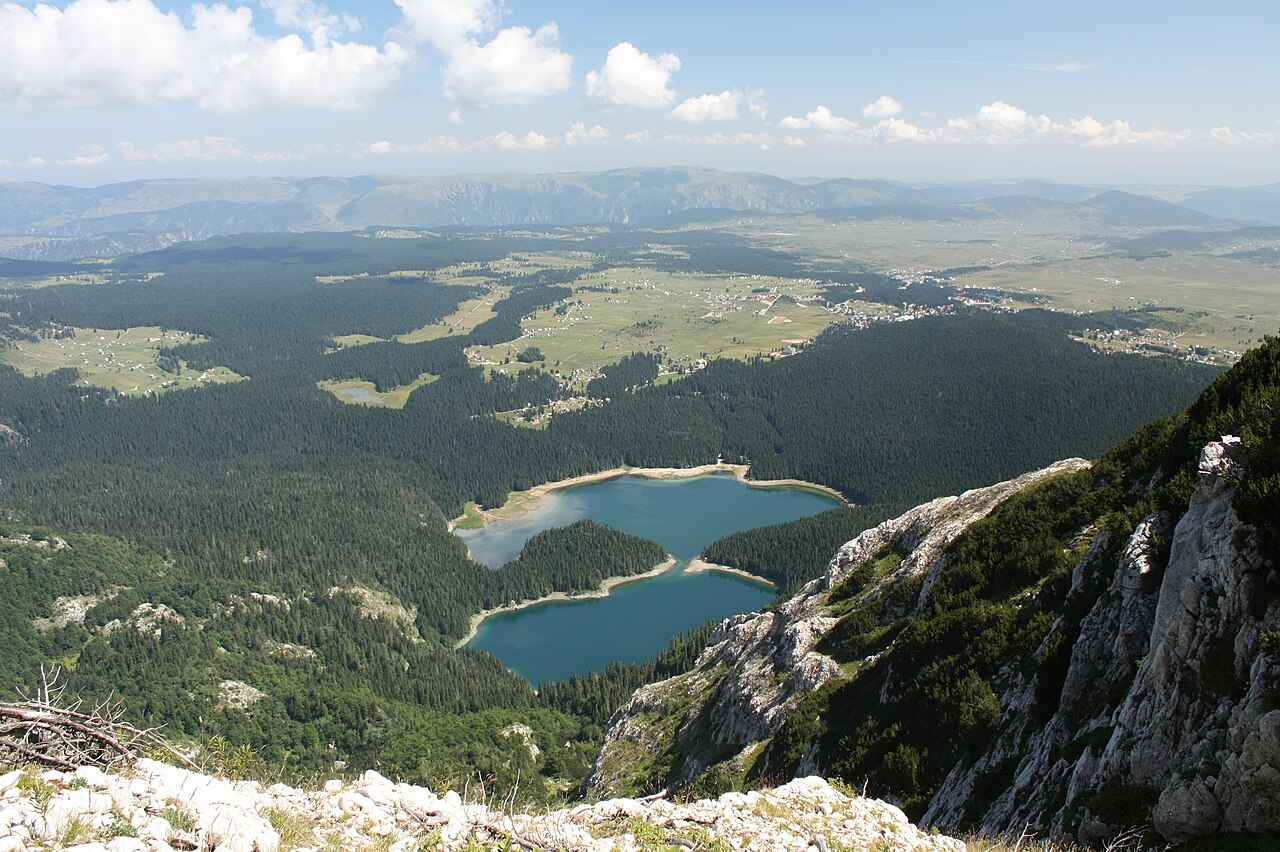
Montenegro protects its interior in 5 national parks — Durmitor, Biogradska Gora, Lake Skadar, Lovćen and Prokletije, administered by the national parks authority — and a first trip that visits 3 of them understands the country better than a fortnight on the riviera. Start with Durmitor, the UNESCO natural property (inscribed 1980, extended 2005): a limestone massif cut by the Tara River Canyon, whose gorges UNESCO describes as the deepest in Europe at about 1,300 m, dotted with 18 glacial lakes of which the Black Lake (Crno Jezero), below the peaks outside Žabljak, is the largest and most loved. The Đurđevića Tara bridge (365 m long, its arch 172 m above the river) and a rafting run through the canyon complete the set; above it all stands Bobotov Kuk at 2,523 m. The country's actual highest summit is nearby in spirit: Zla Kolata, 2,534 m, in the wilder, emptier Prokletije park on the Albanian border, where the stećci — the medieval tombstone graveyards UNESCO inscribed in 2016 — also stand in their Montenegrin necropolises near Žabljak and Plužine.
The second interior is older and quieter. Biogradska Gora, a national park since 1952, preserves one of Europe's last primeval rainforests — the Biograd forest reserve has been protected since 1878, when King Nikola received it as a gift and banned the axe — wrapped around a glacial lake at 1,094 m. Cetinje, the historical capital (Podgorica is the administrative one), holds the National Museum complex in the palaces of the Petrović dynasty, including King Nikola's Palace and the Biljarda, and it is the gateway to Lovćen: the mountain whose 1,657 m Jezerski vrh carries the mausoleum of Petar II Petrović-Njegoš, poet-prince and Montenegro's national figure, reached by 461 steps and holding a view that takes in the bay, the lake and half the country. Between the center and the coast, the Ostrog Monastery — built into a sheer cliff in the 17th century around the relics of St. Basil of Ostrog (died 1671) — draws pilgrims of 3 faiths and is the country's most visited sacred site.
Then the water that is neither sea nor river. Lake Skadar, shared with Albania, is the largest lake in Southern Europe, its surface breathing between 370 and 530 km² with the seasons; the Montenegrin national park (40,000 hectares, since 1983) shelters 260+ bird species including the curly (Dalmatian) pelican, and its working landscapes — the fishing village of Virpazar, the ruined Grmožur island fortress, the Pavlova Strana hairpin above the Rijeka Crnojevića inlet, wine villages of Crmnica on its northern shore — are Montenegro at its most lived-in. Add the south that the Kotor-bound skip: Bar, with an olive tree, the Stara Maslina, claimed at 2,000+ years old, and Ulcinj, whose 13 km Velika Plaža is the coast's great sand beach, and the country has shown all of its registers: gorge, forest, throne, cliff-shrine and lake.
Picture the place
The Black Lake at dawn under Durmitor: spruce forest to the water's edge, the twin basins black-green and still, and Medjed peak doubled in the surface before the first walkers arrive from Žabljak.
The easily missed detail
The stećci are the sleeper: Montenegro's share of the 2016 UNESCO inscription — carved medieval tombstones scattered in high pastures near Žabljak and Plužine — costs a short detour on the Durmitor road and is seen by almost nobody, in a country where Kotor's lanes queue. The second miss is chronological: Biogradska Gora's rainforest is a morning place, when the mist sits on Lake Biograd and the old-growth beech and fir stand empty; by midday the picnic meadows fill and the spell thins.
A practical rhythm
- One park per region — Durmitor (northwest), Biogradska Gora (northeast), Skadar (center): 3 parks, 3 landscapes, no repetition
- Cetinje as the hinge — The royal capital placed between the coast and Lovćen, never as a drive-through
- Ostrog early or late — The cliff monastery visited outside the midday pilgrim-coach hours, with the lower church included
What could complicate the plan
Distance deceives: Montenegro looks small, but the interior runs on mountain roads — Podgorica to Žabljak is about 125 km and the better part of 3 hours, and the Prokletije trailheads are farther again from any base, so the beyond-highlights list must be sequenced north-to-south, never criss-crossed. National-park entry is per-park and per-day, paid at park entrances or online through the parks authority, and Durmitor's high trails are seasonal — snow can hold the passes into June and return in October. Ostrog asks its own respect: it is a working monastery and pilgrimage site (covered shoulders and knees, photography limits inside), and its approach road is a cliff shelf that tour coaches climb on a schedule worth avoiding.
What to do next
Draw the interior loop on the map — Skadar, Cetinje–Lovćen, Durmitor, Biogradska Gora — and give it at least 5 of your nights before the coast gets any.
Sources
- UNESCO World Heritage Centre — Durmitor National Park (1980): Tara gorges about 1,300 m deep, 18 glacial lakes; Stećci Medieval Tombstone Graveyards (2016)
- Public Enterprise National Parks of Montenegro (nparkovi.me) — the 5 national parks; Lake Skadar National Park (1983), 40,000 hectares
- Ramsar Sites Information Service / park authority — Lake Skadar's seasonal surface of 370–530 km² and its 260+ bird species
- National Museum of Montenegro, Cetinje — the Petrović palace museums; Lovćen mausoleum, 461 steps, Jezerski vrh 1,657 m