Morocco country guide Trip planning
How can I plan a memorable first trip to Morocco without rushing?
The short answer
Two bases, not five, over ten to fourteen days — one imperial city and one southern or coastal base, because Morocco's nine World Heritage properties are spread across a country with mountain passes between them and no fast route to the south-east.
The answer, with local context
Start with the paperwork, because it is the only part that cannot be fixed en route. Under the rules published by the UK Foreign, Commonwealth & Development Office, a full British citizen passport must still have three months to run from the day you land, and a polio vaccination certificate is required of anyone whose journey begins in a polio-affected country. Morocco stands at Level 2, Exercise Increased Caution, in the State Department advisory of 21 April 2025, which gives terrorism as the reason. Morocco's current CDC entry is a Level 1 rabies notice, dated 23 December 2025.
Then decide which Morocco you want, because the country is four of them. The Atlantic and Mediterranean coasts, the imperial cities of the plains, the Middle and High Atlas, and the pre-Saharan south-east are different in climate, language mix and food. The nine inscribed World Heritage properties are distributed across all four — Fez and Marrakesh, Meknes and Volubilis, Tétouan and Essaouira, Mazagan at El Jadida, Rabat and Aït-Ben-Haddou — which makes a heritage-led itinerary the clearest way to choose, and a warning against trying to collect them.
A first trip that works tends to look like this: five or six days based in one imperial city with day trips, then a move south or to the coast for the rest. Marrakech at 464 m (1,522 ft) sits directly below the High Atlas and makes the strongest southern base; from there the road over the Tizi n'Tichka reaches Aït-Ben-Haddou and the valleys beyond in a day.
Time the move with the climate, not the calendar. Marrakech's monthly mean is 65.7°F (18.7°C) in April and 71.2°F (21.8°C) in October against 83.7°F (28.7°C) in July, and the city sees only 0.06 inches (1.4 mm) of rain across the whole of July. Those same shoulder months are when the Atlas passes are clear and the desert margin is not punishing.
Picture the place
The drive south from Marrakech climbs out of a flat, dry plain into switchbacks, tops out at a pass with the Atlas falling away on both sides, and drops into a landscape of bare rock and palm-filled valleys that looks like a different country. The transition takes about three hours and is the single best argument for the two-base plan.
The easily missed detail
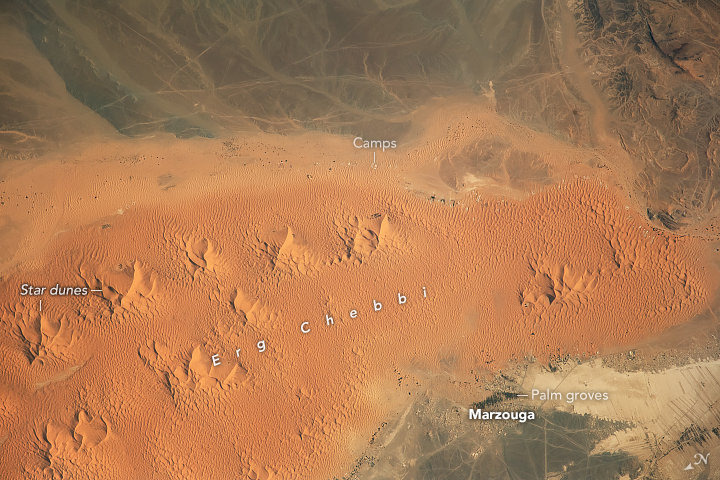
The pre-Saharan dune fields are much smaller and much more specific than the word Sahara suggests. Erg Chebbi, near Merzouga on the Algerian border, is the dune sea most travelers mean, photographed from orbit by an Expedition 70 crew member aboard the International Space Station in December 2023. It is a bounded erg reached by road, not an open desert, and the drive to it from Marrakech is a full day whichever route you take.
A practical rhythm
- Days 1–5 — One imperial city, on foot, with Volubilis or Meknes as a day trip rather than a stop on a transfer.
- Days 6–8 — Move once. The Tizi n'Tichka to Aït-Ben-Haddou and the southern valleys, or the Atlantic to Essaouira and El Jadida.
- Days 9–12 — Stay put somewhere. Morocco rewards a second day in one place far more than a fifth city.
What could complicate the plan
Distances are the main enemy of an unhurried trip: the far north and the south-east are at opposite ends of the country and mountain roads between regions are slow in good weather and closable in snow. Friday prayers shorten many business afternoons. Ramadan, which moves earlier by about eleven days each year, changes restaurant hours nationwide for a lunar month. Marrakech's medina and most old-city riads cannot be reached by car, so arrival logistics involve a handcart.
What to do next
The places-and-experiences question in this group names the sites worth building a second base around. For the climate detail behind the two shoulder windows, read the when-to-visit question.
Sources
- UNESCO World Heritage Centre, States Parties statistics — count and identity of Morocco's World Heritage properties
- UK Foreign, Commonwealth & Development Office, Morocco entry requirements — passport validity and polio certificate rules
- US Department of State, Morocco travel advisory — advisory level, date and stated reason
- US Centers for Disease Control and Prevention, travel notices — rabies notice level and date
- WMO climatological normals, Marrakesh station 60230, published via the Japan Meteorological Agency — monthly means, July rainfall, elevation
- NASA Earth Observatory, Sandy Sculptures in Morocco's Erg Chebbi — astronaut photograph of Erg Chebbi, December 2023