Morocco country guide Food and drink
What local dishes should I try in Morocco, and where should I look for them?
The short answer
Couscous, tagine, harira, bissara and argan-based amlou cover the country's range — and couscous carries a UNESCO listing of its own, inscribed on the Representative List in 2020 as a joint nomination by Algeria, Mauritania, Morocco and Tunisia.
The answer, with local context
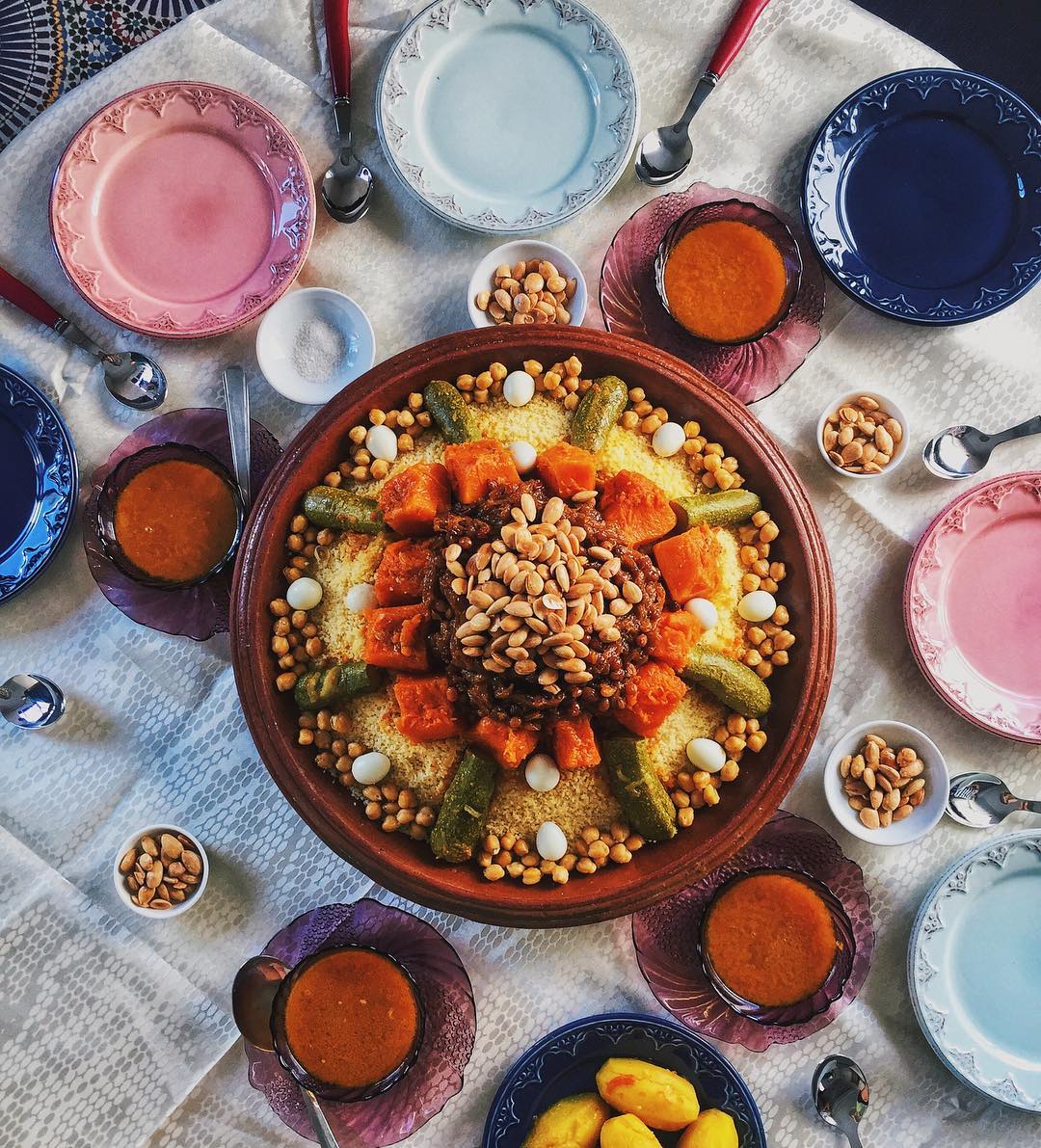
Couscous in Morocco is a Friday dish before it is a restaurant dish. It arrives as a mound of steamed semolina built over broth-cooked vegetables, and in its sweet-savoury form it comes with tfaya — caramelized onions, raisins, butter and spices — scattered with toasted almonds, with small bowls of the vegetable broth on the side to add to taste. UNESCO's 2020 inscription, decided by the Intergovernmental Committee under decision 15.COM 8.B.14, covers the knowledge, know-how and practices around it across four Maghreb countries, which is a reminder that it is not a Moroccan invention so much as a Moroccan inheritance.
Tagine is a cooking vessel first and a category second: a conical earthenware lid over a shallow dish, which returns condensed steam to the food below. Regional versions are genuinely different — goat with quince in the north, chicken with preserved lemon and olives on the plains, lamb with prunes and almonds for celebrations. In Marrakech the local relative is tanjia, cooked in a sealed urn rather than under a cone.
Argan oil is the one Moroccan ingredient with a heritage listing attached to its production. UNESCO inscribed "Argan, practices and know-how concerning the argan tree" in 2014, covering the Arganeraie Biosphere Reserve in the south-west, and its description names cooking among the oil's uses and includes the preparation of recipes and derived products within the element. Amlou — argan oil, almonds and honey — is the breakfast form; the culinary oil is roasted and tastes nothing like the cosmetic grade.
Where to look divides by region rather than by price. The Atlantic ports, Essaouira and El Jadida among them, grill the day's catch; the Rif and the north lean Andalusian; the south-east runs to dates, bread baked in communal ovens and bissara, a thick fava bean soup eaten for breakfast with olive oil and cumin.
Picture the place
A platter of Moroccan couscous arrives wide rather than tall — squash and halved zucchini pressed into the grain, chickpeas scattered through it, the tfaya dark against the pale semolina. It is served to the middle of the table and eaten from the section in front of you, which is why the dish is built as a circle.
The easily missed detail
Morocco's argan oil economy runs through women's cooperatives, roughly fifty of them in the south-west by 2010 according to a WIPO case study, in a region designated a UNESCO Man and the Biosphere reserve in 1998. UNESCO records that the knowledge passes from mother to daughter through imitation and non-formal education. The practical consequence is that oil bought at a cooperative in the Souss has a traceable origin, while oil bought in a city souk frequently does not.
A practical rhythm
- Breakfast — Bissara in the south, or bread with amlou and mint tea; both are everyday food rather than tourist food.
- Friday lunch — Couscous, which is when households make it and when restaurants are most likely to have it properly steamed.
- Evening — Harira to start, then a tagine; in Ramadan harira is the soup that breaks the fast.
What could complicate the plan
The CDC lists Rabies in Morocco as a Level 1 notice dated 23 December 2025 and includes Morocco in its Global Measles Level 1 listing; neither is a food issue, but both belong in the same pre-trip conversation. Vegetarians do better than they expect with vegetable couscous and bissara, though broths are frequently meat-based. Ramadan changes everything about daytime eating for a lunar month that shifts earlier by roughly eleven days each year. The US Department of State's Morocco advisory stands at Level 2, issued 21 April 2025.
What to do next
The places-and-experiences question in this group covers the argan region and the coastal towns where the seafood is landed. The trip-planning question handles how to move between them.
Sources
- UNESCO Intangible Cultural Heritage, Couscous, knowledge, know-how and practices — 2020 inscription, four-country nomination, committee decision 15.COM 8.B.14
- UNESCO Intangible Cultural Heritage, Argan, practices and know-how concerning the argan tree — 2014 inscription, culinary use, transmission between generations
- World Intellectual Property Organization case study on argan oil — cooperative numbers, Biosphere Reserve designation
- Wikimedia Commons file description, Moroccan couscous — composition of the dish, tfaya and bloul
- US Centers for Disease Control and Prevention, travel notices — rabies notice level and date
- US Department of State, Morocco travel advisory — advisory level and date