Morocco country guide Places and experiences
What should a first-time traveler see in Morocco beyond the obvious highlights?
The short answer
Four of Morocco's nine World Heritage properties get a fraction of the attention the medinas of Fez and Marrakech do — Volubilis, Meknes, Tétouan and the Portuguese City of Mazagan at El Jadida — and the Ksar of Aït-Ben-Haddou gives you the pre-Saharan south without a four-wheel drive.
The answer, with local context
Volubilis is the one that most changes a traveler's picture of the country. It is an archaeological site, inscribed by UNESCO, of a Roman provincial city on the far western edge of the empire — mosaics, a basilica and a triumphal arch standing in farmland below the hills near Meknes. Morocco as a Roman province is not what the brochures sell, and the site is an easy half-day from Fez.
Meknes is listed as a historic city in its own right and functions as an imperial capital in miniature: monumental gates, granaries and stables built at scale, with a fraction of Fez's visitor numbers. Pairing it with Volubilis makes a single, unhurried day.
The two coastal listings pull in opposite directions. The Medina of Tétouan, in the Rif in the north, preserves an Andalusian urban fabric brought over by refugees from Spain. The Portuguese City of Mazagan at El Jadida, on the Atlantic south of Casablanca, is a sixteenth-century Portuguese fortification, with a cistern whose reflecting floor is its best-known room. Both are inscribed; neither appears on a standard first itinerary.
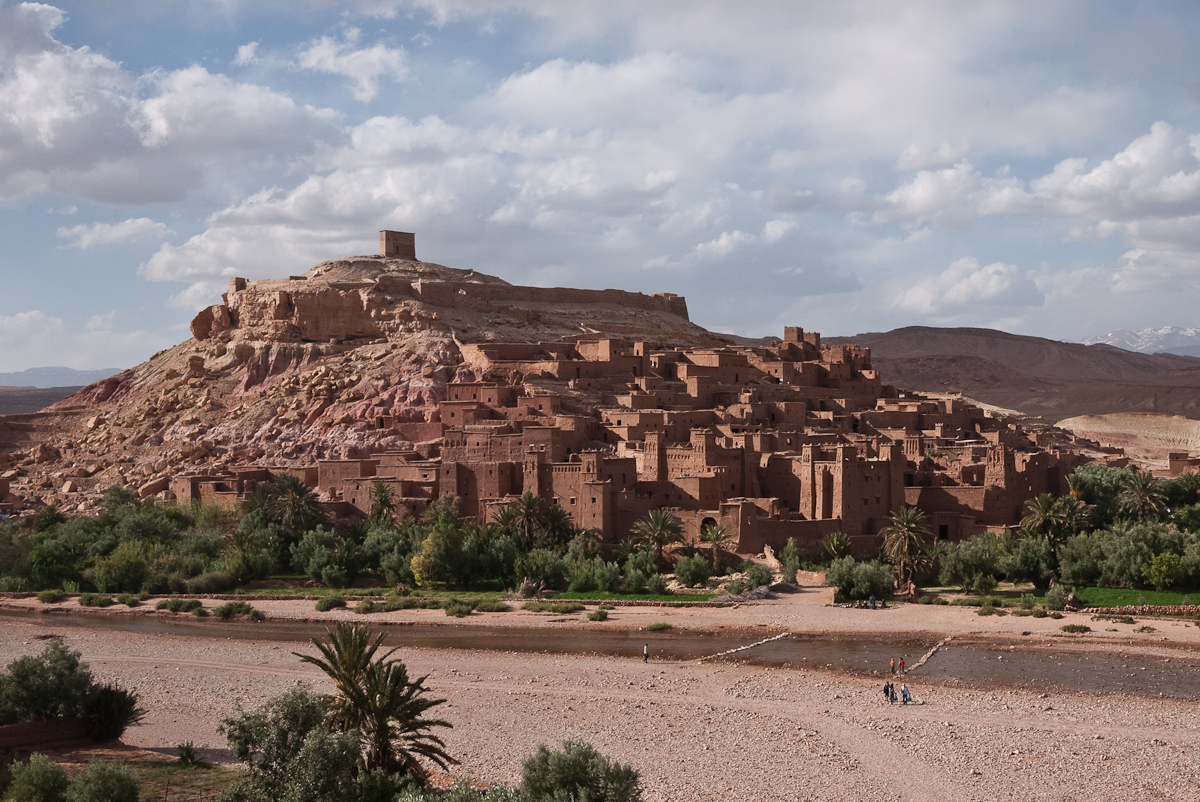
Aït-Ben-Haddou is the south's accessible icon: a fortified ksar of earthen buildings stacked up a hillside above the Ounila valley, on the old caravan route between Marrakech and the Sahara, and a UNESCO World Heritage property. It sits on the paved road over the Tizi n'Tichka pass, which means you can reach it in a day from Marrakech and keep going to the Dadès or the Draa.
Morocco's living heritage is worth planning around too. "Argan, practices and know-how concerning the argan tree" was inscribed on UNESCO's Representative List in 2014, covering the Arganeraie Biosphere Reserve in the south-west — a region designated under UNESCO's Man and the Biosphere Programme in 1998, and the only place on earth where the tree grows wild.
Picture the place
The ksar at Aït-Ben-Haddou is built from the valley it stands in — rammed earth and mud brick the same color as the hillside, so from a distance the whole settlement reads as part of the slope rather than something placed on it. Rain is what damages it, and the repairs are made with the same material.
The easily missed detail
The south-west's argan forest is a UNESCO designation of a different kind from a monument listing. The Man and the Biosphere reserve recognizes a working landscape, and the heritage listing recognizes the labour inside it: harvesting, drying, pulping, grinding, sorting, milling and mixing with carefully measured warm water, done mainly by rural women known as argan women, using hand mills made by local craftspeople. Visiting a cooperative is visiting the listed element, not a gift shop.
A practical rhythm
- North — Tétouan and the Rif for Andalusian urbanism, reachable from Tangier rather than from Marrakech.
- Centre — Meknes and Volubilis together: an imperial city and a Roman one, in one day from Fez.
- South — Aït-Ben-Haddou over the Tizi n'Tichka, then on to the valleys rather than straight back.
What could complicate the plan
None of these places sit close together: Tétouan is in the far north and Aït-Ben-Haddou is beyond the High Atlas, and Morocco has no rail link to the south-east, so the southern legs are road journeys of several hours over passes. The US Department of State has Morocco at Level 2, Exercise Increased Caution, issued 21 April 2025. Entry rules still apply wherever you go: the UK Foreign, Commonwealth & Development Office requires a British citizen passport valid for at least three months beyond arrival, and a polio vaccination certificate from anyone arriving from a polio-affected country. Mountain passes can close in winter snow.
What to do next
The trip-planning question in this group turns this spread of sites into a workable route. For which months make the mountain and desert legs comfortable, see the when-to-visit question.
Sources
- UNESCO World Heritage Centre, States Parties statistics — Morocco's nine World Heritage properties and their identities
- UNESCO Intangible Cultural Heritage, Argan, practices and know-how concerning the argan tree — 2014 inscription, Arganeraie region, production steps and the role of rural women
- World Intellectual Property Organization case study on argan oil — 1998 Man and the Biosphere designation, restriction of the argan tree to south-west Morocco
- US Department of State, Morocco travel advisory — advisory level and date
- UK Foreign, Commonwealth & Development Office, Morocco entry requirements — passport validity and polio certificate rules