Nauru country guide Trip planning
How can I plan a memorable first trip to Nauru without rushing?
The short answer
Give Nauru 4–5 days — long enough to circle it slowly twice, walk Topside with a guide, spend a dawn at Anibare and a dusk at Buada, and let the island's scale become the experience: 21 km², 1 ring road, 12,500 people, and nowhere at all to hurry to.
The answer, with local context
Nauru is the rare destination where "without rushing" is a structural given — the country is 1 island, its ring road is about 19 km, and its longest possible drive is under half an hour — so the planning art lies elsewhere: in sequencing the visa, the flight and the island's few doors in the right order. Step 1 is the visa (begun 6–8 weeks ahead): Nauru requires advance approval for all visitors, applied for by email to Immigration with a confirmed hotel booking, passport valid at least 3 months, visitor stays to 30 days, no issuance on arrival — the booking makes the visa, the visa makes the boarding pass. Step 2 is the flight: Nauru Airlines from Brisbane (the mainline route, a few services a week) or the airline's north-Pacific chain through Tarawa and Majuro, which pairs Nauru beautifully with Kiribati and the Marshalls for Pacific collectors — and which also means Nauru is often most sensibly visited inside a wider island itinerary rather than as a standalone expedition from far away. Step 3 is the base: the Menen Hotel on the east coast (the island's flagship, by Anibare's district) or the smaller Aiwo-side hotels — there are only a handful of properties on the island, and official and project traffic takes a real share of the rooms, so book before the visa application, not after.
The days then compose themselves. Day 1: the ring — a full circuit by rental car or hotel-arranged driver, Yaren's Parliament and museum, Aiwo's cantilevers, Capelle's at Ewa, the northern districts' beaches, home by the west coast's sunset. Day 2: Topside — the guided pinnacle circuit, Command Ridge's bunkers and the island laid out below at 71 m, Moqua Cave's underground lake in the afternoon cool. Day 3: Anibare — dawn on the east coast, the bay on its tides, Buada Lagoon at golden hour on the way home. Day 4: the living island — a game-fishing morning or a reef trip, the weightlifting gyms and the civic center, a Chinese-restaurant lunch in Aiwo, and the frigatebird men if the season and contacts align. Day 5 is the buffer the airline timetable will someday thank you for — Nauru is not a place to schedule to the last hour, because its flights, like its weather, run on their own counsel. Currency is the Australian dollar; cards are accepted at the Menen and Capelle's and almost nowhere else; cash rules the districts. There is no U.S. embassy (Australia's High Commission is the island's senior mission; U.S. interests run through Suva and the embassy structure in the region — the State Department's Nauru page is the reference), and medical evacuation insurance to Brisbane is the serious line in the budget, as the island's hospital, though willing, is small.
Picture the place
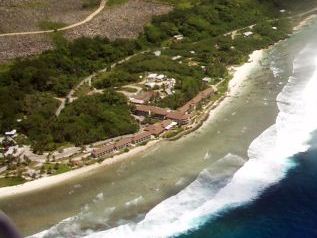
The departure morning: the whole island visible from the Menen's terrace in 1 turning look — reef, ring road, pinnacle interior, lagoon hollow — a country you can hold in a single glance, and have actually come to know.
The easily missed detail
Nauru rewards the traveler who books the driver, not the car: the island's sights are ungated and unsigned, its stories are oral, and a local driver-guide converts a 19-km circuit of mysteries into a narrated country in about 4 hours — while the self-driver completes the same loop in 40 minutes and reports, wrongly, that there is nothing to see. The second detail is the arrival itself: the runway crosses the island's southern waist at Yaren, so the plane lands between the ocean and the government, and the terminal, the Parliament and the Menen's transfer all happen inside your first 15 minutes on Earth — Nauru begins at full intimacy, and there is no arrivals hall anonymity to hide in.
A practical rhythm
- Visa, flight, hotel — in that dependency order — Each unlocked by the one before, all started 2 months out
- 1 theme per day — Ring, Topside, east coast, living island: the country's 4 registers on 4 mornings
- The 5th day held empty — Buffer against the timetable, and the island's invitation day
What could complicate the plan
Everything about Nauru is single-threaded: 1 airline system (a cancellation strands you pleasantly for days — insure the delay), 1 small hotel stock (a conference or project intake can take the Menen's best rooms), 1 hospital, 1 supermarket of consequence, and 1 visa office whose reply speed sets your calendar. The island's politics touch the visitor lightly but really: the Regional Processing Centre's presence shapes immigration scrutiny and photography sensitivities, journalists face the AUD 8,000 media visa and should not attempt tourism entry, and government precincts and the RPC perimeter are not photo subjects. ENSO writes the weather (a La Niña year can drown the "dry" season; an El Niño drought can ration water), sea-level king tides flood the ring road's low stretches in the early-year months, and Sunday stills the island almost completely. None of it argues against going — it argues for the 5-day, buffer-built plan above, which absorbs every 1 of these frictions by design.
What to do next
Email Immigration and the Menen in the same week, 2 months before your October window — and let Nauru Airlines' timetable, not your calendar, pick the exact days.
Sources
- Government of Nauru (Immigration) / IATA — advance visa requirements, 30-day visitor limit, hotel-booking prerequisite, $50 departure tax via the airline
- Nauru Airlines — Brisbane and north-Pacific (Tarawa–Majuro) route network
- Nauru Tourism / hotel record — the Menen Hotel and the island's small accommodation stock
- U.S. Department of State — Nauru country information (entry, health and consular arrangements)