Nauru country guide When to visit
When is the best time to visit Nauru for Anibare Bay?
The short answer
October — Nauru's driest month (about 3.9 inches / 100 mm in the Yaren climate record, against 11 inches / 280 mm in December and January), at the tail of the trade-wind season, when Anibare Bay's east-coast shore is at its calmest and brightest for the year's best swimming and reef days.
The answer, with local context
Nauru has weather but barely seasons, which is what 42 km south of the equator means in practice: temperatures hold 77–88°F (25–31°C) all year, tropical cyclones essentially never reach it, and the only real variable is rain. The published record (the Yaren climate data) puts annual rainfall at about 2,080 mm with extremes that swing wildly by ENSO year (recorded years run from 310 mm to 4,500 mm), falling as a wet season from November to February under westerly monsoon winds and a drier season through the middle of the year under the easterly trades. October is the hinge month at the dry end: the trades still moderate the heat, humidity sits at its annual low end, the island's tanks are as full as the dry season leaves them, and the rain has not yet returned. For Anibare Bay the wind matters as much as the rain: the bay is on the windward east coast, a roughly 2-km arc of white sand between reef and coconut fringe, and the trade-wind months keep it breezy and bright while the wet season turns its surf confused and its access road slick.
The anchor's detail repays honesty: Anibare is Nauru's best beach, not a resort beach — the island has no beachfront development at all, the swimming is reef-flat swimming at the right tide (the bay's coral heads and pinnacles are famous at low water), and strong currents along this coast mean locals' advice about where to enter is a safety system, not small talk. The bay also serves as the island's working harbor (a new port facility at Anibare, built with Australian and ADB support and opened in the early 2020s, handles the cargo that once came over the Aiwo cantilevers). Around an October stay, the island assembles quickly because everything is 20 minutes from everything: the ring road runs about 19 km around the whole country; the population of roughly 12,500 (2021 census) lives on the coastal belt, in places only 100–300 m wide; and the interior is another world entirely (the next answer walks it). The entry machinery is the trip's one hard gate and belongs in this answer: Nauru is the rare Pacific nation that requires every visitor to hold a visa approved in advance — there is no visa on arrival for U.S. citizens (confirmed by the U.S. and Irish governments), applications go by email to Nauru Immigration with a confirmed hotel booking, the passport needs at least 3 months' validity, the visitor visa runs to a maximum of 30 days, and a $50 departure tax is collected through the airline in the fare. October rewards planners; it forgives no improvisers.
2 civic dates frame the alternatives: Angam Day (October 26) — Nauru's uniquely moving national holiday, marking the day in 1932 when the Nauruan population, nearly extinguished by war and disease, recovered to the 1,500 souls deemed necessary for survival — falls inside the October window, and Constitution Day (May 17) opens the dry season. But the bay itself argues for October: driest month, trades steady, water clear.
Picture the place
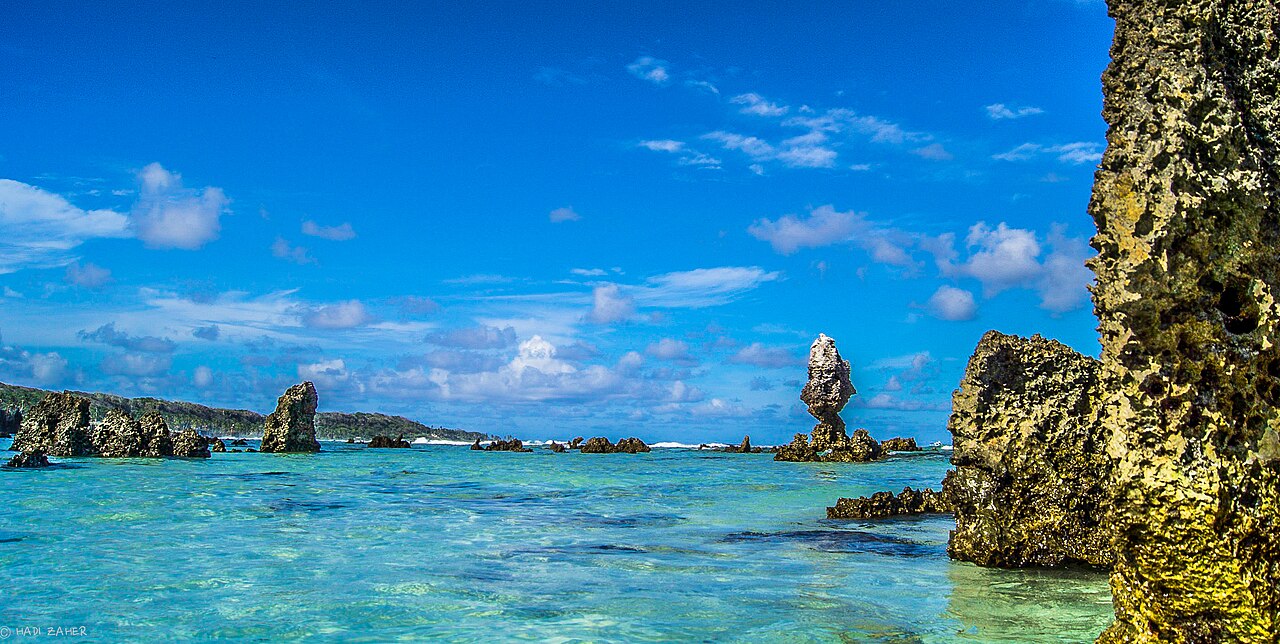
Anibare at sunrise, which on the east coast means the sun comes straight out of the Pacific: white sand empty but for 2 fishing boats, reef pinnacles black in the shallows, and the island's green rim lit from behind.
The easily missed detail
Nauru's calendar has a 3rd season the climate charts miss: the frigatebird season of the dry months, when Nauruan men go up to Topside at dawn for the traditional frigatebird catch — decoy birds, weighted bolas, and a sport-ceremony that is the island's emblem (the frigatebird rides the national coat of arms). It is arranged and witnessed through local contacts, not bought as a tour. The second detail is tidal: Anibare's swimming quality inverts with the tide — high water for swimming over the coral, low water for the pinnacle gardens and reef walking — so the day's plan is written by the tide table the hotel desk keeps.
A practical rhythm
- East coast mornings — Anibare at dawn for the sunrise, the swim on the rising tide, reef pinnacles at the ebb
- Topside afternoons — The mined plateau and Command Ridge taken when the coast bakes
- The ring by bicycle or car — The full 19 km in 1 unhurried circuit, district by district, twice in the stay
What could complicate the plan
The visa is the first complication and it is absolute: without the emailed approval and a confirmed hotel booking, airlines will not board you in Brisbane or Nadi — start the process 6–8 weeks out, and expect Pacific-pace replies. Flights are the second: Nauru Airlines is the island's lifeline (Brisbane services, plus the north-Pacific run to Tarawa, Majuro and beyond) on a few-times-weekly rhythm, so dates bend to the timetable. Then the island's own terms: Nauru hosts Australia's Regional Processing Centre for asylum seekers, and while it sits apart from visitor life, it explains the visa scrutiny, the sensitivity around certain photography, and the notorious media-visa regime (journalists have faced a non-refundable AUD 8,000 visa fee since 2014 — do not travel on a tourist visa to report). Drinking water is desalinated and rain-caught (drink what hotels serve), medical care stops at the Republic of Nauru Hospital (serious cases fly to Brisbane), and the island's 2-3 hotels (the Menen is the flagship) fill with official and project traffic — book before the visa, since the visa needs the booking.
What to do next
Start the visa email first (it needs the hotel, which needs the flight dates), then let Nauru Airlines' October timetable choose your days.
Sources
- Yaren climate record (Weatherbase) — October the driest month (about 100 mm); December–January the wettest (about 280 mm); annual about 2,080 mm
- Government of Nauru / IATA visa policy records — advance visa required for all visitors; no visa on arrival for U.S. citizens; passport valid at least 3 months; visitor stays to 30 days; $50 departure tax collected via the airline
- Nauru Bureau of Statistics, 2021 census — population about 12,500
- Nauru Tourism — Anibare Bay and the Anibare port; Angam Day (October 26) and Constitution Day (May 17)