North Macedonia country guide When to visit
When is the best time to visit North Macedonia for Ohrid?
The short answer
June — the lake has warmed for swimming, the mountains are fully open, Skopje has not yet hit its furnace weeks, and Ohrid gets its churches, fortress and lakefront back from the July–August diaspora crowds that double the town.
The answer, with local context
North Macedonia is a landlocked, mountainous country of 25,713 km² with a continental climate that runs to extremes: Skopje, in its valley bowl, sizzles through July and August with highs in the 90s °F and spikes past 100°F (38°C+), then sits under cold winter inversion fog; the southwest lakes, moderated by water and altitude, run gentler. June is the national sweet spot. The hiking season in the 4 national parks — Mavrovo, Pelister, Galičica and Šar Mountains — is open top to bottom, the high pastures are green, the Tikveš vineyards are in full leaf, and the ajvar peppers are still a season away from harvest, which means the countryside is in flower rather than in production. Entry is not a variable: the U.S. Department of State confirms that U.S. citizens need no visa for tourist stays of less than 90 days within a 6-month period, with a passport valid 3 months beyond departure — and that foreign visitors must present travel medical insurance on entry, a rule worth arranging before, not at, the border.
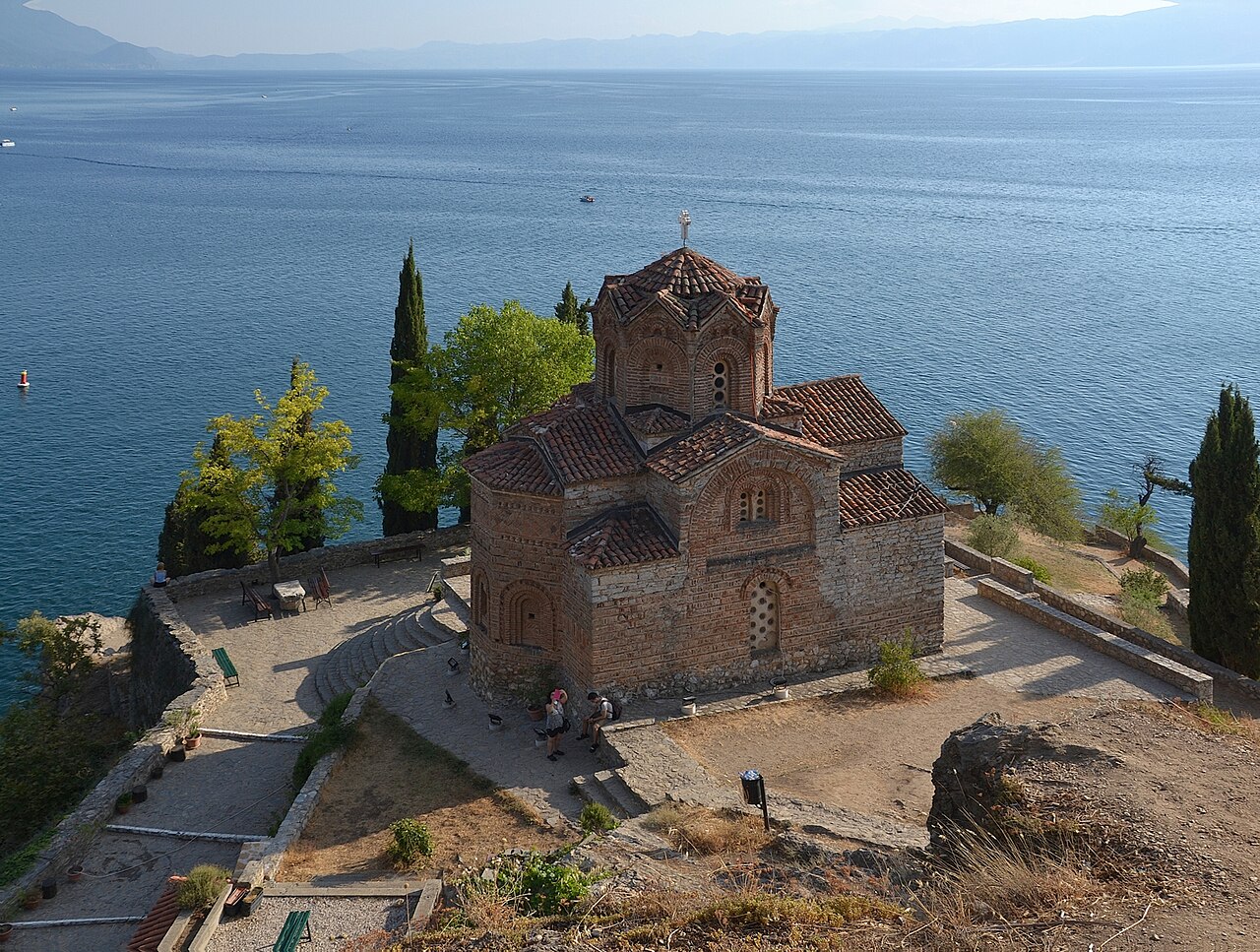
Now the anchor. Ohrid stands on the northeastern shore of a lake that UNESCO describes as having existed continuously for 2–3 million years: 358 km² of water at 695 m above sea level, up to 288 m deep, with clarity measured to 22 m and 212 endemic species among its 1,200 native taxa (the figures in its Ramsar listing, granted February 15, 2021). The mixed UNESCO property — inscribed 1979 for the town, extended 1980 for the lake and 2019 to take in the Albanian shore, 94,729 hectares in all — packs the town with the evidence: St. Sophia's 11th-century frescoes, the 13th-century church of St. John at Kaneo on its cliff, St. Clement's monastery at Plaosnik (founded 893, beside what tradition calls the first Slavonic university), the Hellenistic theater of about 200 BC, and Samuel's Fortress above it all. In June the lake reaches swimmable warmth (low 70s °F by late month), the Ohrid Summer Festival (running since 1961) has not yet started its July 12–August 20 season and its crowds, and the town's famous summer peak — August, when the diaspora returns and Ilinden (August 2) fills every bed — is still 6 weeks away.
The alternatives serve narrower trips. July and August are Ohrid's festival-and-swimming high season and the right answer for a lake-holiday-first visit that accepts the heat in Skopje and the crowds in the old town. September answers back with warm water, empty lanes and the wine and pepper harvests inland — a strong second. Winter belongs to the ski centres (Mavrovo, Popova Šapka) and to a Skopje that travelers mostly transit. But for the country and its anchor together, June is the month when nothing is closed, crowded out or overheated.
Picture the place
Kaneo at 8 p.m. in June: the little church alone on its cliff above water gone copper, swallows working the headland, and the Albanian mountains across the lake turning violet as the day's last swimmers climb out below.
The easily missed detail
Ohrid's water lies about its temperature: fed by springs (including the great spring field at St. Naum, where much of Lake Prespa's water arrives underground through Galičica), the lake warms slowly, and June's early weeks can still feel brisk at 68–70°F (20–21°C) while the air sits at 85°F — swimmers who want the warm lake should aim for the month's second half. The second missed detail is calendrical: the town's traditional "365 churches, one for every day of the year" is a legend about density, not a count — but the density is real, and the churches' fresco cycles (St. Sophia, the Theotokos Peribleptos of 1295) reward the traveler who gives them mornings rather than gaps between swims.
A practical rhythm
- Lakes in June's second half — Ohrid placed after the mountains, when the water has warmed and before the festival season opens on July 12
- Churches before noon — Frescoes and Plaosnik in the morning light and quiet; the lake owns the afternoons
- Skopje at the edges — The capital used as arrival and departure bookends, its heat never given the middle of the trip
What could complicate the plan
The insurance rule is the documented trap: the U.S. State Department notes that foreign citizens are required to present travel medical insurance on entering North Macedonia, and border officers do ask — carry the policy document, not just the booking. Registration is the second formality: visitors must register with the police within 48 hours of arrival (hotels file it automatically; private stays are on you). In Ohrid itself, August-style pressure is absent in June, but the lake has its own clause: the Ohrid trout, the lake's endangered endemic emblem, is protected — its wild fishery is restricted and the Hydrobiological Institute restocks up to 2.5 million juveniles a year — so "Ohrid trout" on a menu should be hatchery fish, and asking is fair. Finally, June weather in the mountains is not settled summer: Korab and the Šar ridges can hold snowfields and afternoon storms well into the month.
What to do next
Book a June window, insure the trip visibly, and put Ohrid in the trip's second half with 3–4 nights — the town is a base, not a stop.
Sources
- U.S. Department of State, North Macedonia travel information — no visa for stays under 90 days in a 6-month period; passport valid 3 months beyond departure; travel medical insurance required on entry
- UNESCO World Heritage Centre — Natural and Cultural Heritage of the Ohrid region (1979, extended 1980 and 2019; mixed property, 94,729 hectares); the lake's 2–3 million years
- Ramsar Sites Information Service — Lake Ohrid (site no. 2449, designated February 15, 2021): 212 endemic species among 1,200 native taxa, clarity to 22 m
- Ohrid Summer Festival — the season's dates (July 12–August 20) and founding in 1961