Patagonia / Argentina Things to do
When is the best time for hiking in Patagonia?
The short answer
Mid-November to early April is the hiking season in Argentine Patagonia — and its sweet spot is February to mid-March, when the trails are snow-free to the high lakes, the December wind peak has passed, and El Chaltén's campsites and Nahuel Huapi's refugios are all still running.
The answer, with local context
Say which Patagonia, because the window shifts by sub-region. The core season everywhere is the austral summer, but the systems that govern the trails differ by park, and a hiker's calendar has to satisfy all of them. In Los Glaciares' northern zone, around El Chaltén, the APN's trail registration is required only from May to September — the winter protocol — while in the main season the town's day hikes run free-form from the trailheads; the high routes tell the harder story: snow can affect the steep final climb to Laguna de los Tres into October, and the free campsites at Capri, Poincenot and De Agostini now require reservations. In Nahuel Huapi, around Bariloche, the rule is different again: trekking registration is free and mandatory for most mountain trails year-round, a safety system built after hard lessons, and the Club Andino's refugio chain — Frey, Jakob, Laguna Negra — beds down for the winter in April.
Within the season, the months divide by enemy. November offers the season's fresh start: the passes clear, the waterfalls run at full melt, and the crowds are a rumor — at the price of the year's rising wind and real snow risk on the high routes. December and January give the longest days — near 17 hours at the summer solstice in the far south — and the SMN's El Calafate normals give them also the strongest winds of the year, 15 mph (24.4 km/h) on average in December with gusts that have closed exposed trails; the famous Patagonian gusts, which can exceed 118 mph (190 km/h) in extreme events, are a summer phenomenon, not a winter one. February and March are the connoisseur's answer: the high lakes are at their most accessible, the wind is measurably off its peak, and from mid-March the lenga and ñire forests ignite into the southern autumn — red and orange slopes above every trail in the Lakes and at El Chaltén — before the first snows close the season in April.
The routes themselves calibrate the choice. Laguna de los Tres, the signature hike, is 15.5 miles (25 km) round trip and 8–9 hours with 2,600–2,950 feet (800–900 m) of gain — a fair test in February, a serious one in November snow. Laguna Torre, at 11 miles (18 km) round trip through the Torre valley, is the gentler classic and the better shoulder-season bet. The multi-day Huemul Circuit demands registration with the park at any season. Entry economics now belong in the plan too: the Los Glaciares pass — ARS 50,000 a day for foreign visitors since June 2026, with the 7-day Flexipass at ARS 175,500 — pays for itself across a week of Chaltén trailheads, and the park's northern portals take it online only.
Picture the place
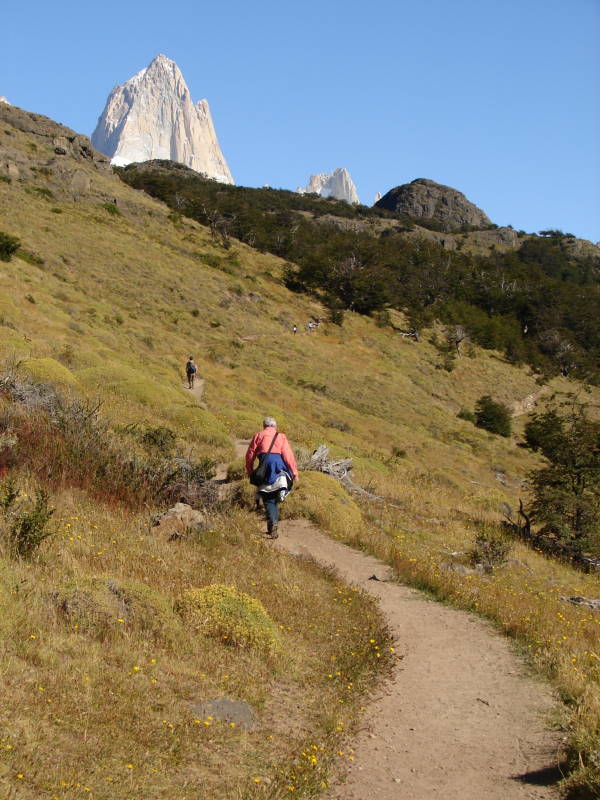
On the final climb to Laguna de los Tres in late February the trail is a staircase of moraine stone above the last lenga trees, the wind arriving in gusts that make the whole line of hikers lean at the same angle — and then the lip of the old glacier's dam, the milky turquoise lake, and Fitz Roy standing out of it, close enough to feel watched.
The easily missed detail
El Chaltén's trailheads begin inside the town — the Fitz Roy path starts at the end of Avenida San Martín, the Torre path a few streets over — which makes the town itself the base camp and the weather decision a breakfast-table one. No shuttle, no gate queue, no sunk cost: if the Fitz Roy is wearing its cloud at eight, walk the Torre valley instead and save the big climb for the clear morning. This flexibility, unique among the world's great trekking towns, is worth a spare day in the itinerary all by itself.
A practical rhythm
- Morning — Start at dawn in the high season: the Fitz Roy and Cerro Torre shake off their cloud caps early, the wind builds through the day, and a 9-hour route begun at seven ends in daylight even in March.
- Midday — Midday is the wind's shift and the lenga forest's gift: the middle hours of every Chaltén trail run through sheltered beech woods, so the exposed sections — the Poincenot flats, the final climb — are best walked early or late.
- Evening — Evenings are for the instruments: the park information center's forecast, the hostel weather boards, and the honest re-ranking of tomorrow's route — in Patagonia the plan you change at dinner is the trip you save.
What could complicate the plan
The registration rules are a patchwork and the penalties are real: mandatory free registration in Nahuel Huapi, winter-protocol registration at El Chaltén from May to September, campsite reservations at Poincenot and its neighbors, and the Huemul Circuit's park registration in all seasons — arriving ignorant of which regime you are in is the commonest planning failure. Weather remains the senior partner: a February week can still deliver a storm that strips the high trails for two days, and the solstice crowds make January's refugios and campsites a booking exercise, not a walk-up. Shoulder-season hikers face the final asymmetry — April's forests are the year's most beautiful and its services the thinnest, with refugios closing and buses thinning as the month turns.
What to do next
Book the second half of February, base in El Chaltén for a week on the 7-day pass, register where each park asks, and hold the Torre valley in reserve for the windy days.
Sources
- Administración de Parques Nacionales (APN) — Los Glaciares northern zone: trail registration required under the May–September winter protocol; reservations required for the Capri, Poincenot and De Agostini campsites; entry rates effective June 1, 2026 (ARS 50,000 per day for foreign visitors; 7-day Flexipass ARS 175,500), payable online only at the El Chaltén portals
- El Chaltén official tourism information — the Laguna de los Tres trail: 15.5 miles (25 km) round trip, 8–9 hours, 2,600–2,950 feet (800–900 m) of elevation gain, with the steep final section snow-affected into October; Laguna Torre at 11 miles (18 km) round trip
- Parque Nacional Nahuel Huapi / Club Andino Bariloche — free, mandatory trekking registration for most mountain trails, and the refugio network's season running to April
- Servicio Meteorológico Nacional (SMN) — El Calafate wind normals: December the windiest month at 15 mph (24.4 km/h) average, easing through late summer