Peru country guide When to visit
When is the best time to visit Peru for Machu Picchu?
The short answer
May — the one month when Peru's three climates compromise in your favor: the Andean dry season has begun at Machu Picchu, the Amazon is drying toward its wildlife season, and only the coast is surrendering its summer to the gray garúa.
The answer, with local context
Peru has to be read as three countries stacked west to east, and SENAMHI, the national weather service, maps no fewer than 38 distinct climates inside its borders. The coast — 11.6% of the territory — is a rainless desert whose summer runs December to April and whose winter is the garúa, the sea fog covering Lima from about May to October. The highlands, 28.1% of the country, run on rainfall rather than temperature: a dry season from May to October, when Cusco receives less than a quarter inch (4–6 mm) of rain a month and January, the wettest month, can bring 3.8 to 5.7 inches (97–146 mm). The Amazon, 60.3% of Peru, is hot all year — Iquitos averages highs of 88–91°F (31–33°C) on 99 inches (2,506 mm) of annual rain — and divides instead by the rivers: high water from December to May, when the Amazon at Iquitos rises 33 to 39 feet (10–12 m), and low water from June to November. The southern Amazon, around Puerto Maldonado and Manu, has its own drier season from May to October, when the trails firm up and wildlife concentrates along the shrinking rivers.
Machu Picchu sits in the highland regime, and May is its hinge: the rains have ended, the terraces and hillsides are still green from them, the nights are cold but not yet at their June–July depth, and the great June festival crowds of Cusco have not arrived. The anchor comes with published rules whatever the month: Peru's Ministry of Culture caps entry at 4,500 visitors a day in the regular season and 5,600 on designated high-season dates, sells named tickets for hourly entry slots, and closes the Inca Trail — though never the citadel — for the whole of February. The alternatives are real but narrower: June through August is the driest, clearest stretch and the busiest; September is May's mirror at the season's other end; and a traveler whose heart is set on the coast's summer or the Amazon's flooded-forest canoeing in high water should build the trip around December to April and accept a wetter citadel.
Lake Titicaca follows the highland calendar with altiplano manners: on its north shore the dry-season days reach 57–62°F (14–17°C) while nights fall to 29–41°F (−2 to 5°C), and Puno's great festival, the Candelaria, fills the wettest month of February with two weeks of parades — a deliberate trade of weather for culture that many travelers make happily.
Picture the place
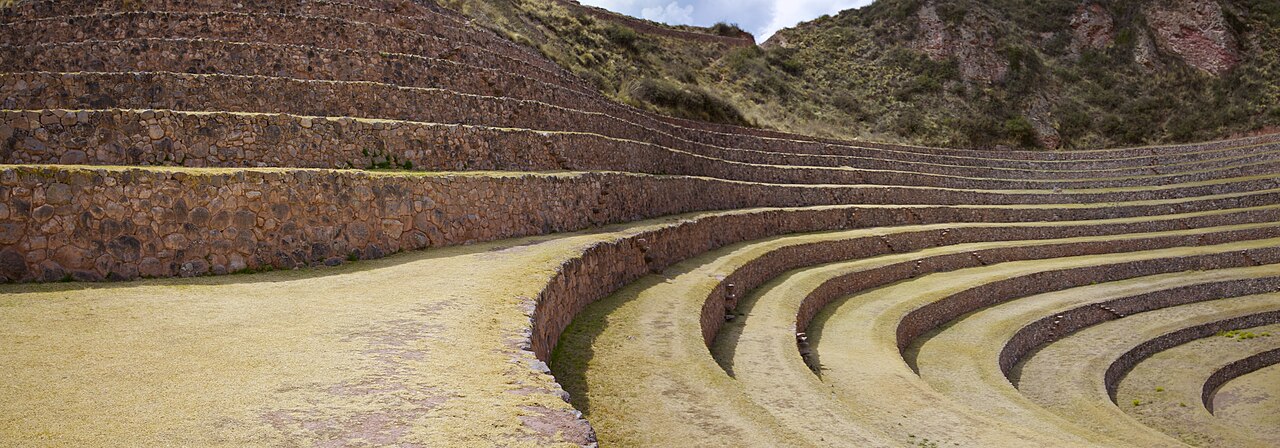
At Moray, in the Sacred Valley in May, the Inca agricultural laboratory — three great circular terraced bowls sunk into the plateau — holds the season in cross-section: the rings still green from the rains, the sky above them the hard, polished blue of the dry months, and the snow line on the cordillera behind standing clear as a ruled edge.
The easily missed detail
The three regions' calendars are not merely different, they are opposed: the month the Amazon runs highest and the coast is in full summer is precisely the month the Inca Trail is closed and Cusco is at its wettest. Any "best time for Peru" that does not name a region is answering a question nobody asked — and any itinerary that strings coast, Andes and jungle into one fortnight is, in effect, choosing which one gets the good weather.
A practical rhythm
- Morning — May mornings in the Andes are the day's guarantee: start for the high viewpoints and the citadel's first slots under a clear sky, before the dry season's afternoon clouds build over the cordillera.
- Midday — The midday sun at altitude is fierce even in the cold months — the Sacred Valley's markets and Moray's open bowls belong to the hours when the UV is the story; shade and a hat are equipment, not comforts.
- Evening — Evenings divide the country: Lima's garúa closes its gray lid by dusk from May onward, while Cusco's nights turn crystalline and near-freezing — pack for both on the same day you fly between them.
What could complicate the plan
The El Niño watch is the standing caveat for the north: Peru's monitoring body ENFEN has kept a Coastal El Niño alert through 2026, with a strong event forecast to raise rainfall on the northern coast into early 2027 — the beaches and the Trujillo–Chan Chan corridor need buffer days in that window. Altitude is the other constant: the dry season's clear nights are also its coldest, with Puno's thermometer falling well below freezing in June and July. And May's balance is popular arithmetic — the citadel's 4,500 daily places in the shoulder weeks sell out weeks ahead, so the month must be booked, not merely chosen.
What to do next
Pick May, buy the Machu Picchu entry the week you book the flights, and sequence the regions so the jungle follows the Andes — the same dry season serves both, in that order.
Sources
- SENAMHI (Servicio Nacional de Meteorología e Hidrología) — Peru's 38 mapped climates; Cusco's rainfall falling below a quarter inch (4–6 mm) a month from May to August against 3.8–5.7 inches (97–146 mm) in the wettest months; Lake Titicaca north-shore and Iquitos climate normals
- Ministerio de Cultura, Peru — Machu Picchu's published capacity: 4,500 visitors a day in the regular season, 5,600 on high-season dates, hourly named entry slots, and the Inca Trail's February closure
- Amazon basin season references — high water December to May and low water June to November around Iquitos, with the river varying 33–39 feet (10–12 m) between seasons
- ENFEN (Estudio Nacional del Fenómeno El Niño) — the Coastal El Niño alert and the forecast of a strong event affecting the northern coast into early 2027