Poland country guide Trip planning
How can I plan a memorable first trip to Poland without rushing?
The short answer
Book the Auschwitz-Birkenau Memorial entry pass first and build everything else around that date — passes are personalized, limited, and never issued at the entrance, so it is the one fixed point in a Polish itinerary.
The answer, with local context
The sequence matters more than the route. Individual visitors to the Memorial need a personalized entry pass reserved in advance through the Memorial's own booking system, and from 1 March entry cards are available online only. Guides should be booked at least two months ahead; online booking for a guide is possible up to five days before a visit, and by telephone two to five days before. Entry to the grounds is free of charge, which misleads people into treating it as a drop-in — it is not. Once that date is set, a Kraków base of four or five nights falls naturally around it.
Give the rest of the country room. Poland's World Heritage properties alone span four decades of inscriptions and most of the national territory: Kraków's Historic Centre and the Wieliczka Salt Mine both in 1978, Auschwitz Birkenau in 1979, the Historic Centre of Warsaw in 1980, and Malbork and Toruń in 1997. A first trip that tries to take in the southern mountains, Kraków, Warsaw and the north in ten days spends most of them on trains. Two bases — Kraków and one other — is the version that works.
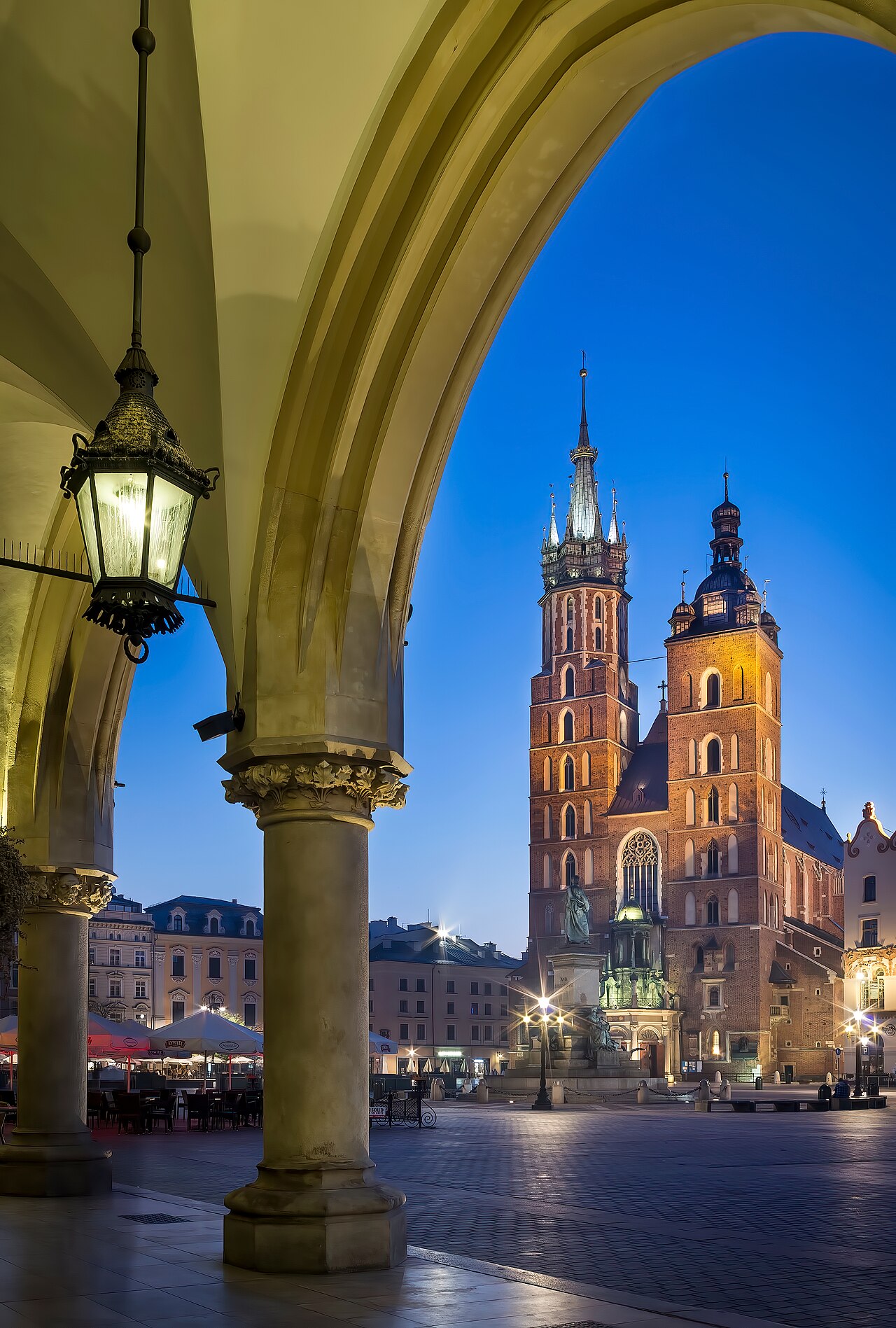
Kraków deserves more days than most itineraries give it, because the listed property is bigger than the square. The inscription covers 149.65 hectares with a buffer zone of 907.35 hectares, and takes in three separate urban areas: the medieval chartered city, Wawel Hill with its castle and cathedral, and Kazimierz with the Stradom suburb. Walking all three properly is two full days, not one afternoon.
Picture the place
Wawel Hill sits at the southern end of the old town where the ground rises directly above the Vistula, with the castle and the cathedral sharing one walled enclosure. From the square it is a fifteen-minute walk on the flat and then a short climb — close enough that visitors underestimate it, and large enough inside the walls to absorb half a day.
The easily missed detail
The Memorial's own guidance on time allocation is the single most useful planning number in Poland. It advises at least ninety minutes each for Auschwitz I and Auschwitz II-Birkenau, and the standard guided tour runs about three and a half hours, with study tours of six or eight hours available. Add the transfer from Kraków in each direction and security screening — visitors are told to arrive at least thirty minutes early — and the day is gone. Trying to pair it with anything else in the same day is the most common planning mistake made in Kraków, and it does the visit no favors.
A practical rhythm
- Nights 1 to 5, Kraków — Two days inside the World Heritage property's three areas, one day underground at the salt mines, one full day for the Memorial, one spare.
- Nights 6 to 9, one second base — Warsaw for the reconstruction story, or the north for Malbork and Toruń. Not both.
- Throughout — Leave one unscheduled day per base; Poland's intercity rail is good but the day trips are longer than they look.
What could complicate the plan
The Memorial is closed on 1 January, 25 December and Easter Sunday, and winter last-entry times are as early as 2:00 p.m. in December, which can make a two-part visit impossible. Bag size is capped at 35 by 25 by 15 centimeters, with larger luggage left in your vehicle — a real problem for anyone arriving straight from a train with a suitcase. Poland is inside the Schengen Area, so a short stay by a US passport holder needs no visa but counts against the shared 90-days-in-180 limit across the whole zone. Carrying 6 months of remaining passport validity is the advice given to US travelers even though the formal floor is 3 months beyond the planned Schengen departure, and no vaccination is required of arriving American visitors. And the Kraków inscription is an inhabited city center with a buffer zone nearly six times the size of the property itself, so construction, events and street closures are routine rather than exceptional.
What to do next
Read the Poland when-to-visit answer in this group for the month-by-month access window at the Memorial, and the Poland places-and-experiences answer for the second base worth choosing.
Sources
- Auschwitz-Birkenau State Museum — personalized entry pass requirement, online-only cards from 1 March, guide booking windows, free grounds admission, recommended time per site, tour durations, thirty-minute arrival rule, bag size limit, closure dates, December last-entry time
- UNESCO World Heritage Centre — Kraków property area of 149.65 hectares, buffer zone of 907.35 hectares, three constituent urban areas
- UNESCO World Heritage Centre — inscription years for Kraków and Wieliczka (1978), Auschwitz Birkenau (1979), Warsaw (1980), Malbork and Toruń (1997)
- US Department of State, Poland country information — six months' passport validity strongly recommended against a required three months beyond Schengen departure, no specific vaccinations required of US citizen travelers (retrieved 5 November 2026)