Poland country guide When to visit
When is the best time to visit Poland for Krakow?
The short answer
Late May through June, or September — these are the months when the Auschwitz-Birkenau Memorial, the day trip almost every Kraków visit includes, admits visitors until 6:00 or 7:00 p.m. rather than the 2:00 p.m. cutoff it applies in December.
The answer, with local context
The Memorial's opening schedule is the hardest seasonal constraint on a Kraków itinerary, and it varies more than most visitors expect. Its published last-entry times run 7:30 a.m. to 7:00 p.m. in June, July and August; to 6:00 p.m. in April, May and September; to 5:00 p.m. in March and October; to 4:00 p.m. in February; to 3:00 p.m. in January and November; and only to 2:00 p.m. in December. Visitors may remain on site for ninety minutes after the last entry time. The Memorial is open every day except 1 January, 25 December and Easter Sunday.
That matters because the Memorial is a two-part site spread across two separate camps, and the visit is long by design. A December arrival with a 2:00 p.m. cutoff makes a full two-part visit effectively impossible in daylight; a June arrival makes an unhurried one straightforward. The Memorial is well outside Kraków, so the return transfer eats into the same window.
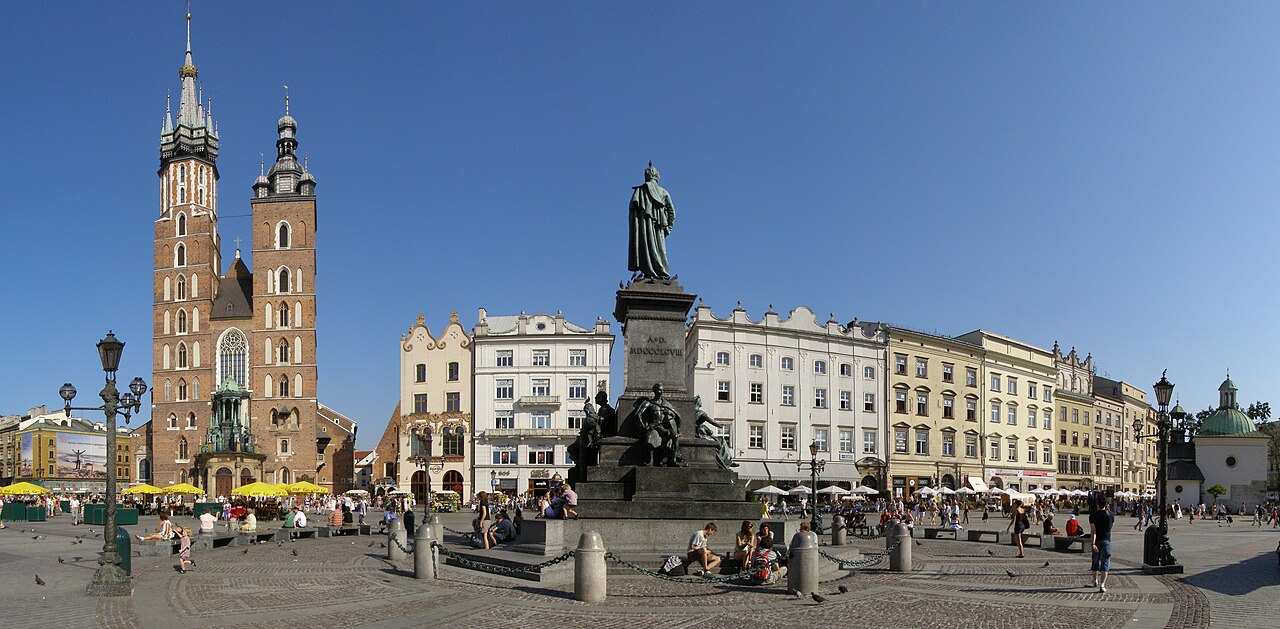
Kraków itself rewards the same months. The Historic Centre of Kraków was inscribed on the World Heritage List in 1978 under criterion (iv), as an urban architectural ensemble of outstanding quality, and the listed property takes in three distinct areas — the medieval chartered city, the Wawel Hill complex, and the town of Kazimierz with its Stradom suburb. The chartered old town dates from 1257 and contains Europe's largest market square, and the Jagiellonian University inside it is among the oldest in Europe. Almost all of that is outdoor walking, which is why a dry, long-daylight month is worth more here than in a city of interiors.
Picture the place
Kraków's old town is flat and compact, laid out around one enormous open square, with Wawel Hill rising at the southern edge above the Vistula. On a long June evening the square stays usable until late; in December the same space is dark by mid-afternoon and the scale that makes it remarkable is simply not visible.
The easily missed detail
The Memorial's entry system catches people out regardless of season. Individual visitors need a personalized entry pass booked in advance through the Memorial's own booking site; passes are limited, and none are issued at the entrance. From 1 March, entry cards are available only online. Entry to the grounds is free of charge — it is the guide service that is paid — but free does not mean walk-up. Anyone planning a Kraków trip around an Auschwitz visit should secure the pass before booking anything else, because the date of that pass will fix the rest of the itinerary.
A practical rhythm
- June to August — Longest Memorial access, 7:30 a.m. to 7:00 p.m., and the most daylight for the Kraków old town. Also the busiest.
- May and September — Access to 6:00 p.m., appreciably fewer visitors, the same walking city.
- November to February — Last entry between 2:00 and 4:00 p.m. Plan a single-site Memorial visit, not both parts.
What could complicate the plan
Three dates close the Memorial entirely — 1 January, 25 December and Easter Sunday — and Easter is a major travel weekend in Poland. Security screening means arriving at least thirty minutes before a booked tour, and bags are limited to 35 by 25 by 15 centimeters, with larger luggage left in the vehicle. Poland is in the Schengen Area, so US passport holders need no visa for a short stay but are counted against the shared 90-days-in-180 allowance. The document rules add one condition travelers overlook: the passport must keep at least 3 months of validity beyond the planned departure from the Schengen area, and at least 1 page must be free for stamps. And the Kraków World Heritage property is a living city center rather than a monument with a gate, so the square and the Wawel approach are subject to events, markets and restoration at any time of year.
What to do next
For what else to build a Poland trip around, read the Poland places-and-experiences answer in this group; the Poland trip-planning answer covers the booking sequence in more detail.
Sources
- Auschwitz-Birkenau State Museum — monthly last-entry times, ninety-minute post-entry stay rule, closure dates, free grounds admission, personalized entry pass requirement, online-only cards from 1 March, bag size limit, thirty-minute arrival rule
- UNESCO World Heritage Centre — Historic Centre of Kraków criterion (iv), the three constituent areas, 1257 charter, Europe's largest market square, Jagiellonian University
- UNESCO World Heritage Centre — Kraków inscription year, 1978
- US Department of State, Poland country information — no visa required for stays under 90 days, three months' passport validity required beyond planned departure from the Schengen area, at least one blank page (retrieved 5 November 2026)