Saudi Arabia country guide Places and experiences
What should a first-time traveler see in Saudi Arabia beyond the obvious highlights?
The short answer
Al-Ahsa, the largest oasis on earth; the petroglyph fields of Hail and Hima; the stone villages of the Asir highlands; the newly inscribed desert city of Al-Faw; and the Empty Quarter reserve of Uruq Bani Ma'arid — Saudi Arabia's second layer is deeper than most countries' first.
The answer, with local context
Start with scale. In the Eastern Province, Al-Ahsa Oasis — UNESCO-listed in 2018 as an evolving cultural landscape — spreads 2.5 million date palms around springs and canals farmed since the Neolithic, the largest self-contained oasis in the world. It is a working landscape rather than a monument: khalas dates coming off the palms, villages inside the groves, and a green horizon in a region travelers picture as empty. North of it in spirit, the Hail region's rock art (UNESCO, 2015) at Jubbah and Shuwaymis records some 10,000 years of inscriptions and petroglyphs — camels, hunters and vanished lakes scratched into desert varnish — while the Hima Cultural Area (2021), 557 km² of wells and carved rocks on the ancient caravan route to Yemen, preserves the graffiti of everyone who ever crossed Arabia.
The south writes a different country altogether. The Asir highlands rise over 7,000 feet (2,200 m) around Abha, where summer rain turns the juniper terraces green when the rest of the kingdom bakes — which is why Saudis holiday here in August. Rijal Almaa is a fortress-village of stone towers painted with white quartz geometric patterns, and Habala, the "hanging village," clings to a cliff face its residents once reached by rope. This is the Arabia of terraces, mist and qat-free coffee culture — except that here the coffee is the point: the Khawlani beans grown on Jazan's mountain terraces earned their own UNESCO intangible-heritage inscription in 2022.
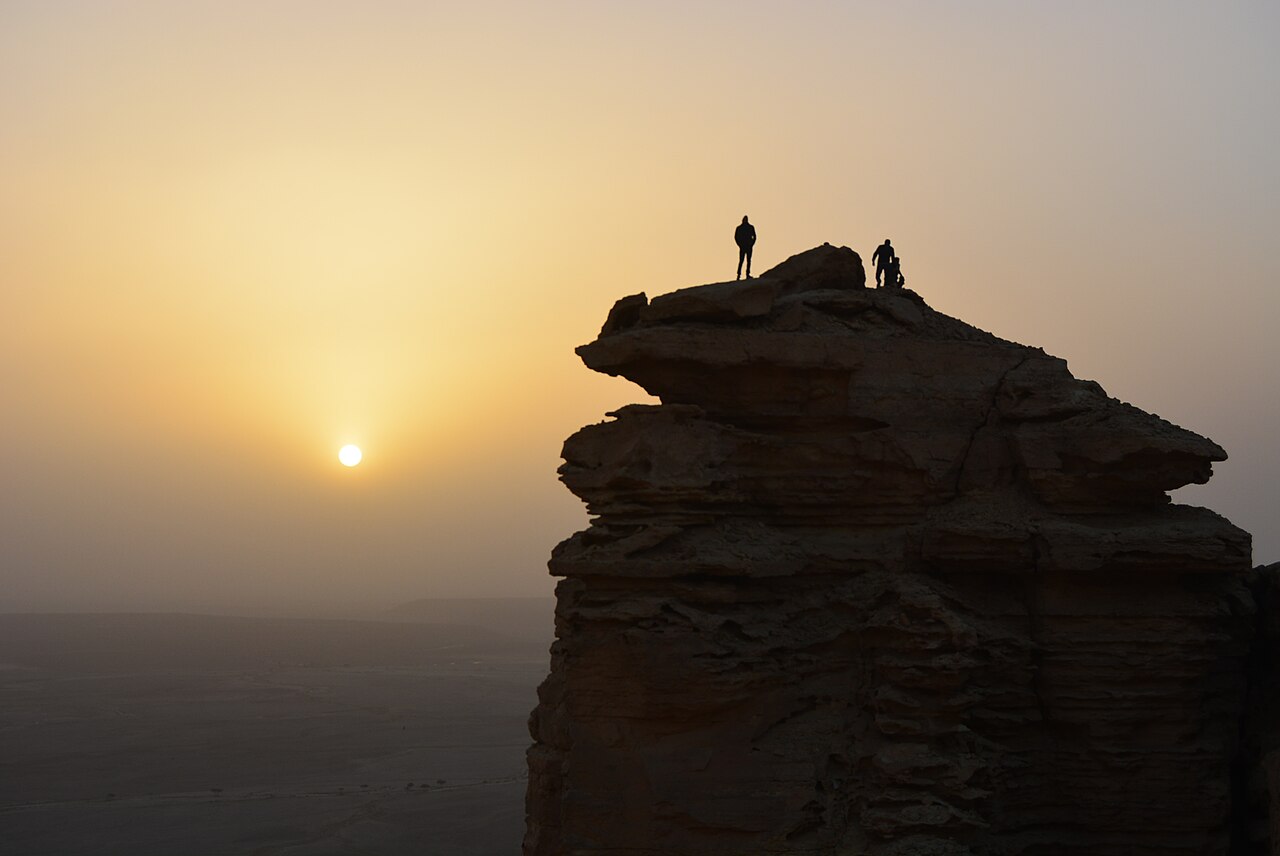
Two fresh inscriptions reward the determined. Al-Faw (UNESCO, 2024), the pre-Islamic capital of the Kingdom of Kinda on the incense road south of Riyadh, was abandoned around the 5th century CE and has yielded temples, tombs and more than 12,000 excavated relics from a 6,000-year occupation. And the kingdom's first natural listing, Uruq Bani Ma'arid (2023), protects 12,765 km² of the western Empty Quarter — linear dunes marching into the largest continuous sand desert on earth, with reintroduced Arabian oryx moving through it. Add the Edge of the World outside Riyadh, where the Tuwaiq escarpment drops sheer into an ancient seabed plain, and the second tier outnumbers the first.
Picture the place
At Jubbah an entire boulder face is a hunting scene ten millennia deep — plump Stone Age cattle under leaner camels under Arabic script, three climates and three civilizations sharing one slab of varnished sandstone.
The easily missed detail
Diriyah, at Riyadh's edge, is the highlight most first-timers under-rank. Its At-Turaif district (UNESCO, 2010) is the mud-brick original capital of the Saudi state, founded in 1727 — vast palaces of raw earth and carved gypsum that have been restored into the kingdom's premier heritage quarter, best in the evening when the walls glow and the terrace restaurants along Wadi Hanifah fill.
A practical rhythm
- The east — Al-Ahsa's palm groves and date markets, paired with Dammam's corniche, as a flight-and-drive leg of two days.
- The south — Abha and Rijal Almaa for two days of highland air, ideally in the January trip as green contrast or as a standalone summer escape.
- The deep cuts — One of Al-Faw, Hima or Uruq Bani Ma'arid with a hired guide and 4x4; these are expedition-grade add-ons, not detours.
What could complicate the plan
Distance is the tax on every ambition here: Riyadh to AlUla is a two-hour flight, the sites are scattered across a country of 830,000 square miles, and several of the second-tier properties have thin visitor infrastructure, seasonal opening or guide requirements. Rock-art sites reward a specialist guide who can actually read what is on the stone; alone they are handsome boulders. Build this layer as deliberate legs, not as stops between the famous names.
Two published rules bear on precisely the regions this answer sends you to. The US State Department's Saudi Arabia travel advisory, last updated on March 13, 2026, carries a Level 4 Do Not Travel designation for the Yemen border because of the threat of terrorism, and the Asir and Jazan highlands are the part of the kingdom where that line runs close to the scenery — so check where a booked village actually sits before fixing the southern leg. Separately, if the trip overlaps Hajj or Umrah, the US Centers for Disease Control and Prevention records that Saudi Arabia requires pilgrims aged one year and older to hold a quadrivalent ACWY meningococcal vaccination, given at least 10 days before arrival and received within the previous 3 to 5 years depending on the vaccine.
What to do next
Pick one second region besides AlUla — Asir for contrast, Al-Ahsa for green — and let the deep-cut sites wait for a second trip, of which this country tends to inspire one.
Sources
- UNESCO World Heritage Centre, Saudi Arabia States Parties page — 8 inscribed properties: Hegra (2008), At-Turaif in Diriyah (2010), Historic Jeddah (2014), Rock Art in the Hail Region (2015), Al-Ahsa Oasis (2018), Ḥimā Cultural Area (2021), ‘Uruq Bani Ma’arid (2023) and Al-Faw (2024)
- UNESCO — Al-Ahsa as the world's largest oasis with 2.5 million date palms; Uruq Bani Ma'arid covering 12,765 km² of the Empty Quarter; Al-Faw's 6,000-year occupation and abandonment around the 5th century CE
- UNESCO Intangible Cultural Heritage — knowledge and practices of cultivating Khawlani coffee beans, inscribed 2022
- US Department of State, Saudi Arabia Travel Advisory, updated March 13, 2026 — the Level 4 Do Not Travel designation for the Yemen border and its stated reason
- US Centers for Disease Control and Prevention, Meningococcal Disease in Saudi Arabia: Vaccine Requirements for Travel During the Hajj and Umrah Pilgrimages — the quadrivalent ACWY requirement, the minimum age of one year, the 10-day lead time and the 3-to-5-year validity